

A commercial property’s risk is rarely controlled by a single inspection or forecast. Effective risk management in commercial real estate means identifying threats, assessing their likelihood and impact, choosing proportionate controls, and monitoring exposure as conditions change.
That approach matters because property performance depends on connected factors: building condition, tenant stability, lease terms, cash flow, financing, and market demand. A weakness in one area can affect the wider portfolio, so decisions should account for both individual assets and shared exposures.
For firms operating in Poland, a structured process can bring clarity to acquisition, ownership, and portfolio decisions. This guide explains how to assess market, financial, tenant, and operational risks; what due diligence and risk modeling can reveal; and how diversification, liquidity planning, and ongoing monitoring support more resilient decisions.
Key Takeaways
- Build a repeatable mitigation process that covers property condition, environmental exposure, legal review, and cybersecurity.
- Track market, financing, tenant, and operational risks together to see how changes in one area can affect cash flow and asset performance.
- Use due diligence and scenario modeling to test assumptions about a property before acquisition and identify issues that could change its feasibility.
- Reduce concentration and liquidity exposure by reviewing portfolio mix, cash availability, and contingency plans.
- Turn risk findings into ongoing actions, with clear ownership, monitoring, and property-management workflows.
1. What are the best risk mitigation practices for commercial property?
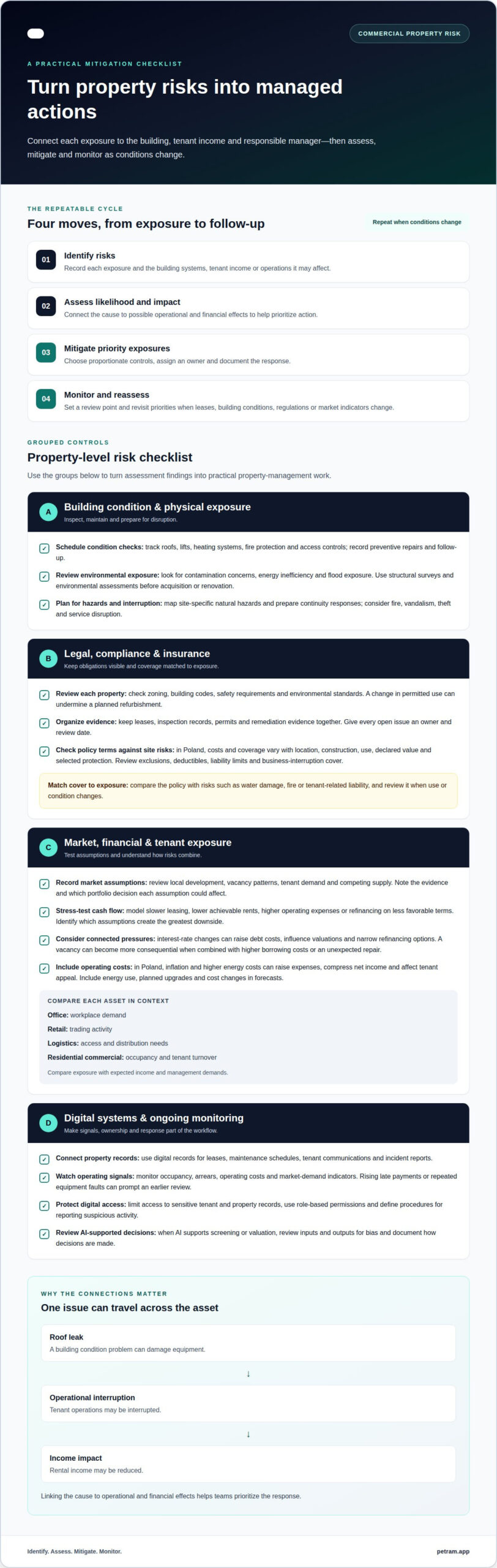
Effective strategies follow a repeatable cycle: identify risks, assess likelihood and impact, mitigate priority exposures, then monitor changes. For each commercial property, record the risk alongside affected building systems, tenant income, and the responsible manager. A roof leak, for example, can damage equipment, interrupt a tenant’s operations, and reduce rental income. Connecting the cause to its operational and financial effects helps teams prioritize action.
Physical risk controls combine inspections, preventive repairs, and documented follow-up. Track the condition of roofs, lifts, heating systems, fire protection, and access controls in a maintenance schedule. Environmental reviews can identify contamination concerns, energy inefficiency, or flood exposure. Structural surveys and environmental assessments provide evidence before acquisition or renovation. For natural hazards, map site-specific exposures and prepare continuity responses. For human-caused events, consider fire, vandalism, theft, and service disruption.
Legal risk calls for a property-by-property review of zoning, building codes, safety requirements, and environmental standards. A change in permitted use can undermine a planned refurbishment, while unresolved defects may lead to disputes or costly corrective work. Keep lease documents, inspection records, permits, and remediation evidence organized. Assign an owner and review date to each open issue so compliance tasks do not get lost between property teams.
Investors compare risks across office, retail, logistics, and residential commercial properties by assessing each asset’s demand drivers, tenant profile, lease structure, building requirements, and sensitivity to market changes. An office may depend on workplace demand; retail on trading activity; logistics on access and distribution needs; residential assets on occupancy and tenant turnover. The useful comparison is each property’s exposure relative to its expected income and management demands.
In Poland, commercial property insurance costs and coverage vary with the building’s location, construction, use, declared value, and selected protection. Policy terms also matter: exclusions, deductibles, liability limits, and business-interruption cover affect what a loss may leave uninsured. Compare the policy with specific site exposures, such as water damage, fire, or tenant-related liability, rather than relying on the policy label alone. Review it when the property’s use or condition changes.
Property-management software and market analytics can make risk signals easier to act on. Use digital records to connect leases, maintenance schedules, tenant communications, and incident reports. Analytics can help teams monitor occupancy, arrears, operating costs, and market-demand indicators. A pattern of rising late payments or repeated equipment faults can prompt an earlier review, before it becomes a larger income or continuity problem.
Digital systems create their own exposure. Limit access to sensitive tenant and property records, use role-based permissions, and maintain clear procedures for reporting suspicious activity. When AI supports screening or valuation, review its inputs and outputs for bias and document how decisions are made. These controls protect data and help teams avoid relying on automated results without context.
Make mitigation operational: document each scenario, assign responsibility, set a review point, and record the response. A flood plan should identify critical equipment and continuity steps; a cybersecurity plan should define access controls and incident reporting. Reassess priorities when leases, building conditions, regulations, or market indicators change. This turns risk identification into decisions that protect property performance.
Market, financial, tenant, and operational risks
Market research turns uncertainty into assumptions that property teams can test. A framework for risk management in commercial real estate connects market signals with individual asset decisions. Review local development, vacancy patterns, tenant demand, and competing supply before acquisition. A new logistics hub, for example, may shift demand for nearby warehouse space. Record each assumption, its evidence, and the portfolio decision it could affect. Repeat the review when employers, transport links, or planned developments change.
Market risk also affects financing. Interest-rate changes can raise debt costs, influence valuations, and narrow refinancing options. Compare income under different occupancy and financing scenarios, then identify which assumptions create the greatest pressure. Fixed-rate financing can reduce exposure to rate volatility, while staggered maturities can limit refinancing concentration. Weigh these choices against each asset’s income profile and the owner’s capacity to absorb changes.
Stress testing makes the assessment practical. Model slower leasing, lower achievable rents, higher operating expenses, or refinancing on less favorable terms. Compare projected cash flow across scenarios and identify the assumptions that create the greatest downside. A stress test may reveal that a manageable vacancy becomes more consequential when combined with higher borrowing costs or an unexpected repair.
In Poland, inflation and higher energy costs can raise operating expenses, compress net income, and affect a building’s appeal to tenants. Building-efficiency requirements can also influence capital planning and property performance. Include energy consumption, planned upgrades, and operating-cost changes in forecasts. Assess their potential effects on rent, occupancy, and future investment needs rather than treating energy performance as a separate technical issue.
Tenant risk begins with income concentration and lease events. A major tenant’s departure can leave space vacant while leasing costs and lost rent accumulate. Track lease expirations, payment patterns, tenant concentration, and renewal discussions together. Assess prospective tenants using available financial information and business performance. Clear lease terms and ongoing communication can help address payment delays, disputes, and service interruptions before they affect wider portfolio results.
Operational risks often first appear as recurring exceptions. Monitor maintenance backlogs, delays, utility consumption, complaints, and service interruptions across properties. A rise in unresolved work orders may signal a building-system problem or a process bottleneck. Assign each issue an owner, priority, and resolution status. Review these records alongside budgets and tenant reports to distinguish isolated incidents from persistent weaknesses.
Effective risk management in commercial real estate links market signals with property-level performance. Review development plans, tenant demand, operating costs, financing terms, arrears, and vacancies consistently. When an indicator shifts, test its effect on income and debt obligations. Document the response, such as revising a forecast, adjusting leasing assumptions, or changing planned expenditure. This decision trail keeps risk planning active and helps teams respond as conditions evolve.
3. Due diligence, feasibility studies, and risk modeling
Before acquiring a commercial property, build a due diligence file that connects legal, physical, tenant, and financial evidence. Start with title, ownership, and the seller’s authority to transfer the asset. Then review financial records, leases, rent rolls, and known repair needs. Missing or inconsistent documents can change the assumptions behind an offer, so record each gap and its potential effect on the decision.
Physical review should establish whether the building can support its current use and planned business case. Commission structural surveys and environmental assessments, then compare the findings with maintenance records and refurbishment plans. A survey may, for example, identify roof work that changes the timing or feasibility of a proposed upgrade. Check environmental studies, zoning, and building-code conformity against the intended use, not simply the property’s current operation.
Legal and lease reviews show how rights and obligations shape future income. Examine lease structures, tenant responsibilities, renewal options, rent adjustments, and restrictions on alterations. Assess tenant mix and quality alongside payment records and lease terms. A property with strong current occupancy can still face concentration risk if one tenant accounts for much of its rental income or controls a large share of usable space.
Financial due diligence should compare appraised value with investment value. An appraisal considers the property under its valuation assumptions; investment value reflects the buyer’s expected income, costs, and strategy. Reconcile both with the rent roll, operating expenses, vacancy assumptions, and planned capital works. Also assess physical, functional, and economic obsolescence. An outdated office layout, for instance, may need redesign before it meets prospective tenants’ needs.
A feasibility study translates those findings into an operating and investment case. Define the intended use, target tenants, expected leasing path, required work, and likely disposal options before acquisition. Test whether local market trends support those assumptions. If a retail property depends on steady foot traffic, assess nearby development and competing supply. If a warehouse requires improved access or power capacity, include those constraints in the feasibility analysis.
Risk modeling tests how changes could affect the investment. Create scenarios for slower leasing, lower achievable rents, greater repair needs, or delayed refurbishment. Compare projected income and cash flow across each case, and identify which assumption creates the greatest downside. Sensitivity analysis shows whether a decision depends heavily on one tenant, one lease renewal, or one planned improvement.
Keep the model tied to evidence. Link each assumption to a lease, survey, market observation, or financial record, and set a review point for when new information arrives. Before signing, set contractual due diligence deadlines for each review stage and document how unresolved findings affect the transaction. This gives decision-makers a clear basis to renegotiate terms, revise the plan, or walk away from an acquisition that no longer fits its risk limits.
4. Portfolio diversification and liquidity
A resilient portfolio spreads exposure across property types, locations, and tenants. An investor concentrated in offices in one city, for example, may face a different demand shock than one holding logistics assets across several locations. Diversification does not remove market risk; it can limit dependence on one local economy, property class, or source of rental income. Map concentrations before deciding where new acquisitions or disposals fit.
Asset mix matters because property sectors respond to different business needs. Offices depend on occupier demand and workplace patterns; retail properties rely on customer activity and tenant performance; logistics assets serve distribution requirements; residential rental properties depend on household demand and occupancy. Compare each sector’s income drivers, lease profile, operating demands, and market sensitivity. Then identify whether the portfolio has too much exposure to a shared risk.
Geographic and tenant diversification add another layer. A portfolio across several cities may be less dependent on one local downturn, while a broader tenant base can reduce reliance on a single rent payer. Review tenant concentration alongside lease expiries and property locations. If one tenant or city accounts for a substantial share of expected income, model how a vacancy or demand decline would affect the whole portfolio.
Liquidity is a separate risk from asset value. Commercial property can take time to sell, while loan payments and operating costs continue during a vacancy or disruption. Investors are advised to hold reserves sufficient to cover three to six months of operating costs and loan payments. Set reserve targets against each asset’s cash-flow profile, financing obligations, and exposure to leasing interruptions.
Build a liquidity plan around cash needs, not just forecast returns. List upcoming debt payments, planned capital expenditure, lease incentives, and likely periods without rental income. Then compare those obligations with available reserves and expected receipts. A delayed lease renewal, for example, can postpone income while essential building costs continue. Contingency planning helps preserve decision-making capacity without forcing a rushed asset sale.
Portfolio optimization requires periodic performance reviews, risk-exposure assessments, asset valuations, and stress testing. Compare actual results with the assumptions used in acquisition decisions. If one property class comes to dominate exposure, rebalancing might involve redirecting new investment or disposing of an asset. Tie every adjustment to portfolio objectives, liquidity needs, and current market evidence rather than short-term fluctuations alone.
Predictive oversight makes those reviews more forward-looking. Combine property-level income, occupancy, lease events, operating expenses, and local market indicators in a consistent view. Scenario analysis can test how a higher interest rate, slower leasing, or a valuation decline affects liquidity and portfolio concentrations. Revisit the results as conditions change, and record which indicators trigger a review. This turns portfolio monitoring into an ongoing decision process.
5. Commercial real estate risk assessment and mitigation
Investors assess commercial property risk by identifying exposures, estimating their likelihood and impact, then matching each priority with a control. For a Warsaw office, that could mean testing vacancy, lease rollover, building-condition, and financing scenarios together. Mitigation then assigns an owner, action, and review trigger to each material exposure. This keeps decisions connected to evidence and property-level outcomes.
Start with a risk register for each asset. Record the risk, affected income or operations, current controls, and evidence supporting the assessment. Separate causes from consequences: a lift failure is a physical event, while tenant disruption and lost rent are potential impacts. Rank risks by potential severity and likelihood, then identify which controls reduce exposure most directly.
Next, test how risks interact. A lease ending during a weak market can extend vacancy and delay planned work. A rise in borrowing costs can make the same income shortfall harder to absorb. Model these conditions separately and together, then compare their effects on cash flow, debt payments, and asset plans. Use scenarios to reveal which assumptions need closer monitoring.
Mitigation should be proactive and proportionate. For a building with recurring equipment faults, prioritize preventive work and track repeat incidents. For tenant concentration, review lease events and prepare a leasing response before space becomes vacant. For financing exposure, test alternative interest-rate and refinancing assumptions. Each action needs a named owner, completion point, and measure of whether the control works.
Set indicators that signal when an assessment needs updating. Examples include rising arrears, repeated maintenance delays, an approaching lease expiry, a valuation change, or new development nearby. Define thresholds based on the asset’s operating plan rather than applying one measure to every property. When an indicator changes, reassess the exposure and document whether the response remains suitable.
Risk decisions also need a clear escalation path. A property manager may identify a maintenance pattern, while an asset manager assesses its effect on tenant service and income. Portfolio leadership can then decide whether to reallocate resources, revise assumptions, or accept the remaining exposure. Keep the decision and its supporting evidence together so later reviews can distinguish a resolved issue from one that continues to affect performance.
Review the register on a scheduled cycle and after material events, such as a major tenant departure or building incident. Compare current risks with prior assessments, close completed actions, and carry unresolved exposures forward. For teams coordinating multiple assets, centralize commercial property risk workflows to keep operational information connected to management decisions.
Petram.app (Rezone): VERTICAL SAAS FOR COMMERCIAL REAL ESTATE REZONE
Petram.app (Rezone) provides vertical SaaS and Property Manager Software for commercial real estate teams managing complex portfolios. Its platform integrates AI Agents and specialized digital tools to help owners and managers streamline property operations, optimize workflows, and support efforts to increase property value.
Consider this software when risk information is spread across properties and operational workflows need stronger coordination. A structured digital environment can help teams manage property operations with greater clarity as they monitor changing conditions and act on emerging issues. It supports management processes; it does not replace property inspections, legal reviews, or investment decisions.
To discuss how Petram.app (Rezone) can support your commercial property management workflows, contact Petram.app (Rezone).
Make risk decisions part of everyday operations
The next step is to make risk oversight a consistent management discipline. Define who reviews emerging issues, how decisions are recorded, and when an exposure is reassessed. That structure helps teams connect operational information with portfolio priorities, rather than treating risk reviews as isolated exercises. Strong risk management in commercial real estate depends on keeping those decisions active as buildings, tenants, and market conditions evolve.
Technology can support that discipline by bringing property-management workflows into a more coordinated environment. Identify where current processes create friction, such as fragmented records or unclear ownership, and decide what better coordination should enable. Petram.app (Rezone) can support that conversation as you consider the needs of your commercial property operations.
Contact Petram.app (Rezone) to discuss your property-management needs. A more deliberate operating framework gives your team a stronger foundation for making informed decisions and moving forward with confidence.
Frequently Asked Questions
How do real estate firms manage risk?
Real estate firms manage risk by assigning clear ownership for decisions and tracking how each issue affects asset performance. A leasing team might monitor renewal discussions, while an operations lead tracks building incidents; both report changes through a shared review process. Management can then decide whether to accept, reduce, transfer, or avoid an exposure. The key is connecting operational signals to decisions, rather than treating each event as isolated.
What are the best risk mitigation practices for commercial property?
Choose controls that address a specific exposure and can be reviewed for effectiveness. For example, a property with repeated access incidents may need revised entry procedures, documented incident reporting, and a review of access permissions. Pair each control with a responsible role and an escalation route. Revisit the measure after an incident or operational change so the mitigation remains relevant rather than becoming a static policy.
What are the three main elements of commercial risk?
A practical framework has three parts: risk identification, risk assessment, and risk treatment. Identification describes what could happen, such as a tenant leaving before a replacement is ready. Assessment considers the likelihood and consequences for the asset. Treatment selects a response, such as adjusting leasing plans or preparing continuity measures. Teams can then monitor whether the original assumptions still hold and update the assessment when conditions change.
Which two risks are involved in commercial risk?
Two useful categories are market-wide and asset-specific risk. Market-wide risk can affect several properties at once, such as a broad decline in occupier demand. Asset-specific risk is concentrated in one building, such as a major system failure or dependence on one tenant. Distinguishing them helps teams see whether a response belongs at portfolio level, at an individual property, or both.
Which use cases show the value of AI in CRE risk management?
AI can help identify patterns across property operations, support forecasting, and organize information for decisions. For example, analysis of maintenance records might flag recurring faults, while market data could inform scenario planning or valuation review. AI-assisted tenant screening also requires human oversight: examine the information and decision criteria, rather than relying on an automated output alone. Protecting sensitive property and tenant data remains essential.
What are the main risks in commercial real estate investment?
Investment risks include weaker-than-expected rental income, valuation declines, financing pressure, tenant default, unexpected capital needs, and limited liquidity. Their impact depends on an asset’s leases, condition, location, financing structure, and ability to attract future occupiers. For example, a building with dated systems may need additional investment before it can compete for tenants. Assess both the source of a risk and its potential effect on the investment plan.
How do interest rates and financing terms affect commercial real estate risk in Poland?
In Poland, higher interest rates can increase the cost of variable-rate borrowing and make refinancing less favorable. Financing terms such as fixed or variable rates, maturity dates, repayment structure, and covenants shape how quickly those changes affect an owner’s cash flow. Compare debt obligations with property income under different rate and occupancy assumptions. This reveals whether a financing change could constrain planned investment or the ability to meet payments.
What are the risks of commercial property vacancy, tenant default, and lease rollover?
Vacancy interrupts rent while operating expenses continue, and tenant default can create collection costs and uncertainty about recovery. Lease rollover adds timing risk: space may remain empty after expiry, or a renewal may require revised terms or incentives. Track lease events alongside tenant payment behavior and upcoming space requirements. Early visibility gives leasing teams time to plan for continuity instead of reacting after income stops.