

In 2026, managing a commercial portfolio with static spreadsheets isn’t just a nuisance; it’s a direct threat to your Net Operating Income. The global market for commercial property management software has surged to approximately 15.5 billion zł, yet many firms remain trapped by manual data entry and fragmented systems that hide critical risks. You’re likely aware that a single missed lease renewal or a delayed maintenance trigger can cost thousands in lost revenue. It’s time to stop reacting to crises and start leveraging algorithmic asset optimization to secure your competitive edge.
We understand the pressure of maintaining real-time visibility for investors while managing complex tenant communications across multiple sites. This guide explores how AI-powered vertical SaaS platforms like Rezone are redefining operational efficiency through automated workflows and sophisticated data analytics. You’ll learn how to transition from opaque data silos to a transparent, scalable infrastructure that drives measurable increases in property value. We’ll examine the specific tools that turn reporting into a strategic advantage for the modern Polish property owner who demands clarity and control.
Key Takeaways
- Understand why 2026 marks the end of generalist ERPs and how specialized vertical SaaS provides the agility needed for high-stakes commercial portfolios.
- Discover how AI Agents automate complex tasks like lease abstraction and renewal tracking to drive a direct increase in Net Operating Income.
- Identify the specific criteria for selecting commercial property management software that eliminates feature bloat and focuses on asset value optimization.
- Learn a structured two-phase approach to transitioning your national portfolio from fragmented data silos to an AI-augmented workflow.
- Shift from reactive management to proactive asset optimization by leveraging cloud-based infrastructure designed for national scalability.
Defining the 2026 Standard for Commercial Property Management Software
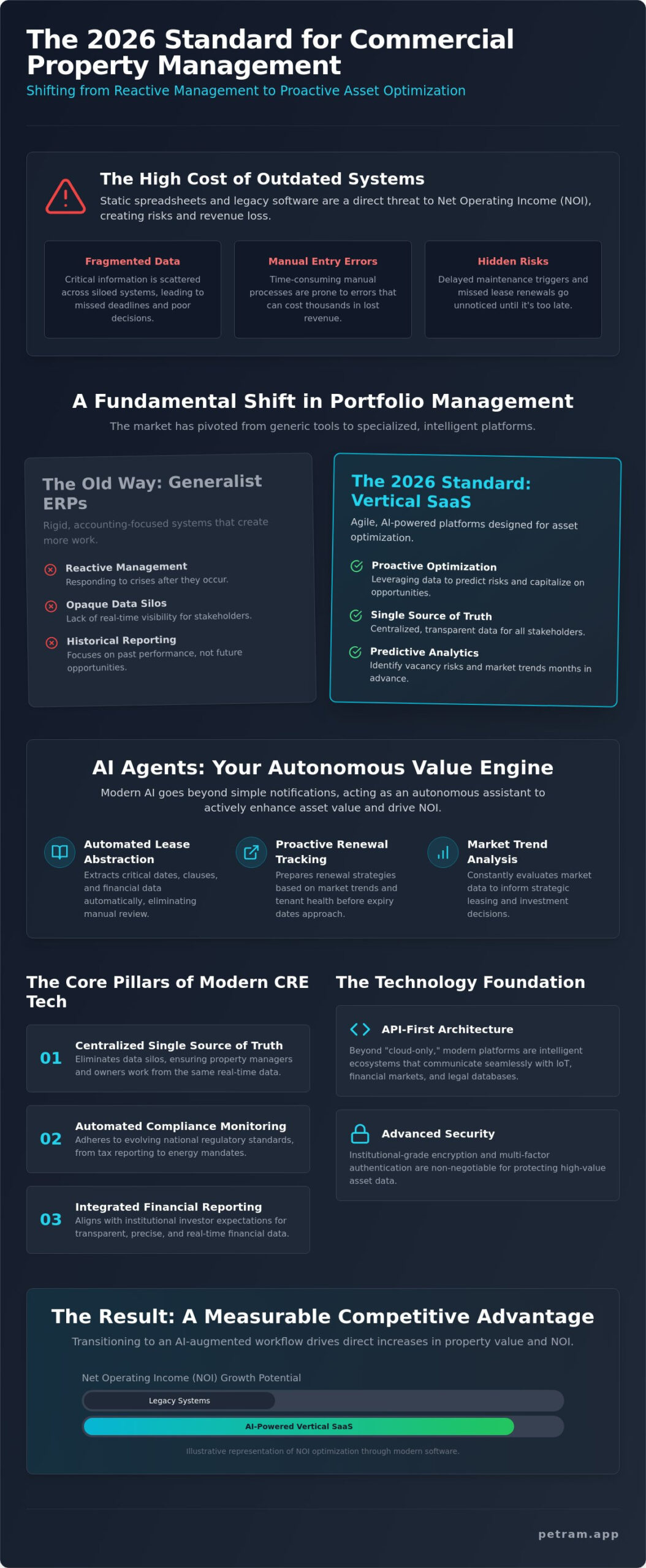
The landscape of commercial real estate has undergone a fundamental transformation. By 2026, the reliance on rigid, legacy ERP systems has become a significant liability for asset managers seeking to scale. These older platforms, originally designed as generalist accounting tools, lack the granular flexibility required to manage the nuances of modern commercial leases. Instead, the market has pivoted toward agile, industry-specific Vertical SaaS. This shift marks the definitive end of one-size-fits-all solutions. High-stakes commercial real estate demands a commercial property management software that understands the difference between a retail triple-net lease and a multi-tenant office agreement without requiring manual workarounds.
Modern management is no longer defined by the administrative task of rent collection. It’s about asset optimization. A Value-First software model prioritizes the metrics that drive Net Operating Income (NOI). This means moving beyond historical reporting and into predictive analytics. Instead of just tracking when a tenant is late on a payment, the system should identify patterns that signal a potential vacancy risk months in advance. In Poland, where market volatility can impact commercial valuations quickly, having real-time data is essential for maintaining national portfolio compliance and investor confidence. Every złoty must be accounted for with precision.
The Core Pillars of Modern CRE Tech
Success in 2026 relies on three structural foundations. First, a centralized single source of truth for asset performance is non-negotiable. Data silos between property managers and owners lead to critical date misses. Second, automated compliance monitoring ensures that your portfolio adheres to evolving national regulatory standards, such as local tax reporting or energy efficiency mandates. Finally, integrated financial reporting must align with institutional investor expectations. This level of sophistication evolved from traditional Computer-Aided Facility Management (CAFM) into the comprehensive digital ecosystems we use today.
Why ‘Cloud-Only’ is No Longer Enough
Simply hosting data on a remote server is the bare minimum. In the current market, your commercial property management software must function as an intelligent, interconnected ecosystem. This requires an API-first architecture. Your management platform must communicate seamlessly with smart building IoT, external financial markets, and legal databases. Security remains the top priority. Protecting institutional-grade real estate data requires more than just a password. It demands advanced encryption and multi-factor authentication to safeguard assets valued in the millions of złoty. Efficiency and security are now inextricably linked.
The Role of AI Agents and Vertical SaaS in Asset Value Optimization
In the current competitive climate, commercial property management software must do more than just store data; it must actively work to enhance the bottom line. We’ve moved past the era where software was a passive digital filing cabinet. Today, the most successful asset managers utilize AI Agents as autonomous engines for value creation. These agents don’t just notify you of an upcoming lease expiry. They analyze market trends, evaluate tenant health, and prepare renewal strategies before a human manager even opens the file. This shift toward algorithmic management allows for a level of precision that was previously impossible to achieve at scale.
The distinction between generalist tools and Vertical SaaS has never been more critical for the Polish market. While basic accounting packages might handle simple invoicing, they lack the structural depth to manage complex commercial recoveries or indexation based on local inflation rates. Utilizing specialized property management software ensures that your digital infrastructure is built specifically for the unique demands of commercial assets. This specialization is what allows firms to predict and prevent tenant churn by identifying subtle shifts in building usage and payment behaviors long before a vacancy occurs.
AI Agents: Beyond the Chatbot
Modern AI Agents function as sophisticated autonomous assistants. They handle lease abstraction by parsing hundreds of pages of legal text to extract escalation clauses and critical dates with surgical precision. This eliminates the risk of missing a 5% rent hike or a break clause window. Furthermore, these agents utilize predictive modeling for maintenance. By analyzing sensor data and historical repair costs, they forecast when a HVAC system might fail, allowing you to transition from reactive repairs to planned CapEx. This proactive stance protects your asset’s long-term valuation in the millions of złoty.
Maximizing NOI Through Digital Efficiency
The direct correlation between workflow automation and Net Operating Income (NOI) is measurable. AI-driven audits are now capable of identifying “hidden” leakage in service charge recovery, ensuring that every grosz of recoverable expense is captured and billed correctly. This level of oversight reduces the need for massive administrative headcounts even as your portfolio grows. Vertical SaaS reduces operational friction for commercial landlords by automating complex, industry-specific workflows that generalist platforms cannot handle. For those looking to modernize, exploring AI-integrated platforms like Rezone provides a clear path toward this new standard of digital efficiency.
Evaluating Generalist ERPs vs. Specialized CRE Management Platforms
Choosing a generalist Enterprise Resource Planning (ERP) system often feels like the safe corporate decision. For commercial asset managers, however, this safety is an illusion that leads to operational stagnation. Traditional ERPs are designed for standard accounting and general ledger functions. They struggle with the high-stakes complexity of commercial real estate, such as managing multi-layered service charge reconciliations or complex indexation across a national portfolio. When your commercial property management software lacks the specific logic required for commercial assets, your team spends more time fighting the system than optimizing asset value.
Legacy systems often suffer from feature bloat. They attempt to serve every niche from residential rentals to industrial warehouses, resulting in a cluttered interface that slows down productivity. This bloat carries a hidden cost in both training time and manual errors. A specialized platform focuses on the high-impact workflows that matter to commercial owners. It ensures that data remains accurate because the software reflects the reality of the asset. If a tool is difficult to use, team adoption drops. Low adoption leads to the creation of shadow spreadsheets and fragmented data, which puts your portfolio at risk. Scalability in 2026 isn’t just about adding more units; it’s about maintaining data integrity as you grow.
The Checklist for 2026 Software Selection
- Native AI Agent Integration: Does the platform use autonomous agents for workflow automation, or is AI just a bolted-on marketing gimmick?
- Commercial Structural Depth: Can it handle multi-tenant structures, retail turnover rents, and complex service charge recoveries specific to the Polish market?
- Institutional-Grade Reporting: Is the reporting granular enough to satisfy the rigorous demands of international investors and regulatory bodies?
Integration Capabilities and Data Portability
Scalability requires a tech stack that communicates. Your commercial property management software must offer robust two-way synchronization with professional accounting standards. This eliminates the need for manual reconciliation between property data and the general ledger. Future-proofing your investment means prioritizing open API access. You don’t want to be locked into a closed ecosystem where extracting your own data becomes a costly hurdle. In the Polish commercial sector, your portfolio data is a valuable asset. Ensuring complete data ownership and portability is essential for long-term strategic flexibility. You need to know that your data remains yours, accessible and ready for the next stage of your portfolio’s evolution.
Strategic Implementation: Transitioning to Automated CRE Workflows
Transitioning a national portfolio to a modern standard of management is a high-stakes strategic move. It requires more than a simple software migration; it’s a fundamental shift in operational philosophy. Many Polish asset managers struggle with local fragmentation, where critical data sits in isolated regional offices or outdated spreadsheets. Phase 1 of a successful implementation focuses on aggressive data consolidation. You must clean and centralize your legacy records to ensure your new commercial property management software operates on a foundation of truth. Without this, even the most advanced AI will produce flawed insights that can lead to costly errors in valuation.
Phase 2 involves mapping your existing manual workflows to AI-augmented processes. This isn’t about digitizing old habits. It’s about letting the software handle the low-value, repetitive tasks so your team can focus on high-level asset strategy. Finally, Phase 3 addresses the ‘legacy mindset.’ Change is often met with resistance from teams comfortable with traditional methods. Demonstrating immediate value, such as the instant generation of complex investor reports, is the fastest way to secure team buy-in. Within the first 90 days, you should see measurable improvements in data accuracy and a significant reduction in the hours spent on manual month-end reconciliations.
Overcoming Transition Friction
Migration doesn’t have to result in operational downtime. A phased rollout allows you to maintain business continuity while upgrading your digital infrastructure. Managing the human element is equally critical. Professional property managers need to see automation as a tool for empowerment that eliminates the stress of missing critical dates. While timelines vary based on portfolio size, most national operators can achieve full-scale automation within four to six months. This period is a necessary investment in long-term operational equilibrium and scalable growth.
Establishing Automated Workflows
Automation brings a level of precision that manual systems simply cannot match. Start by configuring automated lease expiry alerts and multi-stage renewal sequences. This ensures no revenue-generating event is ever overlooked across your Polish assets. Next, integrate AI-driven expense tracking to gain tighter control over your margins and identify service charge leakage. Standardizing these reports across all properties provides the board with instant clarity on portfolio health and JPK compliance. To see how these workflows can transform your bottom line, book a strategy session with Rezone today and take the first step toward proactive asset optimization.
Modernising Your Portfolio with Rezone: The Competitive Advantage
Rezone represents the definitive evolution of commercial property management software for the 2026 market. It isn’t just an administrative tool. It’s a strategic engine designed to eliminate the friction that historically caps portfolio growth. By moving away from the fragmented silos of legacy systems, Rezone provides a unified digital infrastructure that scales with your ambitions. For asset managers in Poland, this means finally achieving the clarity needed to manage complex national portfolios without the traditional overhead costs. You gain a partner that understands the high-stakes nature of commercial real estate. Every złoty is optimized for maximum return.
The transition from reactive management to proactive optimization is powered by our proprietary AI Agents. These are not simple chatbots. They are sophisticated autonomous assistants built specifically for commercial workflows. They handle the heavy lifting of lease abstraction and compliance monitoring with surgical precision. This allows your team to stop chasing data and start acting on it. Firms that have migrated from manual processes to Rezone report a shift from operational chaos to automated clarity. This transparency is what builds investor trust and secures long-term institutional capital. Clarity is the new currency of the CRE market.
The Rezone Ecosystem
Our ecosystem is built on the principle of professional confidence. Rezone offers real-time visibility into asset performance across every property in your national portfolio. Whether you’re managing retail centers in Warsaw or industrial hubs in Katowice, the data remains centralized and actionable. Our AI Agents are designed to understand the nuances of commercial leases, ensuring that escalation clauses and service charge recoveries are handled without human error. This is vertical SaaS built by CRE experts for asset managers who demand excellence. It’s about having total control over every square meter of your portfolio.
Securing the Future of Your Assets
Modernizing with Rezone does more than solve today’s inefficiencies. It prepares your portfolio for the next wave of industry trends, including real estate tokenization and advanced smart-building integrations. By establishing a robust digital foundation now, you position your business as a technology leader in a market that is rapidly consolidating. You don’t just keep up with the competition; you redefine the standard for the entire industry. The future of commercial real estate belongs to those who embrace algorithmic optimization. Discover how Rezone can modernize your commercial portfolio today.
Securing Your Competitive Edge in the 2026 CRE Market
The transition toward algorithmic asset optimization isn’t a future projection; it’s the current standard for institutional-grade portfolios. We’ve explored how moving beyond generalist ERPs toward specialized Vertical SaaS eliminates the friction of manual data silos. By integrating native AI Agents, you transform your management from a reactive cost-center into a proactive driver of asset value growth. This shift ensures your digital infrastructure is as sophisticated as the physical assets you manage.
Selecting the right commercial property management software is the most significant strategic decision you’ll make for your national portfolio this year. Rezone provides the specialized tools and cloud-based scalability required to lead the Polish market with professional confidence. It’s time to replace the stress of fragmented reporting with the calm of automated efficiency. Book a demo of Rezone to see AI-driven asset management in action. Take the first step toward a more profitable and professional future.
Frequently Asked Questions
What is the difference between general property management software and vertical SaaS for CRE?
Vertical SaaS is engineered specifically for the structural complexities of commercial real estate rather than broad residential needs. Generalist software often lacks the logic required for triple-net leases or complex service charge recoveries. Specialized commercial property management software provides a granular framework that aligns with the specific financial and operational workflows of commercial assets. It ensures every lease nuance is captured without manual workarounds.
How do AI agents actually help commercial property managers on a daily basis?
AI agents act as autonomous assistants that handle high-volume tasks like lease abstraction and critical date monitoring. They parse legal documents with surgical precision to ensure no indexation window or renewal deadline is missed. This allows managers to shift from manual data entry to high-level strategic decision-making. Managers gain hours back every day by letting the software handle repetitive validation tasks.
Can modern CRE software help increase the Net Operating Income (NOI) of my assets?
Modern CRE platforms directly increase Net Operating Income by identifying service charge leakage and optimizing operational expenses. Automated audits ensure that every recoverable grosz is billed correctly to tenants. Predictive maintenance modeling also reduces long-term CapEx by preventing catastrophic system failures before they occur. These efficiencies translate directly into higher asset valuations and improved bottom-line performance.
Is it difficult to migrate from a legacy ERP system to a modern platform like Rezone?
Migrating from a legacy ERP to a platform like Rezone is a structured process designed to minimize operational downtime. While transition friction is common with fragmented data, a phased implementation strategy ensures data integrity is maintained. Modern platforms use sophisticated mapping tools to clean and centralize your national portfolio data. Most professional firms achieve full-scale automation within four to six months.
What security standards should I look for in a cloud-based CRE management platform?
Look for institutional-grade encryption, multi-factor authentication, and compliance with local regulatory standards like GDPR and JPK. Cloud-based commercial property management software must offer robust data ownership clauses and high-level redundancy. Protecting assets valued in the millions of złoty requires a platform that treats security as a core architectural pillar. Your data must remain accessible, portable, and fully encrypted at all times.
How does automated reporting benefit commercial real estate investors and owners?
Automated reporting provides investors with instant, granular visibility into asset performance without the delay of manual month-end reconciliations. It builds institutional trust by offering a single source of truth for all financial and operational metrics. Owners can make faster capital allocation decisions when they have real-time data at their fingertips. This transparency is essential for maintaining a competitive edge in 2026.
Does Rezone support national portfolios with multiple asset types like office, retail, and industrial?
Rezone is specifically built to handle the diverse requirements of office, retail, and industrial assets within a single national portfolio. It manages the unique logic of each asset type, from turnover rents in retail to complex utility recoveries in industrial hubs that may serve as distribution centers for brands like Essencera. This centralization eliminates regional fragmentation and provides board-level clarity across all holdings. You manage your entire Polish footprint through one unified digital interface.