

Commercial leases in Poland commonly run for three to ten years, while office and warehouse rents are often agreed in euros and indexed annually to a euro-area consumer price index. Commercial lease management software in Poland can help bring those terms, rent adjustments and related costs into a clearer operating view.
Managing a lease means more than recording base rent. Payment structures, incentives, operating costs and lease durations all affect portfolio performance. When these details are spread across agreements and separate records, it can be harder to keep track of obligations.
This guide covers lease terms and euro indexation in Poland, how incentives and flexibility shape occupancy costs, and what to look for in software for commercial property management. A structured digital view helps owners and managers monitor obligations and make informed decisions across a portfolio.
Key Takeaways
- Plan for varied lease durations: commercial leases commonly run for three to ten years, while ground and build-to-suit agreements may extend longer.
- Track euro-denominated rent and annual indexation alongside the lease clauses that determine how increases are calculated.
- Assess total occupancy costs by bringing base rent, additional charges, payment terms and landlord incentives into one view.
- Use lease records to monitor break options, renewal dates and other negotiated flexibility before key decision points arrive.
- When evaluating a platform for Poland, consider how it handles local lease data, Polish-language workflows and PLN alongside euro-based rents.
Lease terms and euro-indexed rents
Commercial leases in Poland commonly run for three to ten years. Office agreements are often fixed-term for five years or longer, while ground and build-to-suit leases commonly span 15-20 years. Fixed terms of 5, 10, 20, and 30 years are established market standards for office, shopping-center, and warehouse space. For leases between entrepreneurs, the maximum term is 30 years.
Terms are generally negotiable, but commercial leasing relies on freedom of contract rather than residential-style statutory tenant protection. The Civil Code is the main source of rules. Article 358¹ § 2 is relevant to rent indexation clauses, while Article 673 § 3 allows either party to terminate a fixed-term lease in cases specified in the agreement. These clauses should be recorded as operational dates and conditions, not buried in contract files.
Office and warehouse rents in Poland are commonly agreed in euros and indexed annually to a euro-area consumer price index. A clause based on HICP or CPI without a cap can lead to sharp increases during periods of elevated inflation. Software should record the index, adjustment frequency, calculation basis, effective date, and any cap or floor in the agreement. This helps managers distinguish a scheduled adjustment from a data-entry error.
Keep service charges separate from base rent. Record each charge category, allocation method, billing period, reconciliation terms and supporting document. For example, a lease may list base rent separately from common-area costs and utilities. A structured record makes it easier to compare contractual charges with invoices and flag items for review, without treating every charge as rent.
Compare software based on how clearly it captures lease clauses, indexation rules, service charges, alerts, reports and portfolio records. Useful capabilities for landlords and property managers include searchable contract data, obligation tracking, document storage and payment schedules. Polish-language and PLN workflows support local operations, while records of euro-denominated rent remain important.
Polish lease rules primarily come from the Civil Code. GDPR considerations apply when records contain personal data. Assess how a platform controls access and supports appropriate data handling, as well as its contract and document workflows. Accounting, invoicing and ERP compatibility depends on available integrations and data-exchange formats, so compare these with your existing systems.
To migrate lease data, first map existing records to consistent fields for parties, premises, dates, rent, indexation, service charges and options. Import the structured data, attach the source agreements, then reconcile key fields against the contracts. This creates a dependable baseline for managing commercial real estate, including commercial property and industrial portfolios.
Lease costs, incentives and flexibility
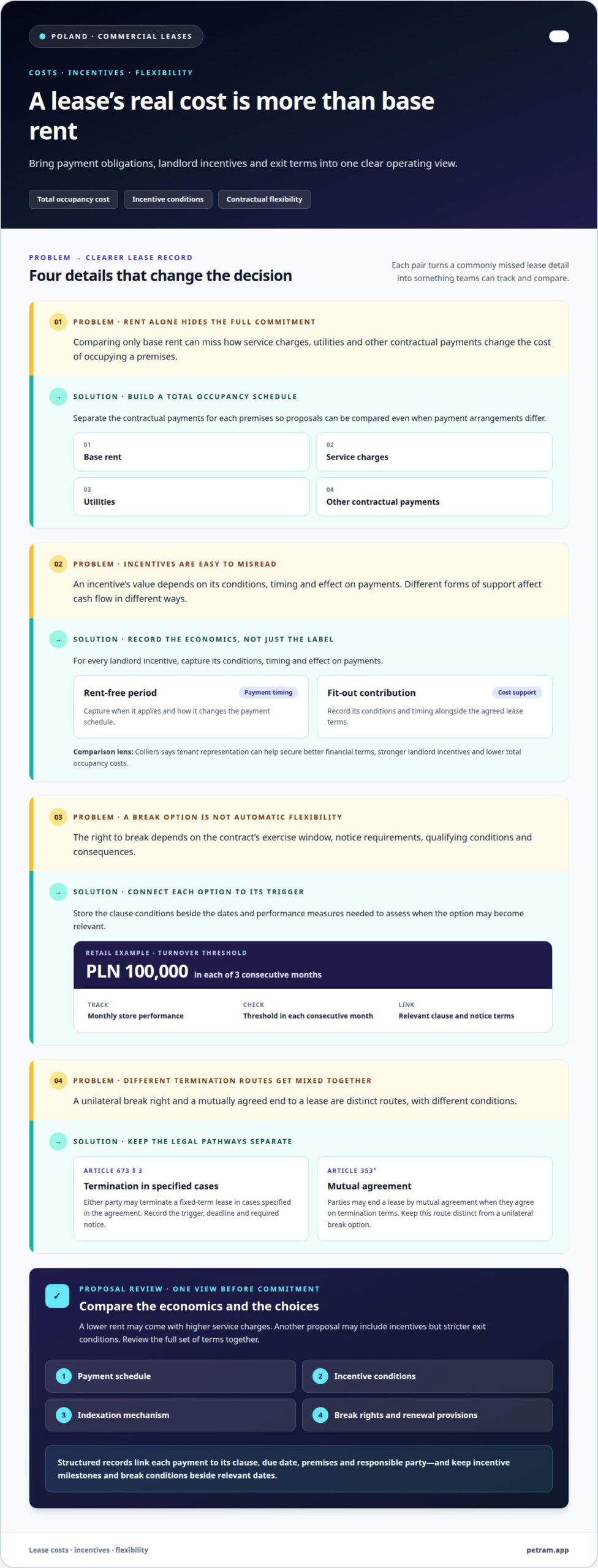
Assess a Polish commercial lease by its total occupancy cost, not base rent alone. Retail, warehouse and logistics contracts can allocate expenses differently. Create a cost schedule for each premises, separating rent, service charges, utilities and other contractual payments. This makes leasing decisions easier to compare across properties, even when payment arrangements differ.
Landlord incentives also affect the financial picture. Colliers says tenant representation can help secure better financial terms, stronger landlord incentives and lower total occupancy costs. Record each incentive with its conditions, timing and effect on payments. A rent-free period and a contribution toward fit-out costs, for example, affect cash flow in different ways. Their value depends on the lease terms and the tenant’s planned occupation.
Flexibility is contractual, not automatic. A break option should be captured with its exercise window, notice requirements, qualifying conditions, and consequences. For a retail example, a tenant break clause sets a turnover threshold of PLN 100,000 in each of three consecutive months of the store’s operation. Tracking that threshold against monthly performance helps clarify when the clause may become relevant.
For a fixed-term lease, Article 673 § 3 of the Polish Civil Code allows either party to terminate in cases specified in the agreement. The practical value therefore lies in the wording: a software record should connect the termination right to its trigger, deadline, and required notice. Separately, Article 353¹ allows parties to end a lease by mutual agreement when they agree on termination terms. Keep that route distinct from a unilateral break option.
Compare scenarios before committing to a contract. One option may have lower rent but higher service charges; another may include incentives but stricter exit conditions. For each proposal, list the payment schedule, incentive conditions, indexation mechanism, break rights and renewal provisions. This gives owners and occupiers a clearer view of committed costs and available choices.
Once signed, preserve the negotiated economics in structured lease records. Link each payment obligation to its clause, due date, premises, and responsible party. Log incentive milestones and break-option conditions beside relevant dates. This creates a practical audit trail for portfolio reviews and supports consistent decisions across retail and industrial assets. Teams organizing those records can explore lease portfolio management tools as part of their commercial property workflow.
Real estate in Poland costs less than in other European countries, but lease-level occupancy costs still warrant comparing proposals, including their payment, incentive and exit terms.
Client experiences with lease support
Lease support is tested in everyday decisions, not just during implementation. Consider a property manager reviewing a Polish agreement before deciding whether to renew. They need the signed document, current obligations, payment history and relevant correspondence in context. If these records are in separate folders, confirming a clause can mean searching repeatedly. A consistent digital record helps teams understand contractual requirements and identify what needs attention.
Consider a practical portfolio scenario: a landlord receives a service-charge invoice for a commercial property. The team needs to find the relevant lease clause, allocation basis, billing period and supporting records. A useful workflow links the charge to the premises and agreement, then records who reviewed it and what decision followed. This creates traceability without assuming that every charge is incorrect or every dispute has the same cause.
Support quality also shows in routine changes. A tenant may update billing details, a lease may be amended, or a renewal date may shift. The process should preserve the original agreement, record the amendment and show which fields changed. For example, changing a notice date should not erase the earlier contractual date. A clear change history helps managers explain the current position to colleagues and business partners.
Security, support and hosting risks include excessive user access, unclear incident handling, unavailable records and uncertainty about data storage. Before relying on a system for lease records, assess access controls, backup and recovery procedures, support escalation routes, hosting locations and contractual guarantees.
Polish-language support can matter when property teams, tenants and finance colleagues work in different languages. A useful support process explains how to report an issue, what information to include and how updates are communicated. For example, a question about an indexed rent calculation should be traceable to the agreement, calculation period and responsible team. Response commitments should be clear in the provider’s support terms.
Before onboarding, map current support needs to recurring tasks:
- Identify who handles lease amendments, payment questions, and document access.
- Define how a user reports a discrepancy in rent or charges.
- Set responsibility for reviewing changes to agreement records.
- Document where escalation goes when an operational issue affects a decision.
These steps turn general expectations into a workable operating model. Property managers can assess whether the support process suits their portfolio’s asset types, internal roles and recordkeeping practices. In a Polish commercial real estate operation, consistent handling of agreements and charges supports continuity when staff responsibilities change. Each user should understand the next action, records should remain accessible, and decisions should be traceable to their contractual context.
Rent and payment structure
A clear payment structure connects each tenant obligation to its lease, premises and due date. For a corporate office portfolio, a rent schedule can distinguish base rent from service charges, utilities and other agreed payments. Keep each item separate rather than combining everything into one total. This makes monthly reports easier to interpret and helps finance teams trace amounts to the relevant agreement. Commercial lease management software in Poland can organize these obligations in a consistent portfolio record.
Office and warehouse rents in Poland are commonly agreed in euros, with annual indexation to a euro-area consumer price index. Payment records should distinguish the contract’s rent currency from the currency used for internal reporting or settlement. Store the indexation method, adjustment date, effective rent and calculation record together. This gives property and finance teams a consistent basis for analysis when an adjustment changes the amount due. Commercial lease management software in Poland can also show the contractual currency alongside PLN reporting.
Payment timing also depends on the agreement. Record the billing frequency, invoice date, payment deadline and any contractual conditions for adjustments. For example, a lease may require rent and service charges to appear as separate invoice lines. Matching each line to its lease provision helps tenants and landlords review billing without confusing recurring rent with variable costs.
For an indefinite-term lease of premises with monthly rent and no agreed notice period, Article 688 of the Polish Civil Code requires three months’ notice, effective at the end of a calendar month. This makes the payment period and notice terms relevant to occupancy planning. A record of the notice clause alongside payment dates helps teams understand how a termination timeline relates to scheduled obligations.
Arrears processes require careful date and document tracking. Under Article 687 of the Polish Civil Code, a landlord seeking termination for rent arrears covering at least two full payment periods must give a written warning and an additional month to pay. Keep the warning, delivery record, outstanding periods, and payment status associated with the lease. Clear records help distinguish a late invoice from a continuing arrears issue.
A practical rent workflow can follow these steps:
- Record each payment obligation, its currency, frequency, and contractual basis.
- Separate base rent, service charges, and other invoice components.
- Reconcile invoices against the lease schedule and record any variance.
- Retain adjustment calculations and payment records for portfolio analysis.
This structure gives office teams a shared view of expected and received payments. It also supports comparisons across corporate tenants and properties without combining distinct obligations. Consistent records help managers identify upcoming adjustments, trace charges to their contractual source and prepare a more reliable cash-flow analysis for each commercial property.
Which lease management platforms support Polish language and PLN?
A platform fits a Polish portfolio when its interface, records and reports support local workflows. Polish-language screens matter for property teams managing agreements and tenant communication. PLN support matters for budgets, charges and reporting. These are separate capabilities: a translated interface alone does not show how the system records or reports currencies.
Assess language support through real tasks, not a setting label. Ask a user to enter a Polish tenant name, review a lease record and generate a report. Check that field labels, date formats, document titles and exported files remain clear in Polish. For example, a finance colleague should be able to identify a payment period and the responsible property without relying on an English-only screen.
Test currency handling in the same practical way. Check whether the platform distinguishes a lease’s original currency from the portfolio reporting currency, and whether amounts remain traceable in exports. For a Polish portfolio, examine how PLN entries appear in budgets, invoices and management reports. If a lease uses another currency, confirm that users can still identify its original amount and contractual basis.
Compare platforms using a repeatable evaluation. Create a sample record for an office property, then test the same workflow with a retail or warehouse asset. Review permissions, document search, report filters and export formats. Ask finance and property teams to assess their own tasks. Their feedback can show whether Polish-language navigation and PLN reporting work across departments, rather than only in a demonstration.
- Test a Polish-language workflow from record entry through report export.
- Review how PLN appears in budgets, payment records, and portfolio summaries.
- Confirm that currency labels and source amounts remain identifiable.
- Check whether exported records retain readable Polish text and consistent fields.
- Assess access roles for property, finance, and management users.
Evaluate integration alongside language and currency support. Map the fields exchanged with accounting, invoicing or ERP systems, including tenant, property, payment date, currency and charge category. Then test a sample transfer and reconcile the output against its source record. This shows whether the connection preserves the information your Polish operation relies on, rather than merely confirming that two systems connect.
A platform comparison is incomplete without testing how daily users handle exceptions. Try a corrected payment entry, an amended agreement record and a report filtered by property. Note which steps require manual work and which information remains visible to relevant teams. A concise scorecard makes differences easier to discuss and supports a decision based on actual portfolio tasks.
For a commercial real estate workflow focused on Polish records and PLN visibility, explore commercial property management workflows.
Compare platforms by testing Polish-language workflows and PLN handling across lease records, budgets, payment records, reports and exports. Also assess currency traceability, user permissions and whether integrations preserve the fields your operation relies on.
Petram.app (Rezone): Property Manager Software (Rezone)
Petram.app (Rezone) provides Property Manager Software (Rezone), a vertical SaaS platform for commercial real estate. It supports owners and managers who need digital tools for workflows across commercial property portfolios. The platform integrates AI Agents to help streamline operations and support property value management. Property management software can serve as the operational layer for organizing portfolio work, alongside lease, rent and cost processes. Consider how digital property management fits your portfolio’s needs and management priorities. Petram.app (Rezone) offers a technology-focused approach to commercial real estate operations. Contact Petram.app (Rezone) to discuss your property management needs.
Set a clearer direction for your portfolio
Start by defining what better lease oversight should make possible. Identify the operational decisions that currently take the most effort, then prioritize the records and workflows that would make those decisions clearer. A focused starting point can help your team establish consistent practices before extending them across the portfolio.
When assessing commercial lease management software in Poland, tie the evaluation to your operating model. Consider how property, finance and management teams need to access information, coordinate responsibilities and maintain a shared view of portfolio activity. Choose a direction that supports your priorities and can evolve with how your organization manages commercial real estate.
Petram.app (Rezone) offers Property Manager Software (Rezone) for commercial real estate operations. If you’re ready to explore how it may fit your portfolio, contact Petram.app (Rezone). A considered next step can help turn complex management into a more deliberate, forward-looking operation.
Frequently Asked Questions
What commercial lease management software is available in Poland?
Petram.app (Rezone) offers Property Manager Software for the commercial real estate sector. Its vertical SaaS platform includes AI Agents designed to help owners and managers streamline operations and increase property value. For a practical evaluation, identify who will use the software, which portfolio workflows need support and what information teams need to coordinate. Then assess whether the platform’s commercial real estate focus matches those priorities.
Which software is best for managing retail, office, and industrial leases in Poland?
The right fit depends on whether a platform supports your organization’s commercial property management needs across asset types. Petram.app (Rezone) provides vertical SaaS for commercial real estate, making it relevant to owners and managers of commercial portfolios. Consider whether a shared software environment and AI Agents align with your operational goals. Base the decision on your portfolio structure, management priorities and intended use of digital tools.
How do commercial lease management software providers compare in Poland?
Compare software based on how clearly it captures lease clauses, euro indexation, service charges, alerts, reports and portfolio records. For Polish operations, assess Polish-language workflows, PLN support, searchable contract data, obligation tracking, document storage and payment schedules.
What Polish legal and GDPR requirements apply to commercial lease management software?
Commercial lease provisions are primarily governed by the Civil Code, including rules relevant to rent indexation and fixed-term termination clauses. GDPR considerations apply when records contain personal data, so assess access controls and appropriate data handling.
How does software handle Polish commercial lease VAT, rent indexation, and service charges?
For rent indexation, software should record the index, adjustment frequency, calculation basis, effective date and any contractual cap or floor. Track service charges separately from base rent, including charge categories, allocation methods, billing periods, reconciliation terms and supporting documents.