

What if a year-end CAM dispute starts months before the final statement, with an expense that was never clearly tied to the lease? For property teams in Poland, common area maintenance (CAM) reconciliation best practices start with one principle: follow each lease and make every recoverable cost traceable. Different clauses, inconsistent expense labels, and spreadsheet-based allocations can turn routine reconciliations into difficult questions from tenants.
A defensible process needs more than accurate arithmetic. It requires consistent expense classification, documented source records, allocation calculations that reflect each lease, and statements tenants can follow. This guide explains how to build that process, from reviewing lease terms and organizing expenses to checking tenant shares, preparing clear statements, and resolving questions efficiently.
Digitized property management workflows can help teams keep these steps organized as portfolios grow. Rezone, Petram.app’s commercial real estate software platform, provides digital tools and AI agents for property management workflows. The aim is a repeatable audit trail, calculations you can explain, and fewer surprises at reconciliation time.
Key Takeaways
- Use common area maintenance (CAM) reconciliation best practices to make lease terms the foundation of every expense and allocation decision.
- Build a traceable expense pool by connecting ledger categories to lease provisions and supporting records.
- Use a consistent calculation sequence to determine each tenant’s share and make variances easier to explain.
- Set clear owners, review points, deadlines, and evidence requirements for each stage of the reconciliation close.
- Standardize portfolio-wide workflows while preserving lease-level rules as the authority for individual calculations.
What CAM Reconciliation Covers, and Why Lease Accuracy Comes First
Common area maintenance (CAM) reconciliation compares a property’s eligible shared operating expenses with the payments tenants made during the relevant period, applying each tenant’s lease rules. It replaces estimated charges collected during the year with actual expenses the lease allows the landlord to recover. For a Polish commercial property, treat “CAM” as an operating label, not as a substitute for the wording of the executed lease. The contract determines which costs can be charged and how each tenant’s share is calculated.
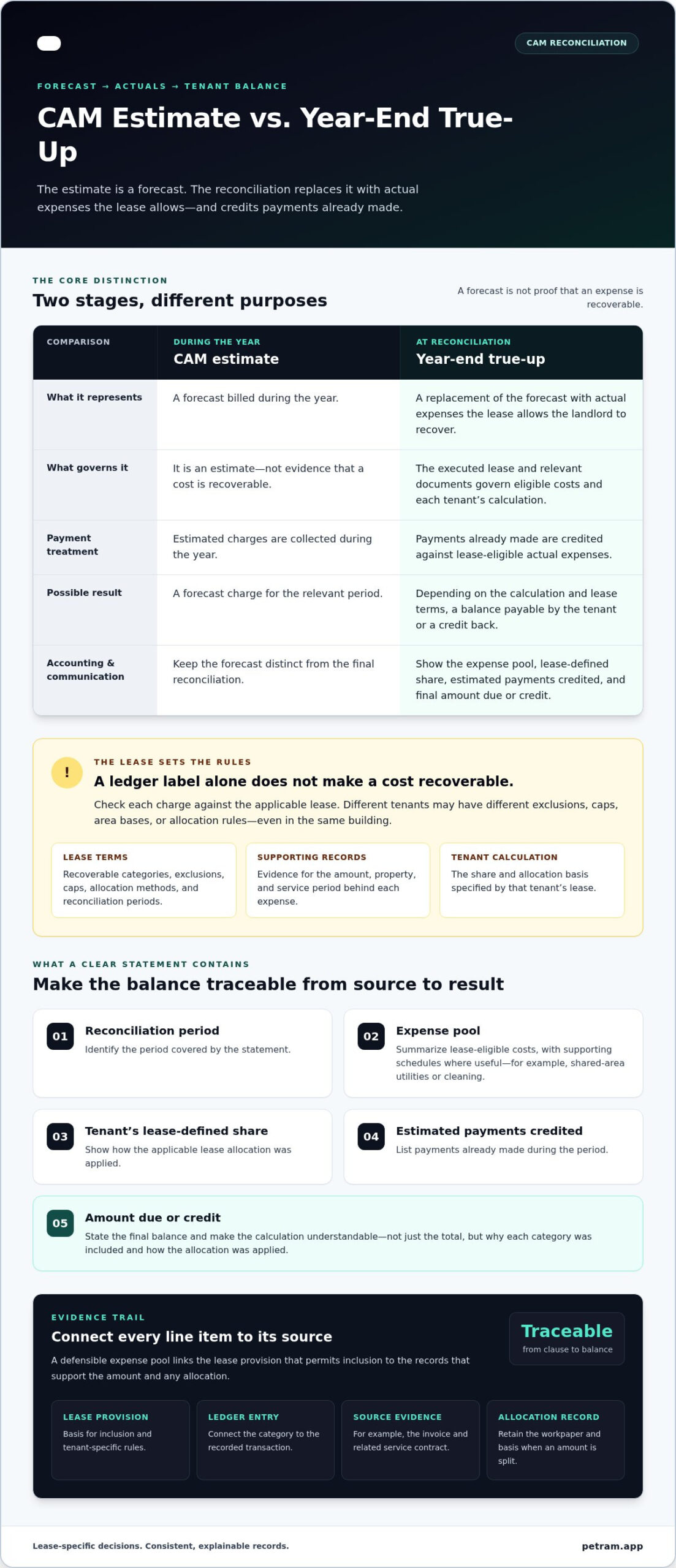
A CAM estimate is a forecast billed during the year; the year-end true-up replaces that forecast with lease-eligible actual expenses and credits payments already made. Depending on the calculation and lease terms, the resulting balance may be payable by the tenant or credited back. An estimate is not proof that an expense is recoverable. Keep the forecast and final reconciliation distinct in accounting records and tenant communications.
Lease accuracy comes first because an agreement may define recoverable categories, allocation methods, caps, exclusions, and the reconciliation period. A cost appearing in the property ledger doesn’t automatically belong in the CAM pool. The lease must provide the basis for including it. These principles underpin Common Area Maintenance (CAM) charges, but each property’s contractual documents control its calculation.
What does a CAM reconciliation statement show?
A useful statement lets a tenant follow the calculation from source to balance. It identifies the reconciliation period, summarizes the expense pool, shows the tenant’s lease-defined share, lists estimated payments credited, and states the amount due or credit. Supporting schedules can break the pool into categories such as shared-area utilities or cleaning. Include records that substantiate each amount and show how it relates to the applicable lease provision.
Tenants should be able to understand not only the total, but also why each category was included and how the allocation was applied. Statement formats vary with lease terms and property accounting practices. Consistency across a portfolio is helpful, but it shouldn’t obscure lease-specific calculations.
Why can the same CAM process differ by lease?
Two tenants in one building may have different cost exclusions, caps, area bases, or other allocation rules. One agreement might exclude an expense category, while another permits recovery subject to a stated limit. The reconciliation workflow can use shared stages, such as gathering ledger records, reviewing costs, calculating shares, and issuing statements. The decisions within those stages must remain specific to each property and lease.
Common market practice can help teams design a process, but it cannot replace the executed lease, its amendments, or relevant side letters. Build common area maintenance (CAM) reconciliation best practices around both: standardize the workflow, then validate each charge against the documents that govern that tenant. This makes the outcome easier to trace, explain, and review.
Build a Lease-Aligned CAM Expense Pool with Traceable Records
A defensible expense pool starts with documents, not ledger labels. Gather each tenant’s executed lease, amendments, and side letters, then identify the provisions covering recoverable expenses, exclusions, caps, allocation methods, and reconciliation periods. Map each relevant general ledger category to the lease language that governs it. If a provision is unclear or documents conflict, flag the item for review instead of treating an accounting code as permission to charge it.
Every CAM line item needs a traceable source, from the lease provision that permits its inclusion to the record that supports its amount. That source trail turns a total into an explainable calculation. ICSC’s guide to CAM for small businesses offers context on how CAM may be addressed in leases, but expense decisions still need to follow the actual agreement and related documents for each tenant.
Classify recoverable expenses and lease-specific exclusions
Use consistent portfolio categories so teams can review similar transactions in a common way, while retaining each lease’s definitions and exceptions. A category is a sorting tool, not a recovery decision. Review each charge against the relevant clause before adding it to the pool.
Give administrative costs, capital items, taxes, insurance, and utilities particular attention. Their treatment can vary by agreement, and a broad label may hide important differences. For each inclusion, exclusion, or reclassification, record the rationale, relevant lease reference, supporting evidence, reviewer, and date. This makes judgment calls visible and easier to revisit during close or in response to a tenant inquiry.
Maintain records that support each reconciliation line
Connect each ledger entry to its underlying evidence. For example, a vendor charge should be traceable from the general ledger to an invoice, the related service contract, and the property or service period it concerns. If an amount is split among buildings or tenants, retain the allocation workpaper and state the basis used. Keep adjustment explanations alongside the original entry so reviewers can distinguish a correction from a source transaction.
A practical record structure can capture:
- The ledger account, transaction date, service period, and property.
- The invoice or contract, relevant lease clause, and proposed classification.
- Any allocation assumptions, adjustment rationale, approval, and supporting workpaper.
Date records consistently and preserve enough context for another reviewer to retrace the decision without relying on the preparer’s memory. BOMA International materials may inform measurement practice where relevant, but they’re a reference, not a replacement for lease-defined requirements. Verify the applicable lease and measurement basis before using area data in a charge calculation.
These common area maintenance (CAM) reconciliation best practices are easier to sustain when document ownership, approvals, and records follow a structured digital workflow. Rezone is a vertical SaaS platform for commercial real estate, with property management tools and AI agents that support digital workflow optimization. Learn more about commercial property management workflow tools and how they can help organize property operations, while keeping lease review central to the process.
Calculate Each Tenant’s CAM Share and Explain Variances
Once the eligible expense pool is established, calculate each tenant’s share using the method in that tenant’s executed lease. A reliable sequence keeps the math visible: confirm the eligible pool, apply the lease-defined share, make only permitted adjustments, then subtract payments credited for the period. Don’t automatically apply one portfolio-wide formula. Standardize the calculation steps, but let each lease determine the inputs.
Which allocation basis should a manager use?
Check the lease for the stated area measure, denominator, or fixed percentage. Record the source of the area figures and the date they apply. If a measurement or denominator changes, document why and assess whether the lease permits the change. A customary allocation method is not a substitute for the tenant’s contractual calculation.
| Possible basis | How it may be expressed | What to verify |
|---|---|---|
| Rentable area | Tenant rentable area divided by the specified total rentable area | Lease definition and source-area records |
| Another area measure | Tenant area divided by a lease-defined building or shared-area denominator | Measurement method and included spaces |
| Fixed percentage | A stated share applied to eligible expenses | Lease language and any stated conditions |
The table describes possible approaches, not interchangeable options. The executed lease controls. Keep the denominator consistent with its terms and retain the area schedule or other source record used in the calculation.
How should managers explain a reconciliation variance?
Show the tenant how estimated payments bridge to eligible actual expenses and the final balance. Identify the main drivers, such as a category-level expense change, a lease-permitted adjustment, or payment timing. If occupancy gross-ups, caps, fixed amounts, or exclusions apply, show each separately and only where the lease allows it. A clear bridge helps tenants distinguish input figures from contractual adjustments.
For example, assume a hypothetical eligible pool of 120,000 zł and a lease-defined share of 8%. The initial share is 9,600 zł. If a lease-permitted cap reduces the charge to 9,000 zł and the tenant has paid 8,400 zł in estimates, the reconciliation shows a hypothetical balance of 600 zł. Present the pool, share, cap adjustment, credits, and result as separate lines so the arithmetic can be checked.
These common area maintenance (CAM) reconciliation best practices make tenant-level calculations easier to review without implying that every tenant follows the same formula. Preserve calculation workpapers alongside the statement and use consistent labels so a reviewer can trace each adjustment and payment credit back to its basis.
Use a Repeatable CAM Reconciliation Close and Review Checklist
A reliable close turns lease rules and accounting records into a controlled sequence, with a named owner and evidence requirement at every handoff. Set the close calendar before work begins. Use the reconciliation period and statement delivery requirements in each lease to anchor deadlines, then assign internal target dates that leave time for review and corrections.
- Define the period and scope. The property manager confirms the applicable reconciliation period and identifies the properties, tenants, and lease documents in scope.
- Extract and reconcile ledger data. The accounting owner gathers transactions for the period, checks the expense schedule against the general ledger, and investigates unexplained differences.
- Review expenses against lease rules. The lease reviewer confirms the applicable lease version and checks inclusions, exclusions, caps, and adjustments. Each decision should have a clause reference and supporting record.
- Prepare tenant calculations. The preparer applies the correct denominator or fixed share, permitted adjustments, and payment credits, retaining the calculation workpaper and source data.
- Complete independent review and approval. A designated reviewer checks the calculation and evidence before an authorized approver releases the statements.
- Deliver statements and track responses. The property or tenant-account owner records the issue date, delivery status, questions received, and follow-up actions.
Make the calendar operational, not aspirational. For each stage, record the responsible owner, target completion date, required approver, and evidence to retain. If a step slips, document the reason and its effect on downstream review or statement delivery instead of silently compressing the controls.
What should the pre-issue review verify?
Before release, confirm that the expense schedule reconciles to the ledger and that every difference has been investigated or explained. Recheck the lease version, tenant-specific clauses, source-area data, denominator, caps, exclusions, adjustments, and payments credited. Verify the arithmetic independently. Each adjustment should have a named owner, a concise rationale, approval where required by the workflow, and a linked source record. Hold the statement if a material item remains unsupported.
How can managers make tenant statements easier to review?
Use consistent category labels, plain explanations, and a clearly stated period. Give tenants a documented route for submitting questions or requesting supporting records, and assign responsibility for acknowledging, investigating, and resolving each query. Log the issue, owner, dates, evidence reviewed, and decision. Track disputed items separately while preserving the original calculation and revision history so any approved correction remains transparent.
These common area maintenance (CAM) reconciliation best practices create a repeatable close without removing lease-specific controls. Structured digital workflows can help organize ownership and records across property management operations. Rezone’s commercial real estate platform brings property management tools and AI agents into this broader approach to workflow management.
Scale CAM Reconciliation with Clear Governance and Digital Workflows
Scaling reconciliation across a portfolio doesn’t mean applying one calculation to every tenant. It means creating a reliable operating framework around lease-specific decisions. Common controls can define how records are named, which review stages are required, where evidence is retained, and who owns escalations. The executed lease remains the authority for each tenant’s recoverable costs, allocation basis, and adjustments.
This balance is central to common area maintenance (CAM) reconciliation best practices: standardize the process, not the contractual outcome. A shared workflow can make responsibilities and review status visible while preserving differences between properties and leases. That distinction helps teams grow without turning a practical template into a rule that overrides the underlying agreement.
Which CAM workflow controls should scale across a portfolio?
Set a common structure for expense and document naming, approval stages, evidence retention, and escalation ownership. Record lease-level exceptions so reviewers can identify them before a calculation is prepared. A consistent framework improves coordination, but it should never force distinct lease provisions into a single template.
- Use consistent labels for expense categories, source documents, and review statuses.
- Assign ownership for approvals, unresolved questions, and tenant follow-up.
- Retain the rationale and evidence behind adjustments in an organized record.
- Review recurring corrections and disputes to identify process gaps or unreliable source data.
For example, repeated corrections to area data may point to a record maintenance issue, while recurring questions about one expense category may signal that supporting explanations need to be clearer. Treat these patterns as prompts for investigation, not proof that a lease interpretation or calculation should change. Document any process update and preserve the tenant-specific rules it must respect.
Where can property management software support the process?
Structured digital records can help teams keep property documents, workflow ownership, review status, and supporting information organized and easier to locate. Clear ownership also makes handoffs more visible: the next person can see what remains open, who is responsible, and what evidence supports a decision. These tools can strengthen oversight, but they don’t eliminate the need for informed review or guarantee error-free reconciliations.
Rezone is a vertical SaaS platform for commercial real estate that incorporates AI agents to support property management workflows. It provides digital tools designed to help property owners and managers optimize workflows and increase asset value, not to replace lease-level judgment. For a wider perspective on technology and asset management, read the commercial property management software strategic guide.
Rezone supports commercial real estate workflow modernization as part of a broader property management strategy.
Make Your Next Reconciliation More Manageable
Use your next close to strengthen the process, not just complete the accounting cycle. Identify one recurring point of friction, such as unclear ownership, hard-to-find evidence, or repeated tenant questions, and define a practical improvement before the next reconciliation begins. Small, well-governed changes can make the process easier to maintain as your portfolio evolves.
The goal of common area maintenance (CAM) reconciliation best practices is not simply to produce a final balance. It’s to build a process your team can explain, review, and refine with confidence. The right digital foundation can support that progress while keeping human oversight and lease-specific judgment central.
Rezone combines commercial real estate property management software with AI agents that support workflow optimization. Explore Rezone for commercial property management and see how a more connected operating approach can support your team’s work.
Frequently Asked Questions
What does CAM reconciliation mean?
CAM reconciliation is a periodic comparison of lease-eligible shared operating expenses, each tenant’s allocated portion, and amounts already paid. It differs from the original estimate, which forecasts charges before actual costs are known. For example, if a service contract changes mid-period, reconciliation reflects actual eligible charges rather than simply repeating the forecast. The lease governs both recoverability and the calculation method, so a ledger total alone cannot establish what is owed.
When should a commercial property manager complete a CAM reconciliation?
Complete the reconciliation according to the period and statement deadlines specified in the applicable lease. There’s no universal deadline to assume across every agreement. Set an internal close calendar that works backward from each lease’s requirements, allowing time to review ledger entries, confirm lease terms, obtain approvals, and prepare tenant communications. A dependable schedule supports common area maintenance (CAM) reconciliation best practices and helps teams identify deadline conflicts early.
Can a CAM reconciliation be corrected after a statement has been issued?
Yes, a statement can be corrected when a review confirms an error or omission, but a tenant’s question alone doesn’t automatically change the balance. Compare the reported issue with the lease and source records, retain the original statement, and document the investigation and decision. If a correction is warranted, issue a clearly identified revised statement that explains what changed. Follow the agreement and applicable procedures for timing and handling.
How should CAM reconciliation handle a lease year that differs from the property’s fiscal year?
Use the accounting and reconciliation period defined in the lease, even if it doesn’t match the property’s fiscal year. Map ledger transactions to the lease period using documented cut-off methods, so charges are assigned to the appropriate period rather than copied from a fiscal-year report without review. Apply the method consistently. For unusual timing, accruals, or transactions spanning periods, involve the accounting reviewer and preserve the reasoning behind the treatment.
Can vacant space affect a tenant’s CAM share?
Vacancy can affect a tenant’s share only according to the lease’s allocation and occupancy language, including any permitted gross-up. Don’t assume an adjustment is allowed simply because space is vacant. If the agreement permits one, show the occupancy assumption and resulting calculation separately, and retain the data supporting it. Apply the documented approach consistently where the governing terms allow, while recording lease-specific differences that change the treatment.
How should a CAM reconciliation address a tenant’s request for supporting documents?
Handle a document request under the lease’s review and access provisions. Organize relevant records by expense category, then provide substantiation and a calculation bridge that connects the charges to the tenant’s share. Keep a record of the request, the materials shared, and how the inquiry was resolved. Don’t assume every tenant has identical access rights or that one response deadline applies; the governing agreement and procedures determine the process.