

Did you know that the average Polish asset manager loses nearly 40% of their workday to manual administrative friction? It’s a frustrating reality where fragmented data and rising utility costs, often reaching thousands of złoty in monthly waste, eat away at your margins. You likely feel the constant pressure of managing disconnected tools while labor and insurance premiums continue to climb across the country. Maximizing commercial real estate operational efficiency is no longer just a back-office goal. It’s the primary strategic lever for asset value in a high-interest-rate environment.
You recognize that the old ways of reactive management are failing to protect your bottom line. This guide reveals how modern leaders are utilizing AI agents and vertical SaaS to turn operational workflows into a powerful engine for Net Operating Income growth. We’ll explore the shift from firefighting to proactive portfolio visibility that recovers lost margins. You’ll discover how to unify your data to ensure every square meter of your portfolio performs at its absolute peak. This is the roadmap to replacing the stress of complex management with the calm of automated, high-level control.
Key Takeaways
- Redefine your strategy by shifting focus from traditional rent increases to a high-performance ratio of asset output versus management effort.
- Master the four pillars of commercial real estate operational efficiency to recover lost margins and eliminate administrative burnout.
- Understand why specialized vertical SaaS provides the precise digital infrastructure needed to outperform generic, one-size-fits-all management tools.
- Deploy AI agents as autonomous assistants to unify fragmented portfolio data and act as a force multiplier for your property management team.
- Follow a structured roadmap to audit operational leaks and migrate your tech stack toward a unified, future-proof management model.
What is Commercial Real Estate Operational Efficiency in 2026?
In the current fiscal environment, commercial real estate operational efficiency is defined as the precise ratio of asset performance to management effort. It’s no longer a metric relegated to the maintenance basement; it’s a primary driver of valuation. For years, landlords relied on the “refinance and raise rent” model to mask operational leaks. That era is over. With interest rates remaining elevated, the ability to control internal margins has become the only sustainable path to growth.
Modern efficiency requires a total shift from reactive firefighting to proactive, data-driven oversight. You aren’t just fixing broken pipes; you’re orchestrating a complex ecosystem of Facility management, tenant relations, and energy consumption. This level of precision directly influences cap rate compression. Investors in 2026 pay a premium for assets with “clean” operations because they represent lower risk and higher predictability. When your data is unified, your asset becomes a liquid, high-performing financial product rather than a collection of administrative headaches.
The Shift from Financial Engineering to Operational Excellence
The Polish market is feeling the squeeze of rising labor costs and insurance premiums that can fluctuate by thousands of złoty annually. High interest rates have effectively killed the era of easy financial engineering. Today, your operating margin is the most important KPI you track. Every percentage point recovered from administrative friction or utility waste goes straight to your Net Operating Income. Operational alpha is the value created through process optimization. This alpha is what separates market leaders from those struggling with stagnant portfolios. You must move beyond simply owning space to becoming an expert in the digital and physical flows that make that space profitable.
The Cost of Inefficiency: Beyond the Utility Bill
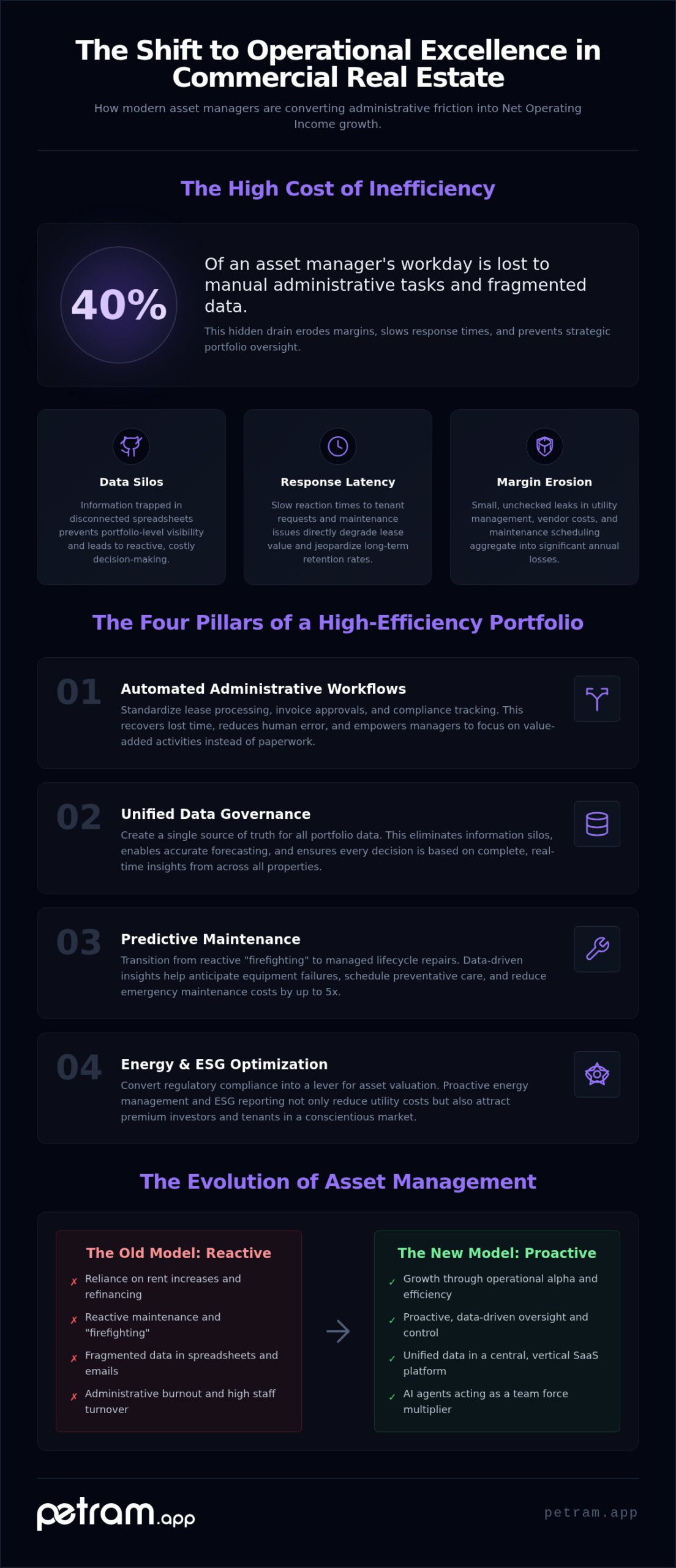
Inefficiency carries a heavy price tag that rarely shows up as a single line item on a balance sheet. It’s buried in the 40% of the day your managers spend on manual data entry or chasing vendor invoices. These hidden costs include:
- Data Silos: Information trapped in disconnected spreadsheets prevents portfolio-level visibility and informed decision-making.
- Response Latency: Slow reaction times to tenant requests directly degrade lease value and long-term retention rates.
- Margin Erosion: Small leaks in utility management or maintenance scheduling aggregate into massive annual losses across a portfolio.
Data silos are particularly dangerous for large commercial portfolios across cities like Warsaw or Wrocław. If your property manager doesn’t have a single source of truth, they’re making decisions based on outdated or incomplete information. This leads to reactive maintenance, which is often three to five times more expensive than proactive care. True efficiency transforms these systemic risks into competitive advantages.
The Four Pillars of a High-Efficiency CRE Portfolio
Operational success in 2026 is built on more than just physical facility engineering. It requires a structural framework that addresses both the digital and physical layers of an asset. While many focus solely on lighting or HVAC, true commercial real estate operational efficiency stems from four core pillars that transform how a portfolio functions at scale. These pillars ensure that every decision is backed by data rather than intuition.
- Automated Administrative Workflows: Eliminating the manual friction that consumes 40% of a manager’s workday.
- Unified Data Governance: Creating one source of truth to prevent information silos across multiple properties.
- Predictive Maintenance: Transitioning from reactive “firefighting” to managed lifecycle repairs.
- Energy and ESG Optimization: Converting regulatory compliance into a lever for asset valuation.
Digital Workflow Optimization
Administrative burnout is the silent killer of margins. When property managers spend nearly half their day on manual tasks, they aren’t managing assets; they’re managing paperwork. High-efficiency portfolios standardize lease processing and invoice approvals through intelligent software. This reduces human error in compliance tracking and reporting, ensuring that regulatory deadlines in the Polish market aren’t missed. You can learn more about this in our guide to Commercial Property Management Software: The 2026 Strategic Guide to AI-Driven Asset Optimization. By centralizing these workflows, you establish a clear digital audit trail for every złoty spent.
Asset Performance and Predictive Insights
Moving past reactive repairs is essential for margin recovery. According to Deloitte’s CRE Outlook, the shift toward AI-integrated operations is a defining trend for 2026. Leveraging historical data allows you to forecast system failures before they occur. Industry research from McKinsey indicates that predictive maintenance can lead to a 20% reduction in maintenance costs. This is a significant figure when dealing with large-scale commercial HVAC systems or elevators. This proactive approach ensures that maintenance isn’t a surprise expense but a managed lifecycle event.
Real-time visibility into these systems improves the speed of decision-making for owners. You can’t optimize what you can’t see. Beyond maintenance, this visibility extends to energy and ESG optimization. In cities like Warsaw, turning energy compliance into a competitive advantage is key as utility costs rise. Efficient buildings attract higher-tier tenants and command better valuations. If you’re looking to unify these disparate data points into one clear dashboard, exploring a platform like Rezone can provide the necessary digital infrastructure to scale.
AI Agents and Vertical SaaS: The New Efficiency Engines
The digital transformation of the Polish property market has reached a critical inflection point. For years, asset managers have struggled with “horizontal” software-generic tools designed for broad business use that fail to account for the nuances of commercial leases. Achieving true commercial real estate operational efficiency requires a move toward vertical SaaS. This specialized architecture is built specifically for the CRE lifecycle, ensuring that every workflow aligns with the actual needs of landlords and tenants rather than forcing users to adapt to rigid, one-size-fits-all frameworks.
While simple automation has existed for years, 2026 marks the rise of the AI Agent. These aren’t just scripts that follow “if this, then that” rules. They’re autonomous assistants capable of orchestrating complex tasks across your entire portfolio. By integrating these engines into your management model, you move beyond basic task completion into a realm of intelligent asset optimization where software acts as a proactive partner rather than a passive database.
Why Horizontal Software Slows You Down
Generic tools create a dangerous amount of friction when applied to specialized commercial portfolios. Because these platforms don’t natively understand complex lease indexation or service charge reconciliations in złoty, managers often resort to “shadow accounting.” This is the practice of maintaining separate Excel spreadsheets because the primary software can’t handle the granular details of the asset. This fragmentation leads to data decay and significant human error. A platform like Rezone eliminates this friction by providing a digital infrastructure designed specifically for commercial asset performance. It ensures that your data remains unified, accurate, and actionable across every square meter you manage.
AI Agents as a Management Force Multiplier
AI Agents function as a force multiplier by handling the high-volume, low-complexity tasks that typically cause administrative burnout. They don’t just notify you of a tenant inquiry; they can triage maintenance requests, verify insurance compliance, and cross-reference vendor invoices against agreed-upon contracts in the background. Unlike traditional automation, these agents use intelligent orchestration to navigate multi-step processes without constant human intervention. AI Agents transform “data entry” into “data strategy” by freeing your team to focus on high-level valuation growth. As these agents monitor portfolio-wide compliance, they provide a level of oversight that was previously impossible for human teams to maintain. This proactive management style ensures that your portfolio remains resilient against rising costs and regulatory shifts in the Polish market.
Roadmap: Transitioning to an Efficient Management Model
Achieving peak commercial real estate operational efficiency isn’t a single event; it’s a strategic migration. Most firms fail because they attempt to automate broken, legacy processes. You must first rebuild the foundation of your management model to support the high-speed demands of 2026. This roadmap provides the structural steps required to move from fragmented chaos to unified, AI-driven control.
- Step 1: Conduct an Operational Audit. Identify exactly where time and money are leaking.
- Step 2: Unify the Tech Stack. Migrate from disconnected silos to a vertical SaaS platform designed for CRE.
- Step 3: Deploy AI Agents for Low-Value Tasks. Offload administrative friction to free up your human capital for high-level strategy.
- Step 4: Establish Real-Time Reporting. Shift from monthly “look-back” cycles to live, portfolio-wide visibility.
- Step 5: Iterate Based on Predictive Analytics. Use historical and live data to refine your model for maximum Net Operating Income (NOI).
Auditing Your Current Efficiency Gaps
You can’t optimize what you don’t measure. Start by tracking “time-per-task” for your management team over a typical month. If your staff spends 20 hours reconciling service charges across Warsaw properties, that’s a clear efficiency leak. You also need to identify “dead data”-information trapped in static PDFs or disconnected spreadsheets that adds zero value to your asset performance. Benchmarking your operating expenses against national Polish standards helps highlight where utilities or labor costs have drifted beyond the norm. This audit isn’t just about cutting costs; it’s about identifying the friction points that prevent your team from focusing on tenant retention and asset growth. Replacing static reports with commercial real estate analytics software that delivers real-time visibility is one of the most impactful upgrades you can make at this stage.
Selecting the Right Platform for Scale
When choosing a platform, integration capability is the most critical feature in 2026. A tool that doesn’t communicate with your existing financial or building management systems is just another silo. Your platform must support the entire commercial asset lifecycle, from initial leasing to long-term maintenance and eventual scaling. It should handle complex indexation and Polish tax requirements natively. You can start your transition by exploring the vertical SaaS solutions offered by Rezone to unify your portfolio today. Ensure the digital infrastructure you select can handle future requirements like asset tokenization, providing a clear path for professionalizing your operations at scale.
Future-Proofing Your Portfolio with Rezone
The status quo of commercial management is a liability. Relying on fragmented spreadsheets and reactive repairs isn’t just inefficient; it’s a direct threat to your asset’s valuation. To achieve true commercial real estate operational efficiency in 2026, you must move beyond traditional software into a unified ecosystem. Rezone, developed by Petram.app, unifies the property manager, the owner, and the AI agent into a single, high-speed workflow. This integration ensures that every decision is backed by real-time data, replacing the stress of manual oversight with the calm of automated control.
Petram.app is modernizing the industry by challenging the “good enough” mentality of legacy management. By providing the digital infrastructure required to scale, we help owners transition from being passive landlords to becoming strategic asset optimizers. This shift is essential for anyone looking to professionalize their operations and stay ahead of rising costs in the Polish market. Clarity and control are the natural results of a system that prioritizes performance over administrative busywork.
The Rezone Advantage for Asset Managers
Rezone provides a specialized environment where asset managers can focus on value creation rather than administrative survival. By utilizing digital workflow optimization, the platform eliminates the friction points that typically lead to burnout. This creates a calm, automated management environment where human capital is reserved for high-stakes strategy and tenant relationship building. The result is what we call “Operational Alpha.” This is the margin recovered through precise process execution and the elimination of “dead data” that adds no value to the bottom line.
- Unified Workflow: Seamless communication between managers and owners without the need for endless email chains.
- Autonomous Orchestration: AI agents that handle the heavy lifting of compliance and vendor verification in the background.
- Margin Recovery: Identifying and capturing every złoty lost to utility waste or manual reporting errors.
Taking the First Step Toward Modernization
Transitioning to a modern management model shouldn’t disrupt your current operations. The goal is a phased migration that strengthens your portfolio while you continue to manage it. Start with a strategic review of your current digital infrastructure to identify where silos are causing the most damage. This audit reveals the hidden costs of your current “status quo” and provides a roadmap for integration. Once the leaks are identified, you can begin deploying specialized tools that act as a force multiplier for your team. If you’re ready to move beyond the limitations of horizontal software, you can modernize your CRE operations with Rezone today. Professionalizing your portfolio isn’t just about adopting new tech; it’s about securing your asset’s future in an increasingly competitive environment.
Seizing the Operational Advantage
The transition to a high-performance portfolio requires more than incremental changes. It demands a total departure from the administrative friction that has historically hampered asset performance. By embracing the four pillars of modern management, you move beyond reactive maintenance into a state of proactive control. You’ve seen how specialized vertical SaaS and AI agents act as the ultimate force multipliers, turning fragmented data into a clear strategy for margin recovery. This is the new standard for commercial real estate operational efficiency.
Success in the 2026 market belongs to those who view their operational workflows as a primary lever for Net Operating Income growth. Rezone offers the precise digital infrastructure needed to unify owners, managers, and autonomous agents in a single ecosystem. It’s time to replace the stress of manual oversight with the calm of automated, high-level orchestration. You have the roadmap; now you need the engine. Scale your portfolio efficiency with Rezone and secure your asset’s competitive edge today. Your portfolio is ready for the future. Don’t let legacy processes hold it back.
Frequently Asked Questions
What is operational efficiency in commercial real estate?
Commercial real estate operational efficiency is the ratio of an asset’s financial performance to the management effort required to sustain it. In 2026, this means maximizing Net Operating Income by minimizing administrative friction and resource waste. It involves standardizing workflows so that every minute spent by a manager directly contributes to asset appreciation rather than just maintaining the status quo.
How does AI improve commercial property management?
AI improves management by acting as an autonomous layer that orchestrates complex workflows without constant human intervention. It handles high-volume tasks like vendor invoice verification and utility monitoring in real-time. By processing data across a portfolio, AI identifies anomalies that human managers might miss. This allows for proactive intervention before costs escalate, ensuring your margins remain protected.
What is the difference between vertical SaaS and generic property software?
Vertical SaaS is engineered specifically for the unique workflows of the commercial sector, whereas generic software offers broad tools that often require manual workarounds. For a Polish landlord, vertical SaaS natively handles complex indexation and service charge reconciliations in złoty. This specialization eliminates shadow accounting in spreadsheets and ensures all data remains in a single, authoritative system.
Can operational efficiency actually increase my property’s market value?
Yes, improving commercial real estate operational efficiency directly increases market value by boosting Net Operating Income (NOI). Because property valuation is typically a multiple of NOI, every złoty saved in operating expenses through better efficiency translates into higher capital value. Investors also pay a premium for assets with transparent, data-driven management histories because they represent lower operational risk.
How much time do property managers save with automation?
Managers typically reclaim significant portions of their workday by automating repetitive administrative tasks. This time is often lost to manual data entry, lease abstraction, and chasing vendor approvals. By offloading these low-value activities to intelligent systems like AI agents, your team can focus on high-impact strategic initiatives like tenant retention programs and portfolio expansion.
Is AI for commercial landlords just hype or a real tool?
AI is a practical tool that provides a measurable competitive advantage in high-interest-rate environments. It isn’t just about chatbots; it’s about algorithmic oversight of energy consumption and predictive maintenance. Landlords using these tools see tangible margin recovery by identifying utility waste and preventing expensive system failures before they occur in their Polish assets.
What are the first steps to improving CRE operational efficiency?
The first step is conducting a thorough operational audit to identify where your team is losing the most time. You must measure time-per-task across your management lifecycle and pinpoint data silos that prevent portfolio-level visibility. Once you’ve identified these leaks, you can begin migrating to a unified vertical SaaS platform that supports automated workflows and real-time reporting.
How do AI agents handle commercial lease renewals?
AI agents manage lease renewals by monitoring expiration dates and automatically triggering standardized communication workflows. They can analyze market data to suggest optimal renewal terms and prepare documentation for review. This ensures that no deadline is missed. It also guarantees that renewal negotiations are backed by the latest portfolio performance metrics, maintaining consistent cash flow across your properties.