

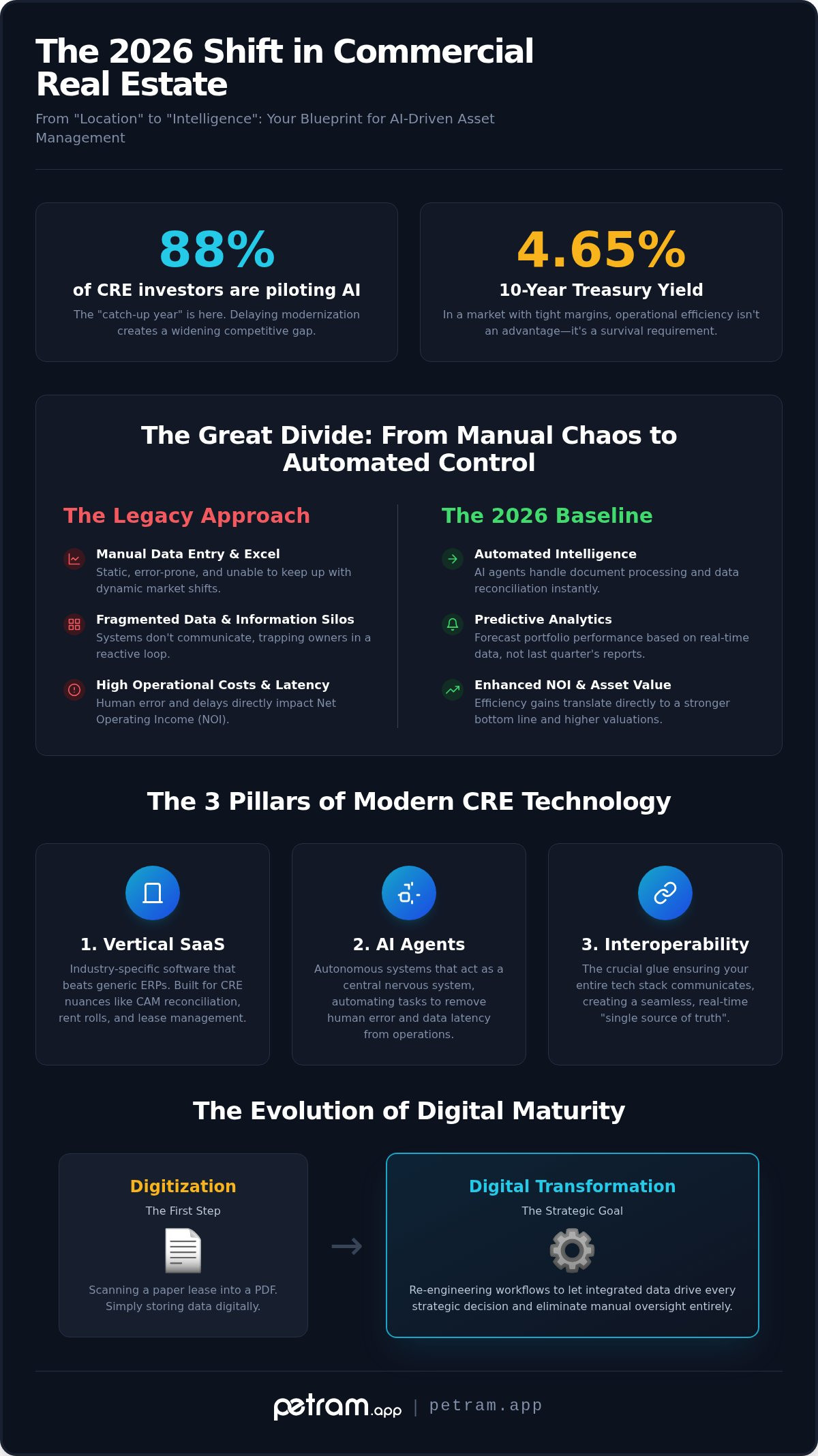
Nearly 88% of commercial real estate investors are now piloting AI tools, yet many still struggle with the friction of fragmented data and rising operational costs. You’ve likely felt the frustration of legacy systems that don’t talk to each other, leaving owners and managers trapped in information silos. It’s clear that the traditional “location, location, location” mantra has evolved. In 2026, the real differentiator is intelligence. Commercial real estate digital transformation is no longer a luxury for the tech-forward few; it’s the baseline for maintaining asset value in a market where the 10-year Treasury yield sits at 4.65% and margins are tighter than ever.
We understand that you need more than just buzzwords; you need a blueprint. This guide provides a master framework for modernizing your portfolio using AI agents and vertical SaaS to drive net operating income. You’ll learn how to build a clear hierarchy of necessary technologies that move your operations from manual chaos to automated efficiency. We’ll explore how to achieve total visibility into asset performance and implement workflows that scale effortlessly with your portfolio. It’s time to replace management stress with the calm of high-tech control.
Key Takeaways
- Understand the 2026 shift from manual data entry to automated data intelligence as the new baseline for asset performance.
- Discover why specialized Vertical SaaS and autonomous AI Agents are essential for a successful commercial real estate digital transformation.
- Identify concrete methods to drive Net Operating Income (NOI) by reducing operational expenses through AI-driven document processing.
- Master a strategic roadmap for auditing legacy bottlenecks and setting measurable KPIs to scale your portfolio efficiently.
- Learn how Rezone acts as a central nervous system to unify fragmented data and future-proof your assets against rising costs.
What is Commercial Real Estate Digital Transformation in 2026?
In 2026, commercial real estate digital transformation has moved past the experimental phase. It’s no longer just about buying a separate tool; it’s about re-engineering the entire asset lifecycle. For firms managing portfolios nationwide, 2026 is the “Catch-up Year.” With nearly 88% of investors now piloting AI tools according to recent industry data, those who delayed modernization face a widening competitive gap. They’re forced to transition from PropTech as a peripheral add-on to PropTech as the central infrastructure of their business.
This shift replaces manual data entry with automated intelligence. Instead of property managers spending hours reconciling invoices or rent rolls, Property technology (PropTech) now acts as the central nervous system. It connects acquisition, leasing, and management into a single, cohesive data stream. The goal is simple: maximize asset value by removing human error and data latency. In an environment where interest rates remain a critical factor for NOI, efficiency isn’t just an advantage; it’s a survival requirement.
The Evolution of CRE Technology: From Excel to AI
Legacy spreadsheets can’t keep up with high-velocity markets anymore. Excel is a static tool in a dynamic world. When market conditions shift or utility costs spike, a spreadsheet won’t alert you to the risk. Cloud-native platforms have become the baseline, providing a single source of truth for every stakeholder. Modern managers use these platforms to fuel predictive analytics. They aren’t just looking at what happened last quarter; they’re forecasting portfolio performance based on real-time usage patterns and economic shifts. This evolution allows for proactive management rather than reactive troubleshooting.
Digital Transformation vs. Digitization: Understanding the Difference
Don’t confuse digitization with transformation. Digitization is scanning a paper lease into a PDF; it’s the first and least important step. True commercial real estate digital transformation happens when you re-engineer processes to eliminate the need for manual oversight entirely. It requires a fundamental shift in how teams operate and how data flows between owners and managers. Digital transformation is a comprehensive cultural and technological shift that leverages integrated data to redefine how real estate assets are managed, valued, and scaled. It’s the move from simply storing data to letting data drive every strategic decision.
The Core Pillars of Modern CRE Tech: Vertical SaaS and AI Agents
Successful commercial real estate digital transformation relies on a shift from generic software to a specialized, unified architecture. The era of using horizontal ERPs to manage complex property portfolios is ending. These legacy systems often lack the granular data schemas required for the nuances of the Polish market, such as specific VAT handling or local utility billing in Polish Zloty (PLN). Modern leaders are now prioritizing Vertical SaaS and AI Agents as the two primary pillars of their digital infrastructure. This combination creates a “single source of truth” where data flows seamlessly between owners, managers, and tenants without manual intervention.
Interoperability is the third, often overlooked pillar. It’s the glue that ensures your digital stack communicates without friction. When your accounting software, leasing platform, and building management systems are siloed, you lose the ability to act on real-time intelligence. Understanding Digital Transformation for CRE Practitioners requires moving beyond surface-level tools and focusing on this underlying architectural connectivity.
Why Vertical SaaS is the Future of Commercial Property Management
Vertical SaaS beats horizontal solutions every time. While generic platforms offer broad utility, they often fail at the specialized tasks that define CRE, such as CAM reconciliation, complex rent rolls, and lease management. Industry-specific platforms provide tailored features that respect the asset lifecycle. Specialized commercial property management software like Rezone consolidates fragmented tools into a single interface. This reduces the “tech tax” paid in lost time and integration errors, allowing managers to focus on asset performance rather than data entry. It’s about having software that speaks the language of real estate natively.
The Role of AI Agents in Daily Operations
AI Agents aren’t just chatbots. They are autonomous workflow executors. In 2026, these agents move beyond answering simple tenant questions to executing complex tasks across different software modules. They can monitor rent rolls and automatically trigger renewal workflows 90 days before an expiration date. AI-driven anomaly detection can identify a 500 zł discrepancy in a utility bill before it’s even processed, flagging potential leaks or billing errors instantly. By automating these repetitive, high-stakes tasks, agents allow your team to scale the portfolio without a linear increase in headcount. This level of automation is the ultimate goal of any commercial real estate digital transformation strategy. If you’re ready to see how autonomous workflows can modernize your assets, it’s time to evaluate your current digital stack.
Calculating the Impact: How Digitalization Enhances Asset Value and NOI
The true measure of a successful commercial real estate digital transformation is found on the balance sheet. In a market where operational costs are rising, technology acts as a primary lever for protecting and expanding margins. Automation directly reduces operational expenses (OpEx) by eliminating the manual friction that historically plagued portfolio management. According to the Deloitte CRE Outlook, firms are increasingly prioritizing these efficiencies to combat economic volatility. By shifting from reactive to proactive management, owners can secure higher property valuations during exit events through the sheer transparency of their digital records. A clean, digital audit trail reduces the risk premium for buyers, often leading to more favorable cap rates.
Digital-first engagement platforms also redefine the relationship between manager and tenant. By providing a seamless interface for service requests and communications, you reduce the friction that often leads to churn. In a competitive market like Warsaw, keeping a tenant is significantly more cost-effective than the capital expenditure required to fit out a space for a new one. These platforms ensure that tenant needs are logged, tracked, and resolved with a speed that manual systems simply cannot match.
Optimizing Net Operating Income (NOI) Through Digital Efficiency
Reducing labor hours in administrative and accounting tasks is the fastest way to impact NOI. When software handles complex rent rolls and automated arrears management, the risk of human error vanishes. This is particularly vital in the Polish market, where managing diverse lease structures across retail and office sectors requires precision in PLN. Automated rent collection ensures better cash flow by shortening the time between billing and receipt. High-fidelity data accuracy serves as the fundamental engine for driving consistent NOI growth across the entire asset lifecycle.
Data-Driven Asset Performance Management
Real-time reporting transforms how leaders approach capital expenditure (CapEx) planning. Instead of relying on gut feelings or outdated physical audits, managers use digital tools to benchmark portfolio performance against live market data. This allows for the immediate identification of underperforming assets through automated KPIs. You can see exactly which properties are dragging down the portfolio average and why. These tools are also essential for meeting ESG and regulatory compliance standards, which are becoming non-negotiable for institutional investors in Europe. Leveraging digital infrastructure ensures your portfolio remains attractive to top-tier capital by proving compliance through verified, real-time data sets.
Building Your Transformation Roadmap: A Strategic Framework for CRE Leaders
Execution is the graveyard of many commercial real estate digital transformation initiatives. While the theoretical benefits of AI and automation are undeniable, moving from a fragmented collection of tools to a unified digital ecosystem requires a disciplined, strategic approach. It isn’t enough to simply purchase a new license; you must shift the operational paradigm of your entire organization. This roadmap provides a concrete framework for leaders ready to modernize their portfolios and eliminate the manual bottlenecks that stifle growth.
- Step 1: Audit existing workflows. Conduct a deep dive into your current operations. Identify exactly where manual data entry occurs and where information silos exist between managers and owners.
- Step 2: Define clear KPIs for success. Set measurable targets. Aim for specific outcomes, such as a 20% reduction in monthly reporting time or a 15% decrease in CAM reconciliation errors within the first six months.
- Step 3: Select a Vertical SaaS platform. Choose an ecosystem that supports AI Agent integration. This ensures your software isn’t just a database but an active participant in your workflows.
- Step 4: Execute a phased rollout. Don’t attempt to migrate your entire portfolio overnight. Start with a single asset class or a specific region to build momentum and ensure team buy-in.
- Step 5: Continuous optimization. Use the automated data feedback from your new system to refine processes. Digital transformation is an ongoing cycle of improvement, not a one-time event.
Overcoming Internal Resistance and Legacy Mindsets
Internal friction is often the biggest hurdle. Staff frequently fear that AI Agents are designed to replace them. You must frame technology as a partner that handles the repetitive, high-volume tasks, such as cross-referencing utility invoices or checking rent rolls. This frees your team to focus on high-value activities like tenant retention and strategic asset positioning. Demonstrating quick wins, like the immediate resolution of a 1,000 zł billing discrepancy, proves the value of the digital shift early. Executive sponsorship is non-negotiable; leadership must champion the change to ensure it remains a priority across all departments.
Selecting the Right Tech Partner
The difference between legacy vendors and modern AI-first platforms is profound. Legacy providers often bolt AI features onto aging codebases, leading to clunky integrations and data lag. Modern platforms build AI into their core architecture. When evaluating partners, prioritize security, scalability, and deep CRE expertise. In the Polish market, local support and an understanding of national compliance standards are essential. You need a partner who understands how to manage assets in PLN while providing the global-standard reporting institutional investors expect. If you’re ready to move beyond legacy limitations, explore how Rezone can anchor your digital roadmap.
The Rezone Advantage: Future-Proofing Portfolios with AI-Driven Asset Management
Rezone isn’t just another software layer. It’s the architecture that supports a modern, high-performance portfolio. By acting as the central nervous system, Rezone unifies fragmented data points into a single, actionable stream. It’s the ultimate tool for commercial real estate digital transformation because it was built specifically for the complexities of this sector. Whether you’re managing retail centers in Wrocław or office towers in Warsaw, Rezone provides the clarity needed to navigate a shifting economic environment. It replaces the chaos of manual oversight with the precision of automated control.
Rezone’s AI Agents are the primary differentiator. They don’t wait for human input to find errors. Instead, they autonomously execute workflows from lease abstracting to portfolio reporting. This reduces the time spent on manual data entry from hours to minutes. These agents extract structured data from complex lease agreements and operating statements with over 90% accuracy. It’s about moving from reactive management to a state of constant, autonomous optimization. You gain a partner that works as fast as the market moves.
Integrated Asset Optimization
Rezone combines property management and asset performance into one cohesive platform. You no longer need to jump between disparate tools to understand your yield. The platform provides real-time visibility into portfolio-wide metrics, allowing you to spot trends before they become liabilities. Scaling a national CRE portfolio across Poland becomes a matter of logic rather than labor. With every asset connected to the same intelligence layer, you maintain total control regardless of geographic spread or asset diversity. This unified view is essential for driving asset value in a high-interest-rate environment.
Getting Started with Rezone
Migrating from legacy systems shouldn’t be a source of stress. Rezone is designed for a seamless transition, allowing you to import historical data and go live without the typical downtime associated with older ERPs. As a modern vertical SaaS, Rezone benefits from continuous innovation. Updates for 2026 and beyond are deployed automatically, ensuring your portfolio always operates on the cutting edge of digital infrastructure. You’re not just buying software; you’re securing a partnership with a visionary technology provider focused on your bottom line. It’s time to move past the limitations of the status quo.
Optimize your commercial portfolio with Rezone by Petram.app
Secure Your Competitive Edge in 2026
Success in the modern market demands a unified ecosystem. Data must flow with purpose. You’ve seen how Vertical SaaS and autonomous AI Agents redefine your NOI by eliminating the manual friction that drains capital. Commercial real estate digital transformation is the only path to maintaining high-level asset performance in a volatile economic climate. It’s time to replace the stress of fragmented systems with the calm of automated efficiency.
Rezone provides a Vertical SaaS platform designed specifically for CRE experts. It features AI Agents for automated workflows and comprehensive national asset management support to ensure your portfolio scales without friction. Don’t let legacy mindsets anchor your growth or compromise your valuations. Streamline your CRE operations with Rezone AI Agents and take command of your portfolio’s future today. The transition to a smarter, more efficient operation is within your reach.
Frequently Asked Questions
What are the first steps in commercial real estate digital transformation?
The first steps involve a comprehensive audit of current manual workflows to pinpoint exactly where data silos exist. You must identify high-friction tasks, such as manual invoice processing or spreadsheet-based rent rolls, that drain resources. Once these bottlenecks are documented, the next move is defining measurable KPIs, such as reducing reporting time by a specific percentage. This clarity allows you to select a vertical SaaS platform that aligns with your portfolio’s unique operational requirements.
How do AI agents differ from traditional property management software?
AI agents differ from traditional software by acting as autonomous executors rather than static databases. While legacy systems require manual input for every action, AI agents can proactively identify anomalies in utility bills or trigger lease renewal workflows without human intervention. They process unstructured data from PDFs and emails with high accuracy, transforming a passive tool into an active operational partner. This shift enables your team to manage larger portfolios without a linear increase in headcount.
Can digital transformation improve my property value or NOI?
Yes, digital transformation directly enhances asset value by optimizing Net Operating Income through significant OpEx reduction. By automating administrative tasks and improving rent collection efficiency, you increase the cash flow available for distribution. A transparent, digital audit trail reduces the risk premium for potential buyers during exit events. This often leads to more aggressive cap rates, as institutional investors place a higher premium on assets with verified, real-time performance data.
Is it difficult to migrate legacy data to a new vertical SaaS platform?
Migrating legacy data is no longer the arduous process it once was, thanks to modern ingestion tools. Vertical SaaS platforms like Rezone are built to handle messy historical records by using AI to structure and validate data during the import phase. While the initial cleanup requires focus, the long-term benefit of having a single source of truth far outweighs the temporary effort. Most firms find that a phased migration strategy minimizes operational disruption.
What is the ROI of digital transformation in commercial real estate?
The ROI of commercial real estate digital transformation is typically realized through reduced labor costs and improved recovery of billable expenses. By eliminating manual errors in CAM reconciliations, managers often recover thousands of złoty that would otherwise be lost. The speed of digital reporting allows for faster capital recycling and more agile strategic pivots. Most organizations see a positive return within the first 12 months as operational efficiencies begin to scale across the portfolio.
How does Rezone help with commercial real estate compliance?
Rezone automates the tracking of regulatory requirements and local Polish standards to ensure your portfolio remains compliant. The platform manages complex VAT calculations and utility billing in PLN, reducing the risk of tax errors. By maintaining a centralized repository of lease documents and certificates, Rezone’s AI agents can flag upcoming deadlines or missing documentation. This proactive approach protects owners from the penalties associated with overlooked regulatory obligations in the Polish market.
Does digital transformation require hiring a specialized IT team?
No, modern vertical SaaS solutions are designed to be managed by real estate professionals rather than IT specialists. Because these platforms are cloud-native and maintained by the vendor, your team doesn’t need to worry about server maintenance or software patches. The focus shifts from managing technology to using it for asset optimization. Most platforms provide intuitive interfaces and dedicated support, ensuring your existing staff can transition to tech-enabled workflows with minimal technical training.
What are the biggest risks of delaying digital transformation in CRE?
The biggest risks of delaying commercial real estate digital transformation are operational obsolescence and an uncompetitive cost structure. As nearly 88% of investors adopt AI tools, those relying on manual processes face higher OpEx and slower decision-making speeds. This lag makes your assets less attractive to institutional tenants and buyers who expect digital-first transparency. Over time, the inability to provide real-time performance data can lead to higher vacancy rates and diminished asset liquidity.