

The industry giant you have relied on for a decade might actually be the primary bottleneck preventing your portfolio from scaling in 2026. While VTS established the foundation for digital leasing, the modern landscape has shifted toward autonomous execution. This comparison of VTS vs Rezone isn’t just about choosing a software provider; it’s a strategic decision between maintaining a legacy record-keeper or embracing an AI-driven engine that actively grows your asset value.
You already know that fragmented data and manual lease management are silent killers of Net Operating Income. It’s exhausting to watch renewals stall because your team is buried in administrative tasks rather than strategic optimization. This article provides a definitive breakdown of these two platforms to help you choose the right vertical SaaS for your commercial portfolio. We will explore how Rezone’s specialized AI Agents and centralized visibility can significantly increase the value of your Polish property holdings through automated workflows and real-time performance analytics.
Key Takeaways
- Understand the fundamental shift from passive data storage to active, AI-driven asset execution in the 2026 commercial landscape.
- Analyze the definitive comparison of VTS vs Rezone to identify which platform delivers superior ROI through comprehensive workflow automation.
- Discover how vertical SaaS architecture eliminates data fragmentation and provides a single source of truth for your entire commercial portfolio.
- Learn how to leverage specialized AI Agents to automate complex management tasks and drive measurable increases in Net Operating Income.
- Evaluate the strategic impact of modern digital infrastructure on tenant retention and regulatory compliance within the Polish market.
Navigating the CRE Tech Landscape: VTS vs Rezone
The 2026 commercial real estate market demands more than just record-keeping. The CRE Tech Landscape has undergone a radical transformation, moving away from passive data storage toward active asset execution. Asset managers no longer settle for fragmented systems that require manual data entry and reconciliation. In this environment, the choice between VTS vs Rezone represents a fundamental shift in how portfolios are optimized. VTS serves as a massive repository for leasing data; Rezone functions as an AI-driven engine for operational efficiency.
General property management tools are proving too broad for the complexities of modern commercial portfolios. They lack the surgical precision required for high-stakes assets like retail parks or logistics hubs. Asset managers are moving toward vertical SaaS solutions because they eliminate the data silos that historically obscured real-time performance. A CRE Vertical SaaS is a software environment tailored to the specific lifecycle of a commercial asset. This specialization allows for deeper integration and more accurate forecasting, which is essential for maintaining a competitive edge in the Polish market.
The Evolution of Asset Management Software
The journey began with cumbersome spreadsheets. These evolved into cloud-based leasing platforms that offered basic visibility into tenant pipelines. By the mid-2020s, the rise of AI-driven property management redefined expectations. 2026 is the tipping point where automation is no longer a luxury. It is the baseline for asset optimization. Modern platforms now prioritize digital workflow optimization over simple data entry, allowing managers to focus on high-level strategy rather than administrative maintenance.
VTS: The Global Industry Giant
VTS commands a dominant market position. With over 1.2 billion square meters managed globally, it is the established operating system for many. It was primarily built for large-scale brokers and global landlords who need a massive, data-rich ecosystem to track leasing velocity across international borders. Its strength lies in its historical data and its ability to provide a comprehensive record of market demand. For those who prioritize a legacy record of leasing transactions, VTS remains a powerful tool. However, the debate of VTS vs Rezone often hinges on whether a firm needs a record of the past or a driver for future performance.
Asset managers are increasingly frustrated with systems that store data without acting on it. This frustration drives the migration toward platforms that offer automated workflows. When data remains trapped in isolated silos, renewals slow down and asset value stagnates. The goal in 2026 is a centralized visibility that turns every data point into an actionable insight.
The Core Philosophies: Leasing Standard vs. AI-First Execution
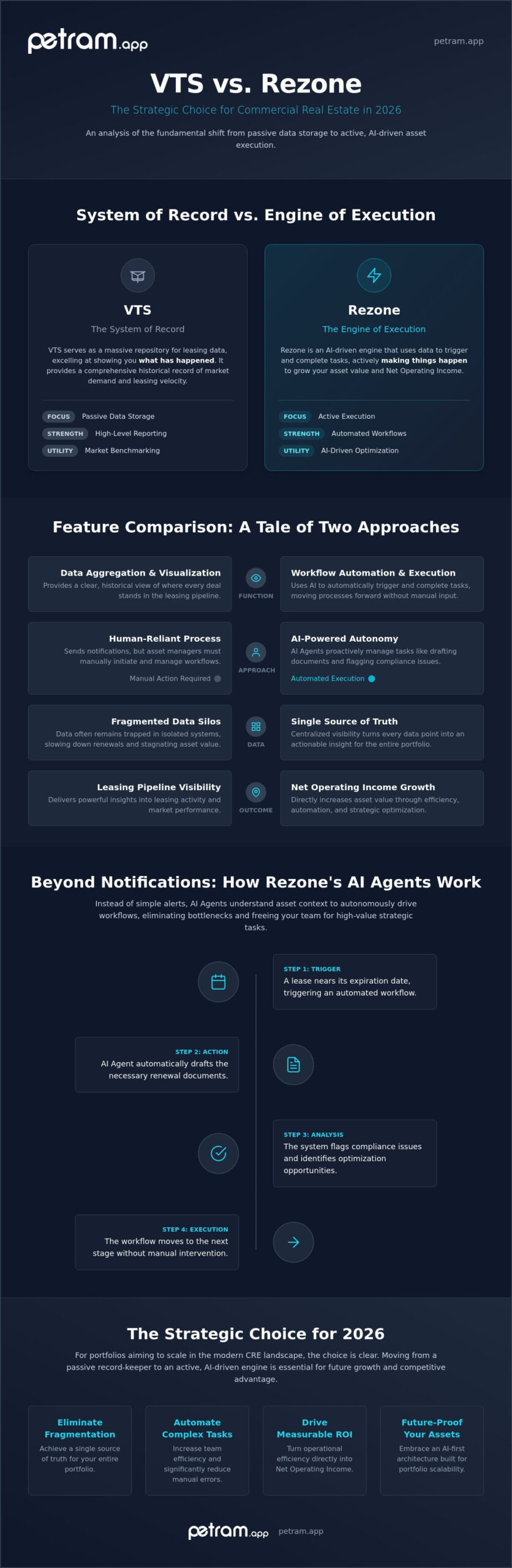
The distinction between VTS vs Rezone centers on a fundamental debate in modern property technology: is your software a passive observer or an active participant? VTS operates as a sophisticated system of record, designed to aggregate and visualize leasing data across vast portfolios. It excels at showing you what has happened. Rezone, by contrast, is built on a workflow-centric philosophy. It doesn’t just store data; it uses that data to trigger and complete management tasks. This shift from passive tracking to active execution is what defines the next generation of asset management.
Passive management tools rely on human intervention to bridge the gap between insight and action. When a lease is nearing its expiration, a traditional platform sends a notification. The asset manager must then manually initiate the renewal process, coordinate with legal teams, and update the rent roll. Rezone’s AI-first architecture changes this dynamic. Instead of simple notifications, the platform utilizes AI Agents that understand the context of the asset. These agents can draft documents, flag compliance issues, and move the workflow forward without waiting for a human to click a button. This level of automation is essential for maintaining portfolio scalability without exponentially increasing headcount.
VTS: Data Visualization and Leasing Insights
VTS is the gold standard for understanding leasing pipeline velocity. It provides landlords with a clear view of where every deal stands, from initial inquiry to executed lease. The platform’s strength lies in its massive global data sets, which allow for high-level market benchmarking. You can see how your assets perform against regional averages, which is invaluable for high-level reporting. However, the limitation arises when the data is collected. VTS shows you the “what,” but it often stops short of the “how.” The burden of the next step remains with your team, creating a bottleneck that can slow down renewals and impact your bottom line.
Rezone: The AI-Driven Vertical SaaS Advantage
Being an AI-first platform in 2026 means that intelligence is baked into the core architecture, not just added as a plugin. Rezone is a specialized vertical SaaS designed specifically for the commercial sector. Its AI Agents are programmed with the logic of asset management, allowing them to execute complex workflows independently. This focus on digital operational efficiency is a direct path to increasing Net Operating Income (NOI). By reducing the time spent on administrative maintenance, you can focus on strategic growth and asset optimization. To see how this technology integrates into a modern management strategy, you can explore the capabilities of AI-driven property management.
Software architecture ultimately dictates how fast you can grow. A system that requires manual updates for every tenant interaction will eventually hit a ceiling. Rezone’s automated environment ensures that as your portfolio expands, your operational overhead doesn’t follow the same steep trajectory. It’s about replacing the stress of complex management with the calm of automated efficiency, ensuring your assets are always performing at their peak potential. This drive for efficiency is universal; for instance, residential owners often reach peak potential by partnering with professional services like Home Showings Property Management.
Comparing Key Capabilities: Asset Management vs. Automated Workflows
Functional superiority in 2026 is measured by the distance between data collection and profitable action. When evaluating VTS vs Rezone at a capability level, the primary distinction lies in the transition from observation to operation. VTS provides a sophisticated lens through which you can view your portfolio. It offers static dashboards that are aesthetically pleasing and useful for high-level reporting. Rezone, however, replaces these static views with dynamic AI-generated insights. These insights don’t just highlight a problem; they provide the digital infrastructure to solve it immediately.
Complexity shouldn’t mean chaos. As your commercial portfolio grows, the manual burden of tracking financial data and asset performance can become overwhelming. A platform must scale with this complexity by automating the underlying processes. Rezone integrates financial data directly into its workflow engine, allowing for real-time tracking of performance metrics against your strategic goals. This ensures that every stakeholder has a single source of truth that is always current and actionable.
Lease and Tenant Management
VTS is built for the leasing lifecycle. Its workflow is highly effective at tracking a lead from the initial inquiry through to the signed deal. It is a robust tool for brokers and landlords who prioritize pipeline velocity. Rezone takes a different approach by focusing on the entire tenant lifecycle with a heavy emphasis on retention. Its automated lease renewals use AI to predict tenant churn and execute retention strategies months before a lease expires. This proactive communication, managed through integrated portals, ensures that your vacancy risk remains low without requiring constant manual oversight. For owners who want to deepen this engagement, looking at how apps like Truemeet turn digital connections into real-world group activities provides a blueprint for building the vibrant communities that modern tenants demand.
Asset Performance and NOI Optimization
Profitability depends on precise margin control. While both platforms help you identify underperforming assets, Rezone actively works to improve them. Its AI-driven expense tracking identifies cost-saving opportunities that might be missed by human auditors. For a portfolio operating in the Polish market, managing operational costs in złoty requires this level of granular, automated oversight. Rezone’s specific tools for increasing property value focus on digital workflow optimization, stripping out the administrative inefficiencies that erode Net Operating Income. By automating routine tasks, the platform ensures that your team stays focused on high-value asset strategy rather than data entry. This is the definitive advantage of a vertical SaaS designed for the modern commercial owner.
Operational Impact: Reporting, Compliance, and Tenant Retention
The ultimate winner in the VTS vs Rezone debate is decided by the tangible impact on your balance sheet. Asset managers today prioritize five critical operational metrics: lease cycle velocity, tenant retention rates, operational expense (OpEx) ratios, weighted average lease expiry (WALE), and overall growth in Net Operating Income (NOI). While VTS provides the data to track these indicators, Rezone provides the automation to improve them. This shift from reporting to active optimization is what drives long-term ROI in a competitive market like Poland.
Compliance often acts as a significant hurdle for international platforms. Managing commercial assets in Poland requires adherence to specific regional regulatory standards, including local tax reporting and data privacy laws. Rezone’s vertical SaaS architecture is designed with these industry-specific requirements in mind. It ensures that your digital infrastructure remains compliant without requiring manual audits. This reduces the “human cost” of management. Instead of spending weeks training staff on complex legacy systems, your team can leverage AI-driven onboarding to become productive in days. You can automate your operational compliance and reporting today to see how this translates into headcount efficiency.
Automated Reporting and Stakeholder Transparency
The era of the monthly PDF report is over. Owners and stakeholders now expect real-time access to asset performance. VTS addresses this through its global portfolio reporting, which is excellent for high-level benchmarking across different territories. Rezone takes transparency a step further by deploying AI Agents that generate executive summaries automatically. These agents synthesize complex financial data into actionable insights, allowing owners to understand their portfolio’s health in seconds. It’s the difference between looking at a spreadsheet and receiving a strategic briefing.
Compliance and Security in 2026
Security is no longer just an IT concern; it’s a core asset management responsibility. Modern cloud-native platforms offer significant security advantages over older, patched systems. Rezone ensures that tenant data and financial records are protected by the latest encryption standards, which is vital for maintaining trust and avoiding the heavy fines associated with data breaches. By integrating compliance logic directly into the workflow, the platform prevents the small administrative errors that often lead to larger legal complications. This proactive stance on security and regulation is essential for any firm looking to professionalize its operations through modern technology. The long-term ROI of this approach is clear: fewer errors, lower overhead, and a significant increase in the terminal value of your assets.
Making the Switch: Why Rezone is the Strategic Choice for 2026
The perception of the “safe choice” in enterprise software is often a lagging indicator of actual market value. In the current VTS vs Rezone debate, sticking with the incumbent platform might feel secure, but it introduces a significant opportunity cost. As AI-driven execution becomes the industry standard, relying on a system that primarily functions as a database puts your portfolio at a competitive disadvantage. Choosing a legacy path in 2026 is a risky strategy for any firm that prioritizes aggressive growth and operational scaling.
Migration from legacy systems is no longer the multi-year ordeal it once was. Rezone’s vertical SaaS architecture is built for rapid integration, allowing for the seamless transition of complex data sets from traditional platforms. The process focuses on data integrity and immediate workflow activation, ensuring that your team doesn’t lose momentum during the switch. By embracing a specialized environment designed for the Polish commercial sector, you move from a generalist tool to a surgical instrument for asset value creation.
The ROI of AI-Driven Management
Profitability is a direct result of time recovered. Automating lease renewals and reporting doesn’t just reduce stress; it fundamentally changes your OpEx profile. When AI Agents handle the administrative burden, your asset managers can focus on the high-level negotiations that drive terminal value. Rezone helps owners professionalize their operations by ensuring that every asset is managed with the same level of digital precision, regardless of portfolio size. You can see how Rezone’s AI Agents can transform your portfolio and start quantifying the impact on your Net Operating Income today.
Future-Proofing Your Portfolio
The roadmap for CRE technology extends far beyond 2026. We are moving toward a future where asset tokenization and autonomous financial reconciliation will be the norm. Rezone’s modern, cloud-native architecture is better suited for these upcoming integrations than the patched legacy frameworks of older competitors. It provides a scalable foundation that adapts as the market evolves. If your goal is simple maintenance of the status quo, the established record-keeping of VTS might suffice. However, if your strategy is built on modernization and maximizing the exit value of your holdings, Rezone is the only logical partner. The time to transition is now, before the gap between the innovators and the laggards becomes insurmountable.
Securing Your Portfolio’s Competitive Edge in 2026
The decision between VTS vs Rezone ultimately dictates whether your team functions as data entry clerks or strategic asset optimizers. Legacy platforms provide a valuable historical record. However, they often fail to bridge the operational gap between insight and execution. Rezone’s vertical SaaS architecture and specialized AI Agents deliver a level of clarity and control that traditional systems simply can’t match. By centralizing visibility and leveraging AI-driven workflow optimization, you replace administrative stress with automated efficiency. This modernization is the most direct path to increasing Net Operating Income and maximizing the terminal value of your commercial holdings in Poland. Our authoritative expert support ensures a seamless transition to a digital infrastructure built for the future of the industry. It’s time to stop maintaining the status quo and start scaling your operations with precision.
Request a Rezone Demo to Automate Your Portfolio
Embrace the future of commercial real estate management and watch your asset value reach its peak potential with confidence.
Frequently Asked Questions
Is Rezone a better alternative to VTS for commercial landlords?
Rezone is a superior alternative for landlords who prioritize operational speed and automated execution over simple record-keeping. While the definitive choice of VTS vs Rezone depends on your specific portfolio goals, Rezone’s focus on AI Agents allows you to move beyond data visualization into active asset optimization. It’s built to handle the complex workflows that legacy systems still require humans to manage manually.
Does VTS offer AI agents for property management?
VTS provides AI-driven analytics tools, such as its Asset Intelligence feature, but it doesn’t currently offer autonomous AI Agents that execute management tasks. These analytical tools are designed to help teams gain visibility into building data. Rezone differs by deploying agents that actually complete workflows, such as drafting documents or managing renewals, rather than just reporting on them.
How does Rezone help increase Net Operating Income (NOI)?
Rezone increases NOI by stripping out the administrative inefficiencies that erode your bottom line. It uses AI to identify cost-saving opportunities in your operational expenses and executes proactive retention strategies to keep your occupancy rates high. By automating routine tasks, the platform reduces your overhead while simultaneously protecting your revenue streams.
Can I migrate my data from VTS to Rezone easily?
Data migration from VTS to Rezone is a streamlined process managed by our technical experts to ensure zero data loss. We map your historical leasing data and financial records directly into our AI-driven environment. This allows your portfolio to benefit from automated workflows and real-time insights immediately after the transition is complete.
What is the difference between general property software and vertical SaaS like Rezone?
General property software tries to serve every asset type, which often results in a shallow feature set that lacks commercial depth. A vertical SaaS like Rezone is engineered specifically for the commercial real estate sector. It integrates industry-specific logic, financial performance tracking, and regulatory standards directly into its core architecture for a more professional management experience.
How do AI Agents in Rezone handle tenant communication?
AI Agents in Rezone handle tenant communication by monitoring lease milestones and drafting necessary documentation automatically. They use context-aware logic to ensure that your tenants receive professional, timely updates regarding renewals or building operations. This ensures a high level of tenant satisfaction without requiring your management team to oversee every interaction.
Is VTS primarily for brokers or property owners?
VTS was originally designed as a leasing and asset management platform for brokers and large-scale landlords to track pipeline velocity. While it has expanded its suite for owners, its core architecture remains heavily weighted toward the brokerage and leasing side of the industry. It excels at showing you where deals stand rather than managing the operational lifecycle of the asset.
Which platform is better for managing retail and industrial real estate portfolios?
Rezone is the strategic choice for retail and industrial portfolios because these assets require high operational precision and margin control. The platform’s ability to manage complex service charges in złoty and automate maintenance workflows ensures that your margins remain protected. Its specialized focus on commercial assets makes it more effective than generalist platforms for these specific asset classes.