

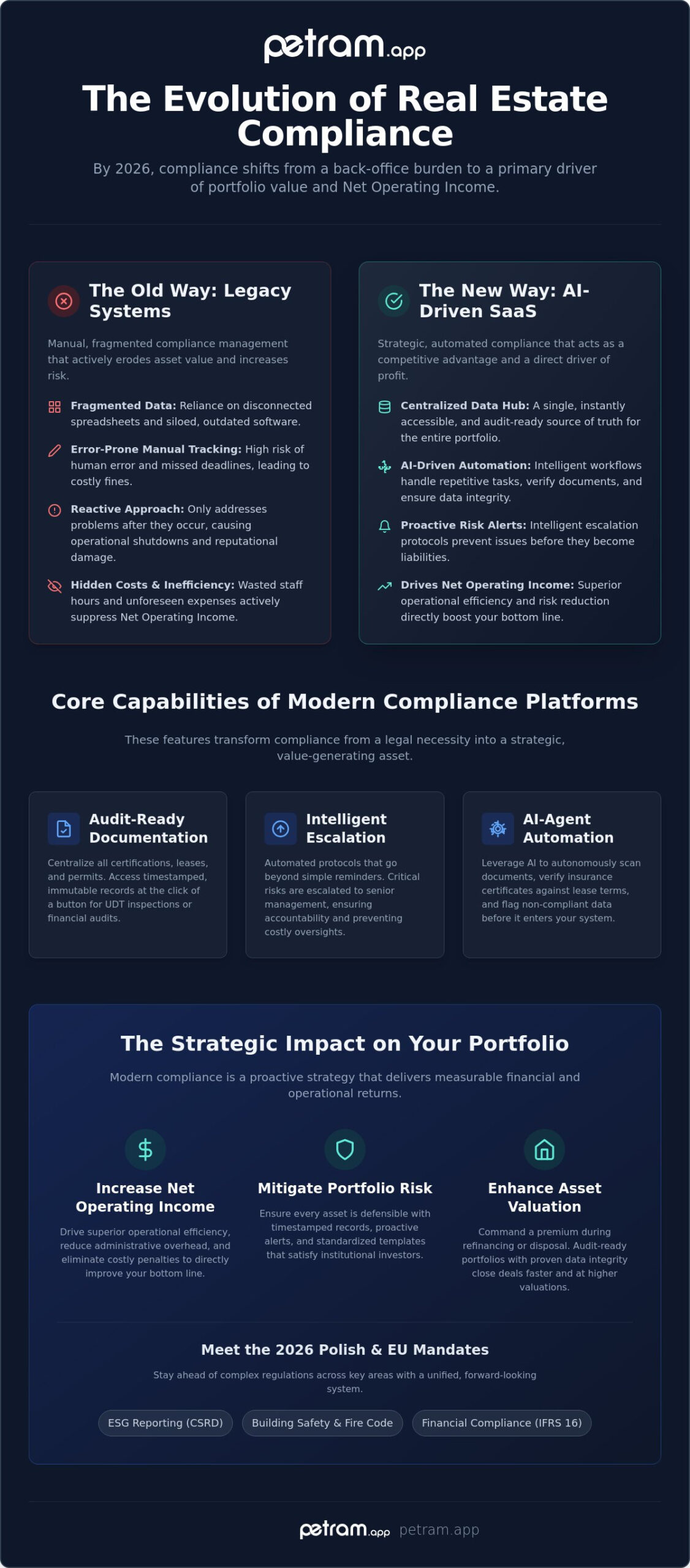
By 2026, regulatory compliance has ceased to be a back-office burden and has instead become a primary engine for driving Net Operating Income. If you’re still managing safety certifications and ESG reporting through a patchwork of disconnected spreadsheets, you aren’t just risking a fine; you’re actively eroding your portfolio’s value. The modern Polish market demands more than basic record-keeping. It requires a sophisticated approach where commercial real estate compliance software acts as a strategic partner in your daily operations. This shift from manual tracking to AI-driven execution is the only way to safeguard your margins against rising regulatory costs and complex EU mandates.
We understand the frustration of fragmented data and the persistent fear of a missed deadline costing thousands of złoty in avoidable penalties. It’s a common pain point for professionals striving to maintain control over aging legacy systems. This guide provides a comprehensive framework for selecting and implementing AI-driven automation tools that transform compliance into a competitive advantage. You’ll learn how to achieve audit-ready documentation at the click of a button and use proactive risk alerts to protect your bottom line. We’ll explore the specific strategies needed to modernize your digital infrastructure and ensure your assets remain ahead of the curve.
Key Takeaways
- Understand how audit-readiness has evolved from a legal necessity into a primary driver of property market value in the 2026 Polish landscape.
- Identify the core capabilities of commercial real estate compliance software that allow you to transition from error-prone manual tracking to AI-driven automation.
- Learn to mitigate portfolio risk by standardizing compliance templates and implementing intelligent escalation protocols across multiple asset classes.
- Evaluate the operational advantages of vertical SaaS architectures over legacy ERP systems to reduce hidden costs and improve digital agility.
- Discover how AI Agents can automate complex regulatory workflows to directly increase Net Operating Income through superior operational efficiency.
The Regulatory Landscape: Why Compliance is the New Asset Performance Driver
Compliance has evolved from a defensive checkbox into a high-performance engine for asset valuation. In the current market, “good enough” record-keeping is a liability that actively suppresses Net Operating Income. Real estate professionals in Poland now face a dense thicket of EU-driven mandates and local safety protocols that manual systems simply cannot navigate. Transitioning to a dedicated commercial real estate compliance software isn’t just a technical upgrade; it’s a strategic move to preserve liquidity and market appeal. Risk is quantified. Value is protected. Efficiency is realized.
The era of digital transformation has fundamentally altered Legal and Regulatory Compliance. Today, an asset’s value is inextricably linked to its data integrity. When a portfolio is audit-ready at a moment’s notice, it commands a premium during refinancing or disposal. Conversely, fragmented data across legacy systems creates a “risk fog” that institutional buyers won’t tolerate. Non-compliance costs go far beyond a few thousand złoty in administrative fines. They manifest as reputational damage and a lack of access to favorable credit terms. If your data isn’t defensible, your asset isn’t truly secure.
The 2026 Compliance Standards: ESG, Safety, and Finance
ESG reporting is no longer a peripheral marketing effort. Under the latest CSRD and EU Taxonomy requirements, Polish asset managers must integrate carbon footprint tracking and social impact metrics into their daily workflows. Safety compliance has also tightened. Managing fire safety certifications and building code inspections across a national portfolio requires real-time oversight to prevent operational shutdowns. On the financial front, IFRS 16 has turned lease accounting into a rigorous compliance exercise that demands precision to protect the balance sheet. Automating these workflows ensures that no certification expires unnoticed.
Investor Expectations and Data Transparency
Core Capabilities of Modern CRE Compliance Systems
Modern commercial real estate compliance software transcends simple digital storage. It’s a dynamic ecosystem. Version control ensures you never rely on an outdated lease amendment or an expired safety certificate. Timestamps provide the immutable proof needed during a UDT (Urząd Dozoru Technicznego) inspection or a rigorous financial audit. These aren’t just features; they’re the legal foundations of commercial property management brought into the digital age. By centralizing documentation, you eliminate the risk fog that plagues manual systems.
Intelligent escalation protocols are the ultimate safeguard against human error. If a fire safety certificate isn’t uploaded within 48 hours of the deadline, the system doesn’t just send another email. It triggers an escalation to the regional director. This ensures that critical risks are visible before they become liabilities. Connecting lease terms directly to operational tasks means that a “right to inspect” clause in a contract automatically generates a site visit schedule for the facility manager. You gain portfolio-wide visibility through advanced data visualization that highlights risks before they impact your bottom line.
From Notifications to Autonomous Execution
Traditional systems are passive. AI-driven workflows are active. For instance, AI Agents can now autonomously scan incoming Certificates of Insurance (COIs). They verify coverage limits against the specific requirements of a Polish retail lease. If the document is insufficient, the system contacts the tenant directly. This level of autonomy allows your team to focus on high-value asset strategy rather than chasing paperwork.
Integration Ecosystems: API-First Architecture
An API-first architecture is non-negotiable for scaling portfolios. Your compliance data shouldn’t live in a silo. It must sync with accounting and facility management tools to create a single source of truth. Implementing a robust commercial real estate compliance software solution ensures that every stakeholder has the data they need. This is why many firms are moving toward vertical SaaS solutions designed for CRE rather than generic tools.
Evaluating Software: Legacy ERPs vs. AI-Driven Vertical SaaS
Selecting the right commercial real estate compliance software requires a clear-eyed assessment of long-term value versus initial familiarity. Many firms remain tethered to legacy Enterprise Resource Planning (ERP) systems, seduced by the promise of an “all-in-one” solution. These monolithic platforms often hide significant costs. You’ll encounter high implementation fees, specialized consulting requirements, and a persistent need for manual data entry to bridge functional gaps. In the Polish market, where agility is paramount, these rigid systems often become bottlenecks rather than enablers. They demand thousands of złoty in customization just to handle basic local reporting requirements.
Vertical SaaS offers a superior alternative for those seeking modern commercial real estate compliance software. It’s built specifically for the nuances of commercial assets. Unlike generic ERPs, vertical solutions provide the flexibility to adapt to shifting EU regulations without requiring months of custom coding. Total Cost of Ownership (TCO) is lower because maintenance and updates are handled by the provider. You aren’t just buying software; you’re investing in a platform that evolves with the industry. Speed to value is essential for maintaining operational momentum during a software transition.
User experience (UX) is often overlooked, but it’s a primary driver of data accuracy. If the interface is intuitive, team adoption rates soar. High adoption leads to cleaner data and more reliable reporting. When a system is difficult to navigate, employees find workarounds; this inevitably leads to fragmented records and missed obligations. A modern UX ensures that every team member, from facility managers to C-suite executives, can access and update compliance data with minimal friction.
The Rise of AI Agents in Compliance
Administrative burdens are the silent killers of asset performance. AI Agents can reduce time spent on routine compliance tasks by up to 80%, allowing teams to focus on strategic asset growth. These agents don’t just wait for a deadline; they engage in predictive compliance. They identify potential risks, such as a localized safety certification lapse, before they escalate into legal violations. Evaluating the “intelligence” of your property management stack is now a core requirement for any forward-thinking asset manager.
Security and Data Governance in the Cloud
Security is a non-negotiable pillar of digital infrastructure. Modern cloud-based systems prioritize SOC2 compliance and advanced encryption to safeguard sensitive portfolio data. Role-based access control (RBAC) ensures that team members only see what they need to, protecting data integrity in multi-tenant environments. For those managing tokenized assets, Prime Asset Recovery offers specialized support in the forensic investigation and recovery of digital assets should security be breached. For portfolios spanning across Poland and beyond, data sovereignty is critical. You must ensure your provider understands the legalities of where data is stored and how it is accessed to maintain full regulatory alignment.
Best Practices for Mitigating Portfolio Risk through Automation
Automation success depends on the quality of the foundation. Before migrating to a dedicated commercial real estate compliance software, you must conduct a rigorous audit of your existing records. Digitizing a broken process only accelerates failure. By identifying missing certifications and expired insurance policies during the pre-migration phase, you prevent legacy errors from polluting your new digital infrastructure. This baseline allows you to set clear benchmarks for operational improvement and risk reduction across your entire portfolio of assets.
Standardizing compliance templates is the next critical step for portfolio scalability. Whether you manage diverse commercial properties, from urban retail centers to sprawling industrial parks, your safety and financial reporting protocols must remain consistent. This uniformity allows your team to move between assets without learning new sets of rules. It also provides a cleaner data set for AI Agents to analyze. In this automated environment, the “Trust but Verify” model is essential. While the software handles the repetitive verification of thousands of data points, your senior asset managers remain the final authority on complex legal interpretations.
Phased Implementation Strategies
Attempting a total system overhaul overnight is a recipe for operational friction. Start with high-risk areas where the cost of failure is highest, such as insurance tracking and fire safety certifications. Once these workflows are stabilized, expand the scope to include environmental compliance and complex lease obligations. Success should be measured through specific KPIs, such as a percentage reduction in administrative hours or the elimination of late-filing penalties. To see how these strategies work in practice, explore the Rezone platform for automated CRE management.
Maintaining Audit-Ready Documentation
Audit-readiness is a state of constant preparation. Modern systems automate the creation of defensible activity trails, capturing every interaction, document upload, and approval in an immutable log. This level of transparency is vital during regulatory inspections or due diligence phases. To generate an audit report in 2026, simply select the desired reporting period and asset class within the dashboard to trigger an automated aggregation of timestamped digital certificates and maintenance logs. This one-click reporting capability transforms a process that once took weeks into a task that takes seconds.
Rezone: Elevating Compliance into a Competitive Advantage
Rezone by Petram.app represents a fundamental shift in how assets are managed. It isn’t just another layer of commercial real estate compliance software; it’s a vertical SaaS architecture designed to replace the fragility of manual spreadsheets with the precision of AI Agents. These agents don’t just alert you to problems. They execute workflows autonomously. By delegating routine verification and documentation to intelligent systems, you transition from reactive management to proactive asset optimization. This shift is essential for any firm serious about scaling in the competitive Polish market.
Future-proofing your portfolio requires more than basic digital storage. It demands a system that understands the nuances of commercial assets and the specific pressures of the 2026 regulatory environment. Rezone provides the digital infrastructure needed to turn compliance from a cost center into a value driver. When your data is clean, your records are defensible, and your workflows are automated, you eliminate the operational drag that limits growth. You aren’t just maintaining the status quo; you’re building a foundation for sustainable asset performance.
The Rezone Advantage: Precision and Performance
Performance is measured in more than just avoided fines. Rezone focuses on workflow optimization that directly impacts your Net Operating Income (NOI). When your team isn’t bogged down by administrative minutiae, they focus on high-level leasing strategies and tenant retention. Real-time reporting builds immediate confidence with institutional lenders and investors, proving that every square meter of your portfolio is managed with absolute transparency. Many commercial owners have already seen a dramatic reduction in manual compliance hours, allowing them to redeploy talent to revenue-generating activities.
Getting Started with Petram.app
Modernizing a large-scale commercial portfolio doesn’t have to be a disruptive event. Petram.app provides a seamless onboarding process that integrates your existing data into the Rezone ecosystem with minimal friction. You can begin accessing the power of AI Agents today to future-proof your assets against the evolving regulatory demands of 2026 and beyond. It’s time to move past legacy limitations and embrace a platform built for the future of the industry. Modernise your portfolio compliance with Rezone and secure your asset’s performance for the long term.
Mastering the New Era of Asset Performance
The shift toward automated compliance isn’t just about avoiding penalties; it’s about building a more resilient, valuable portfolio. We’ve seen how modern commercial real estate compliance software bridges the gap between legal obligations and operational excellence. By implementing vertical SaaS built for CRE, you replace the risks of manual entry with a single source of truth. This digital maturity is what separates market leaders from those struggling with legacy inefficiencies in the competitive Polish market.
You deserve a system that works as hard as your assets do. With AI Agents for autonomous execution and audit-ready reporting in seconds, you can finally reclaim your time for strategic decision-making. Don’t let fragmented data hold back your portfolio’s potential in the evolving 2026 landscape. Transform your compliance into a value driver with Rezone by Petram.app. You have the framework; now it’s time to execute with the precision your investors demand. Your journey toward a more efficient, high-performing portfolio starts with a single strategic choice.
Frequently Asked Questions
What is commercial real estate compliance software?
Commercial real estate compliance software is a specialized digital platform designed to centralize and automate the management of legal, safety, and financial obligations. It replaces fragmented spreadsheets with a single source of truth for lease terms, safety certifications, and insurance records. By maintaining defensible, timestamped records, these systems protect asset managers from regulatory penalties and ensure that all properties remain audit-ready for investors and lenders at any moment.
How does AI improve compliance management in property portfolios?
AI improves management by shifting the process from manual tracking to autonomous execution. Intelligent agents can now scan incoming documents, such as Certificates of Insurance, to verify coverage limits against specific lease requirements without human intervention. This technology identifies potential risks and predictive patterns before they escalate into violations. It transforms compliance into a proactive strategy that actively safeguards your portfolio’s operational integrity and reduces human error.
Can compliance software help increase my property’s value?
Yes, implementing commercial real estate compliance software directly increases asset value by optimizing Net Operating Income (NOI). Efficiency gains from automation reduce administrative overhead, while audit-ready documentation minimizes the “risk fog” during property exits or refinancing. Institutional buyers often pay a premium for assets with transparent, digital histories. Clean data reduces due diligence timelines and allows you to secure more favorable credit terms from Polish financial institutions.
What are the most important features to look for in CRE compliance tools?
The most critical features include centralized document management with version control, automated deadline alerts, and intelligent escalation protocols. You should also prioritize an API-first architecture that allows the system to sync seamlessly with your existing accounting and facility management tools. Look for platforms that offer advanced data visualization to provide portfolio-wide visibility. These features ensure that no safety certification or lease obligation expires unnoticed, protecting your bottom line.
Is vertical SaaS better than a traditional ERP for property management?
Vertical SaaS is generally superior for modern property management because it offers greater agility and a lower Total Cost of Ownership (TCO). Traditional ERPs are often rigid, monolithic systems that require expensive custom coding to handle specific Polish regulatory changes. Vertical solutions are built specifically for commercial assets, providing faster implementation and intuitive user experiences. This focus leads to higher team adoption rates and much cleaner data compared to complex, legacy ecosystems.
How much time can I save by automating compliance workflows?
Industry data suggests that AI Agents can reduce the time spent on routine administrative compliance tasks by up to 80%. This massive reduction in manual labor allows your team to stop chasing paperwork and start focusing on high-value asset strategy. Instead of spending days aggregating maintenance logs for an inspection, you can generate comprehensive, audit-ready reports in seconds. Automating these workflows eliminates the operational drag that typically limits portfolio scalability.
Does compliance software support ESG reporting?
Modern platforms are specifically designed to integrate ESG (Environmental, Social, and Governance) tracking into daily operations. They automate the collection of data required for EU Taxonomy and CSRD reporting, which is increasingly vital for the Polish market. By tracking carbon footprints and building efficiency metrics in real-time, the software ensures your portfolio meets the evolving expectations of institutional investors. This integration turns mandatory reporting into a clear demonstration of long-term asset resilience.
Is my data secure in a cloud-based compliance platform?
Professional cloud-based platforms utilize advanced encryption and SOC2 compliance to ensure your portfolio data remains protected. Role-based access control (RBAC) allows you to define exactly who can see or edit sensitive information, maintaining data integrity in multi-tenant environments. These systems also prioritize data sovereignty, ensuring that your records are stored and accessed in alignment with national and EU regulations. You gain the flexibility of cloud access without compromising the security of your digital infrastructure.