

What should CRE software actually help an asset manager manage and decide? The answer isn’t a longer feature list. CRE software for asset managers should connect asset-level activity with portfolio priorities, so decisions can translate into coordinated operational work. When information and workflows are spread across teams or systems, it can be difficult to see whether a platform fits the work that matters, beyond what its claims promise.
That makes evaluation less about buying the most functions and more about finding the right operational fit. You need clear portfolio oversight, useful decision support, and workflows that can scale with your organization, while keeping day-to-day execution connected to asset-level goals.
This guide provides a practical framework for comparing platforms around those priorities. We’ll examine capabilities that map to real asset-management workflows, ways to assess execution and scalability, and how vertical CRE software can support a more coordinated operating environment. We’ll also introduce Rezone, a commercial real estate platform combining property-management tools with AI agents, as an example of vertical SaaS designed specifically for the sector.
Key Takeaways
- Define the scope of asset management first, distinguishing portfolio oversight and decision-making from property operations and other real estate functions.
- Map software capabilities to the workflows your team needs to support, from managing asset information to analysis and reporting.
- Evaluate CRE software for asset managers by workflow fit, portfolio visibility, usability, and adaptability, not by feature count alone.
- Compare vertical CRE platforms and specialist tools according to the role each is meant to play in your technology environment.
- Use a structured evaluation process, beginning with workflow inventory and success measures before testing platforms against real scenarios.
What CRE Software for Asset Managers Should Help You Control
CRE software for asset managers is a digital layer that organizes commercial property information, supports asset and portfolio oversight, and coordinates workflows used to make and act on management decisions. Its purpose is to help teams connect operating activity with priorities, not to replace professional judgment or guarantee stronger asset value.
Define the scope before comparing products. Asset-management software can support performance monitoring, planning, and coordination, but it isn’t automatically a property-operations system, debt-analysis tool, brokerage service, or source of investment advice. These activities may inform asset decisions, yet they involve distinct responsibilities and, in some cases, specialized tools or professional expertise. Write down which decisions and workflows the platform needs to support, and which sit elsewhere.
Commercial real estate covers a range of property types and uses, as outlined in this Commercial Property Overview. For asset managers, the practical question is how information about an individual property can guide priorities across the wider portfolio. A system can make relevant data easier to organize and review; the management decisions, and their effect on performance, remain with the people responsible.
How asset management differs from property management
Asset management focuses on performance, priorities, and value across one or more properties. Property management centers on the operational work that supports buildings and occupiers, including coordinating day-to-day processes. The roles overlap when strategy becomes execution: an asset objective may need to be translated into operating tasks, assigned, tracked, and reviewed. When assessing software, check whether the handoff is visible and whether responsibility for each decision and action remains clear.
Why asset managers assess software at both asset and portfolio level
At asset level, a manager might review an individual property’s operating activity against its objectives and decide where attention is needed. At portfolio level, the manager may compare assets to prioritize reviews or resources. For example, a portfolio view can help identify which properties need a closer review, while the asset record provides context for that follow-up. The relevant measures depend on the organization and its strategy; there is no single portfolio structure or set of priorities that suits every owner.
Comparisons become harder when teams record information differently or rely on separate systems and documents. A consistent view can help reveal missing data, highlight where performance needs further investigation, and show which issues warrant attention across the portfolio. It doesn’t make assets directly comparable when their circumstances differ, but it can give teams a clearer basis for asking the right questions. During evaluation, test whether users can trace a portfolio-level question back to the information available for a specific property.
Which CRE Software Capabilities Support Asset-Management Workflows?
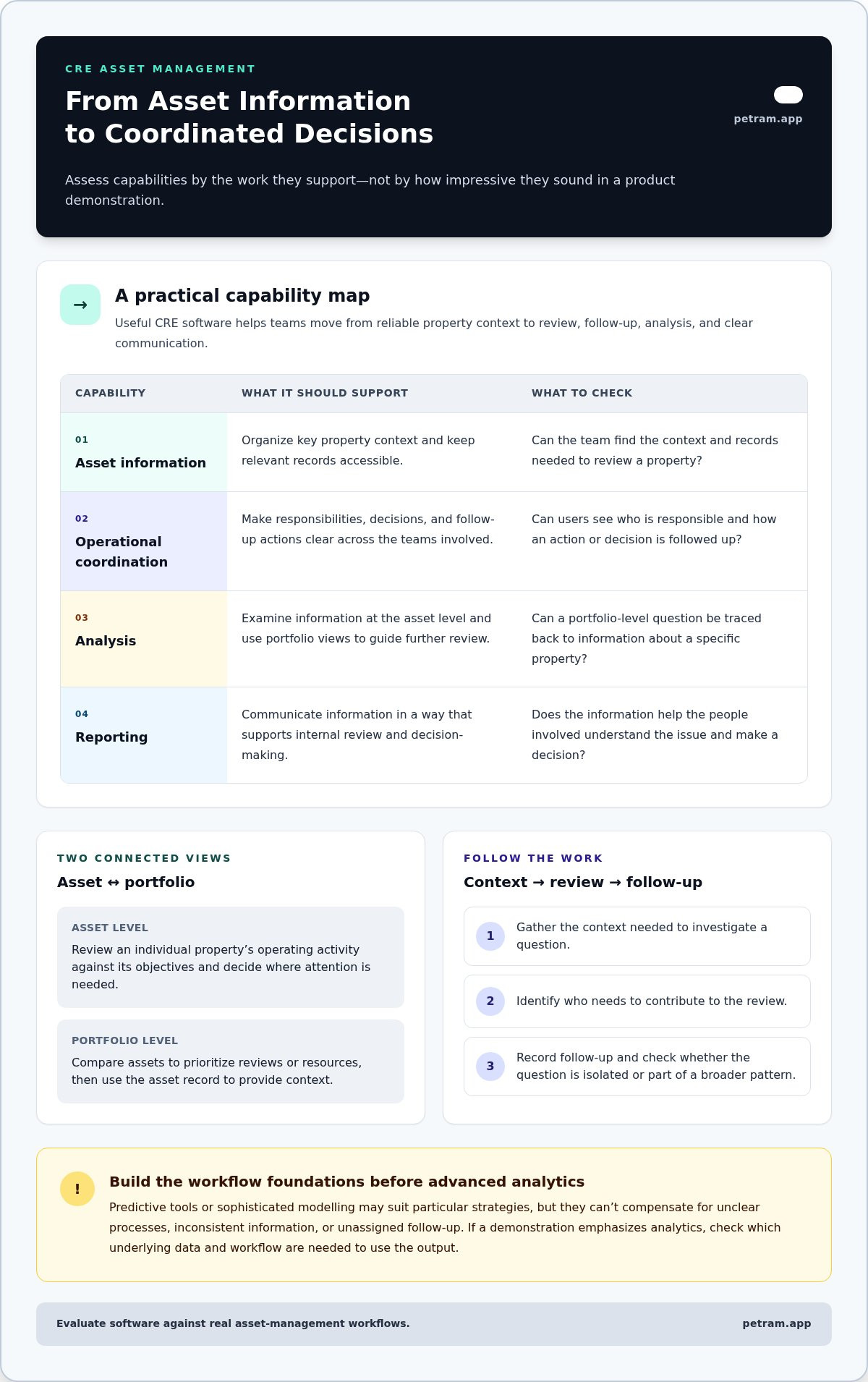
Evaluate capabilities by the work they support, not by how impressive they sound in a product demonstration. For CRE software for asset managers, a useful capability map follows the path from reliable asset information to coordinated action, analysis, and clear communication. Shared information gives teams consistent context for reviewing an asset, recording decisions, and following up, provided people maintain accurate records and understand who is responsible.
Map software capabilities to the asset manager’s decisions
Start with decisions your team makes, then identify the information and workflow needed to support each one. For example, if a property review raises a question about operating activity, list the context needed to investigate it, the people who need to contribute, and how follow-up should be recorded. A portfolio view can help determine whether the question is isolated or part of a broader pattern. The software should make it practical to move from context to review and follow-up, without assuming every portfolio needs identical data or reporting.
Use this adaptable checklist to assess the fundamentals:
- Asset information: Can the team organize key property context and keep relevant records accessible?
- Operational coordination: Can responsibilities, decisions, and follow-up actions be made clear across the teams involved?
- Analysis: Can managers examine information at the asset level and use portfolio-level views to guide further review?
- Reporting: Can the information be communicated in a way that supports internal review and decision-making?
These workflow foundations come before advanced analytics. Predictive tools or sophisticated modelling may suit particular strategies, but they can’t compensate for unclear processes, inconsistent information, or unassigned follow-up. If a demonstration emphasizes analytics, ask which underlying data and workflow are needed to use the output.
Assess AI agents as workflow support, not a standalone strategy
AI agents may assist with structured tasks within CRE workflows, but their value depends on how the task is defined and reviewed. During evaluation, examine what information an agent uses, how its output can be checked, where human approval is required, and which actions remain outside its remit. This helps teams distinguish workflow assistance from independent investment decision-making.
Set boundaries before introducing AI: specify the task, identify the accountable reviewer, and decide how exceptions or uncertain results are handled. Keep final asset decisions with the designated people. Rezone is a commercial real estate vertical SaaS platform that combines property-management tools with AI agents. Explore Rezone’s commercial real estate platform as you assess how its tools fit your CRE workflows.
How to Compare CRE Asset-Management Software Without Chasing Feature Lists
A long feature list doesn’t show whether a platform fits your operating model. Compare CRE software for asset managers against the decisions and workflows your team actually owns, then distinguish core workflow support from specialist capabilities that serve a narrower purpose. This keeps the evaluation focused on practical fit rather than the volume of functions presented in a demonstration.
Vertical CRE SaaS versus specialist analytics and AI tools
Vertical CRE SaaS is designed around commercial real estate workflows, while specialist tools may focus on a particular task, such as analytics or AI-assisted work. These categories can complement each other: a broad platform may support coordinated operating workflows, while a specialist tool addresses a defined analytical need. Neither category is automatically right for every portfolio. Rezone is a vertical SaaS platform built for commercial real estate, combining property-management tools with AI agents.
A practical scorecard for asset managers
Set the same criteria for every option and rate each against a real use case. A simple scale can help: 0 means the workflow isn’t supported, 1 means it’s partly supported or requires a workaround, and 2 means it’s supported in a way that fits the team’s process. Record evidence and unresolved needs alongside each score.
- Workflow fit: Which defined asset-management tasks does the platform support, and where does work still happen elsewhere?
- Asset and portfolio visibility: Can the relevant users review property-specific context and use portfolio-level information to frame priorities?
- Usability and responsibilities: Can each role understand what information to use, what action to take, and who owns follow-up?
- Adaptability: Can the workflow accommodate your portfolio’s operating model as priorities or responsibilities change?
Also note which capabilities are native to the platform and which depend on another system, a manual step, or a separate specialist tool. For each use case, record the inputs, handoffs, and outputs required. That distinction reveals operational steps a feature list can hide.
Treat vendor claims and customer metrics as evidence to interpret, not universal benchmarks. Ask what workflow was measured, in what context, and whether it resembles your own. A result from a different portfolio or process may be informative, but it doesn’t establish what your team should expect.
Use the scorecard to identify the role each platform would play, not to force every need into one system. To see how a CRE-focused platform fits this evaluation framework, explore Rezone’s commercial real estate software.
How to Evaluate and Introduce CRE Software Across Your Portfolio
A disciplined evaluation starts with operating needs, not a vendor feature list. Before comparing CRE software for asset managers, define who owns each workflow, what information supports decisions, and how your team will recognize a better fit. That foundation makes platform demonstrations and scenario tests more relevant, while helping surface data, adoption, and governance considerations early.
Start with workflows, stakeholders, and decision requirements
Map recurring tasks such as asset reviews, operational follow-up, and portfolio-level prioritization. For each, note the teams involved, where information comes from, and where handoffs or duplicated effort create friction. Turn priorities into questions you can assess consistently: Can the right people access the context they need? Is responsibility for follow-up clear? Can managers review information at the level required for the decision? Use the answers to select a small set of representative scenarios for platform demonstrations.
Plan a controlled evaluation before broader adoption
Use representative scenarios to assess how each platform fits actual work. Include the people who would use or oversee those workflows, and agree on evaluation criteria before testing. Review data quality and ownership, user roles, governance, and change-management needs. For AI-supported tasks, examine how outputs are reviewed, who remains accountable, and where human oversight is required. Treat the evaluation as a way to identify fit and gaps, not as a promise of a particular result.
Where Rezone fits in an asset manager’s software evaluation
Rezone is a vertical SaaS property-management platform built specifically for commercial real estate. It combines property-management tools with AI agents, reflecting a software approach focused on CRE workflows. Asset managers can evaluate Rezone against the criteria established for their teams, including operational fit and how day-to-day workflows connect with portfolio priorities. Assess its role against those needs rather than assuming any platform replaces every system or decision process.
Choose the next step based on your portfolio priorities
Prioritize criteria according to the challenge you’re addressing. If teams struggle with handoffs, focus on workflow ownership and coordination. If asset context is difficult to compare, emphasize consistent information and portfolio visibility. If AI is under consideration, make task boundaries, oversight, and accountability central to testing.
With workflows, responsibilities, and success measures defined, you can assess platforms against realistic scenarios and plan adoption with greater clarity. For a broader view of how software supports commercial property operations, consult the strategic guide to commercial property management software. Explore Rezone as a CRE-focused platform for coordinating digital workflows around your asset-management priorities.
Build a More Coordinated Approach to Asset Management
The right CRE software for asset managers should fit the decisions and workflows your teams are responsible for, not simply offer the longest feature list. Start by defining priorities, ownership, and success measures. Then compare platforms against real scenarios, considering workflow fit, asset and portfolio visibility, usability, and the work that may remain outside the system.
Keep the roles of core platforms and specialist analytics or AI tools clear. They may complement one another, and AI agents are best evaluated as workflow support with defined tasks and human oversight. A disciplined process helps you make a confident choice based on operational needs rather than assumptions about technology alone.
Rezone is a vertical SaaS platform built specifically for commercial real estate, combining property-management tools with AI agents designed to support CRE workflows. Petram.app focuses on software-driven workflow optimization for owners and managers. Explore Rezone for commercial real estate workflows as you consider how a CRE-focused platform could align with your asset-management priorities.
Clear priorities are a strong starting point. With them, you can move toward more coordinated digital workflows with confidence.
Frequently Asked Questions
What is CRE software for asset managers?
CRE software for asset managers is a digital system that organizes commercial property information and supports oversight, decisions, and related workflows. At the asset level, it helps teams review an individual property’s context and activity. At the portfolio level, it can help managers compare assets and set priorities. It complements rather than replaces property operations, which focus on building processes and occupier needs.
How is asset-management software different from property-management software?
Asset-management software supports strategic oversight of performance, priorities, and value across properties. Property-management software focuses on building operations, including the workflows that support properties and occupiers. The roles intersect when asset objectives need to be translated into operational activity, assigned to responsible teams, and reviewed. A platform may support both kinds of workflows, but evaluation should make clear which responsibilities it helps coordinate and which remain with people or other systems.
Which features should asset managers look for in CRE software?
Start with the workflows and decisions your team needs to support, rather than a universal feature checklist. Assess whether the system can maintain shared asset context, provide useful views at property and portfolio levels, and support the reporting your stakeholders require. Consider usability, responsibility for follow-up, data quality, and governance too. The right capabilities depend on your portfolio, operating model, and the work the platform is expected to support.
Can CRE software help asset managers improve portfolio performance?
CRE software can support portfolio decisions by making relevant information easier to organize, review, and connect to operational follow-up. For example, a manager may use consistent asset context to identify questions for further review or prioritize attention across properties. Software doesn’t determine the right action on its own, and improved financial performance isn’t guaranteed. Results depend on data quality, management judgment, operating decisions, and the circumstances affecting each asset.
How do you compare CRE software platforms for asset managers?
Compare platforms against consistent use cases drawn from your team’s actual responsibilities. Involve stakeholders who manage, review, or act on the workflows, then assess operational fit, asset and portfolio visibility, usability, and adaptability. Record which tasks the platform supports directly and where work requires another system or manual handoff. Feature counts alone can obscure these differences. Scenario-based evaluation offers a more useful comparison than treating every listed capability as equally important.
How much does CRE software for asset managers cost?
CRE software costs depend on the subscription terms, scope, and requirements involved, so there isn’t one price that applies to every asset manager. Rezone is provided through recurring subscription fees, and the relevant cost depends on the selected arrangement. For a meaningful budget assessment, define the workflows and users in scope, identify any separate tools your process requires, and compare the overall subscription commitments rather than relying on a generic market range.
Is AI useful in CRE asset-management software?
AI can be useful when it supports a clearly defined CRE workflow, such as assisting with structured tasks or organizing information for review. Its role should be assessed in context: understand what the task involves, how outputs are checked, and where the system’s responsibility ends. AI assistance isn’t the same as investment judgment or decision authority. Keep people accountable for reviewing outputs and making asset-management decisions.