

The era of the Excel-driven asset manager is officially over. You’ve likely felt the mounting pressure of reconciling complex CAM charges and correcting manual data entry errors that threaten the integrity of your financial reporting. It’s a common struggle. Most professionals recognize that relying on fragmented spreadsheets for long-term CapEx planning is no longer a viable strategy for maintaining a competitive edge. This guide provides the roadmap to master commercial real estate budgeting and forecasting by transitioning from static, historical reporting to AI-driven predictive modeling.
You’ll discover how to leverage vertical SaaS to maximize your portfolio’s Net Operating Income through automated efficiency and real-time data clarity. We’ll examine the shift toward digital infrastructure that enables automated budget-to-actual reporting and provides the predictive tools necessary to navigate market fluctuations. By the end of this strategic guide, you’ll have the framework to replace management stress with the calm of high-tech optimization. It’s time to evolve beyond the status quo and embrace the future of asset performance.
Key Takeaways
- Shift from reactive reporting to proactive simulation by replacing error-prone spreadsheets with high-tech automation.
- Use AI Agents to reduce weeks of manual CAM reconciliation into minutes while increasing the accuracy of your financial models.
- Modernize your commercial real estate budgeting and forecasting to achieve real-time NOI visibility across your entire portfolio.
- Evaluate your tech stack to ensure your digital infrastructure supports the scalability required for sophisticated asset management.
- Centralize lease and operational data to create a resilient workflow that anticipates market fluctuations and maximizes asset value.
The Precision Gap: Why Traditional CRE Budgeting Fails in 2026
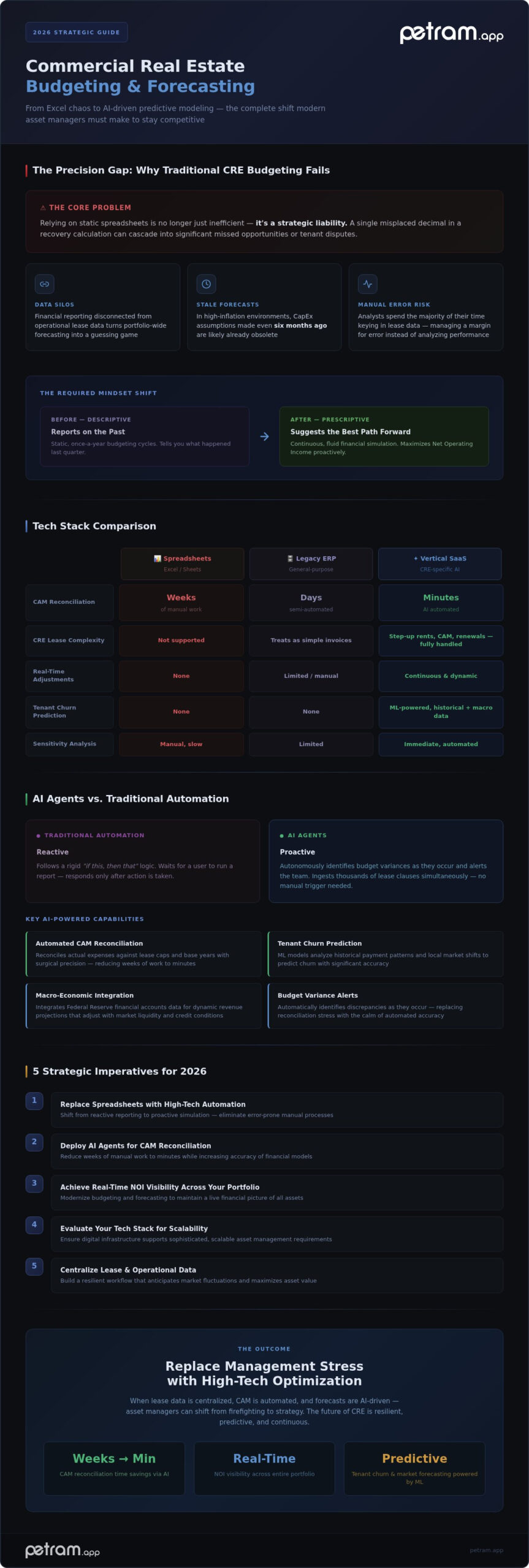
The annual budgeting cycle was once a predictable, if tedious, ritual. That era is over. Relying on static spreadsheets for commercial real estate budgeting and forecasting is no longer just inefficient; it’s a strategic liability. Modern asset management requires a shift away from the “once-a-year” mindset toward a continuous, fluid model of financial simulation. To survive in 2026, your approach to commercial real estate budgeting and forecasting must be as dynamic as the assets you manage.
Manual data entry remains the primary source of structural weakness in most portfolios. When analysts spend the majority of their time keying in lease data, they aren’t analyzing performance. They’re managing a margin for error. A single misplaced decimal in a recovery calculation can cascade into significant missed opportunities or tenant disputes. Competitive management has evolved beyond descriptive analytics that merely report on what happened last quarter. Success now depends on prescriptive analytics that suggest the best path forward for maximizing Net Operating Income.
The Limitations of General-Purpose ERPs
Generic accounting software often treats commercial real estate as a series of simple invoices. This reductive approach fails to account for the intricate reality of modern lease structures. Step-up rents, complex CAM recoveries, and nuanced renewal options create a level of operational friction that standard ERPs cannot resolve. This results in dangerous data silos. When your financial reporting is disconnected from your operational lease data, your portfolio-wide forecasting becomes a guessing game rather than a strategic exercise. You need a system that understands the specific nuances of CRE, not just general ledger entries.
The Impact of Market Volatility on Static Forecasts
Static forecasts are inherently fragile. In a high-inflation environment, CapEx assumptions made even six months ago are likely already obsolete. The market dynamics of 2026 demand real-time budget adjustments that reflect current labor costs, material pricing, and shifting interest rates. If your workflow doesn’t allow for immediate sensitivity analysis, you’re making decisions based on financial fiction. Relying on outdated data leads to underfunded reserves and missed acquisition windows. It’s impossible to maintain asset value when your financial roadmap is stuck in the past.
The Precision Gap is the growing discrepancy between static financial projections and the volatile operational reality of the modern market.
Predictive Intelligence: The Role of AI in CRE Forecasting
The transition from static spreadsheets to predictive intelligence is anchored in the deployment of AI Agents. Unlike traditional software that requires manual triggers, these agents autonomously transform raw lease data into actionable financial models. This capability is foundational for modern commercial real estate budgeting and forecasting. It allows asset managers to move beyond data entry and focus on high-level strategy. By ingesting thousands of lease clauses simultaneously, AI identifies recovery nuances that human analysts might overlook during a standard review.
Automating Common Area Maintenance (CAM) reconciliations is perhaps the most immediate value add. What typically takes an accounting team weeks of painstaking manual cross-referencing can now be executed in minutes. The software reconciles actual expenses against lease caps and base years with surgical precision. This level of automation doesn’t just save time; it eliminates the friction of tenant disputes over billing inaccuracies. It’s about replacing the stress of reconciliation season with the calm of automated accuracy.
Predictive modeling also extends to revenue protection. By analyzing historical payment patterns and local market shifts, machine learning models can predict tenant churn with significant accuracy. Integrating Federal Reserve financial accounts data provides a macro-economic layer to these forecasts. This integration allows for dynamic revenue projections that adjust based on broader market liquidity and credit conditions. This ensures that your commercial real estate budgeting and forecasting remains resilient even during periods of fiscal tightening.
AI Agents vs. Traditional Automation
Traditional automation is reactive. It follows a rigid “if this, then that” logic. AI Agents are proactive. They don’t wait for a user to run a report; they identify budget variances as they occur and alert the asset manager to potential bottom-line impacts. This synergy allows the human manager to act as the strategic pilot while the digital assistant handles the granular execution. It’s a partnership that scales without increasing headcount.
Enhancing Net Operating Income (NOI) with AI
Maximizing NOI requires granular control over every line item. AI optimizes expense tracking by automatically categorizing vendor invoices and identifying outliers that suggest billing errors or operational inefficiencies. It also provides a logical basis for capital improvements. For instance, agents can predict the ROI of energy-efficient upgrades by modeling historical utility data against projected savings. Utilizing advanced commercial property management software ensures that these insights are centralized rather than scattered across disparate folders. If you’re ready to professionalize your operations, exploring AI-driven vertical SaaS is the next logical step in your digital evolution.
Evaluating the Tech Stack: Spreadsheets vs. Legacy ERP vs. Vertical SaaS
Choosing the right infrastructure defines the success of your commercial real estate budgeting and forecasting. Most firms operate within one of three tiers. Tier 1 is the ubiquitous spreadsheet. It’s flexible but inherently dangerous. Spreadsheets are the primary bottleneck for accurate commercial real estate budgeting and forecasting as you scale. Once you reach five properties, the complexity of inter-linked workbooks creates a fragile ecosystem. One broken formula or hidden cell can compromise an entire portfolio’s valuation without warning. It’s a high-stakes gamble that modern asset managers can’t afford to take.
Security and compliance are the next casualties of an unmanaged data strategy. Financial data living in local Excel files lacks the audit trails, version control, and encryption required for institutional-grade reporting. If your data isn’t centralized, it’s vulnerable. Legacy ERP systems, or Tier 2, attempted to solve this through centralization, but they often struggle with usability. These systems weren’t built for the speed of the 2026 market. They represent a reactive era of computing that feels increasingly out of sync with the needs of a proactive, tech-forward management team.
The Vertical SaaS Advantage for Commercial Landlords
Vertical SaaS represents the third and most advanced tier. Unlike legacy ERPs that offer “bolted-on” real estate modules, vertical SaaS provides purpose-built workflows designed specifically for the nuances of commercial leases. This specialization leads to significantly higher user adoption. Your team will actually use a platform that feels intuitive and respects their time. Implementation is also faster because the system already understands CPI escalations, percentage rent, and complex recovery structures. You aren’t fighting the software to make it work for CRE; it’s already there.
Cost of Ownership: Subscription vs. Opportunity Cost
Don’t let a monthly subscription fee distract you from the “spreadsheet tax” currently draining your resources. This tax is the massive opportunity cost of having your most expensive talent spend 40% of their month on manual data reconciliation. Legacy on-premise ERPs carry hidden maintenance costs and require constant IT intervention. In contrast, modern cloud-based platforms provide immediate transparency for investor reporting. The ability to provide real-time, accurate visibility into asset performance is a competitive differentiator. It’s an investment in clarity that pays dividends through improved Net Operating Income and professionalized operations.
How to Build a Resilient CRE Budgeting Workflow
Constructing a resilient workflow requires a structural overhaul of how data moves through your organization. It’s not enough to simply adopt new tools; you must redefine the sequence of financial planning. A modernized approach to commercial real estate budgeting and forecasting ensures that your digital infrastructure remains robust under market pressure. This transition begins with a shift from fragmented reporting to a centralized, high-velocity data pipeline.
- Step 1: Centralization. Consolidate all lease, vendor, and operational data into a single source of truth. Eliminating disparate spreadsheets is the first step toward professionalizing your operations.
- Step 2: Benchmarking. Establish baseline benchmarks by analyzing historical asset performance. This provides the logical foundation for identifying outliers in future reporting cycles.
- Step 3: Automation. Configure automated escalation and recovery structures. This removes the manual burden of calculating CPI adjustments and complex CAM reconciliations.
- Step 4: Rolling Forecasts. Implement rolling forecasts to replace the static annual budget. This allows your team to pivot based on real-time market shifts rather than waiting for the next fiscal year.
Data Governance and Integrity
Success depends on the quality of your inputs. You must prioritize cleaning “dirty data” before migrating to any automated system. Inconsistent naming conventions or missing lease clauses will compromise the integrity of your predictive models. Establish clear, permission-based access for property managers and accountants to ensure accountability. Maintaining strict data governance also ensures compliance with national reporting standards, providing the transparency that institutional investors demand. It’s about building a foundation that scales without introducing systemic errors.
Optimizing the Forecasting Cycle
The 2026 market moves too fast for annual reviews. You should move toward quarterly or even monthly rolling reviews to maintain a competitive edge. This frequency allows you to leverage “What-If” scenarios for major CapEx decisions, such as a roof replacement or a HVAC overhaul. By simulating different outcomes, you can choose the path that best protects your Net Operating Income. Linking your budget directly to automated property management workflows creates a seamless loop between financial planning and operational execution. If you’re ready to modernize your portfolio’s financial health, schedule a demo of Rezone to see these workflows in action.
A resilient workflow transforms commercial real estate budgeting and forecasting from a seasonal chore into a continuous strategic advantage. It empowers your team to anticipate market fluctuations rather than merely reacting to them. This proactive stance is what separates market leaders from those still struggling with legacy systems.
Rezone: Modernizing Commercial Budgeting with AI-Driven SaaS
Rezone isn’t just another layer of software. It’s a fundamental shift in how assets are valued and managed. By unifying the principles of commercial real estate budgeting and forecasting within a vertical SaaS environment, Rezone replaces manual fatigue with automated precision. This platform was built specifically for the modern asset manager who demands more than just a digital version of a paper ledger. It’s designed to professionalize every aspect of your financial workflow, from lease ingestion to investor reporting.
Our AI Agents are the heart of this transformation. They don’t just store data; they actively monitor lease parameters, market indices, and operational expenses to provide real-time updates. This proactive management ensures that your financial models are never stagnant. You gain a level of foresight that was previously impossible with legacy ERP systems. By integrating seamlessly with your existing property workflows, Rezone ensures that data flows without friction. This precision directly drives asset value by identifying recovery leakage and optimizing expense ratios before they impact your year-end performance.
The Future of Asset Optimization
Scaling your portfolio shouldn’t mean scaling your administrative overhead. Rezone allows you to manage more square footage with the same lean team by automating the repetitive tasks that consume your analysts’ time. It’s the preferred partner for forward-thinking CRE owners who recognize that digital infrastructure is a competitive advantage. Rezone serves as the bridge between traditional management and AI innovation. This partnership enables you to focus on high-level acquisition and disposition strategies while the software maintains the integrity of your daily commercial real estate budgeting and forecasting.
Next Steps for Your Portfolio
The transition to a modern tech stack begins with an honest assessment of your current maturity. If you’re still relying on fragmented Excel files or rigid legacy modules, you’re likely leaving Net Operating Income on the table. It’s time to replace the stress of manual reconciliation with the clarity of automated efficiency. We invite you to request a tailored demonstration of Rezone’s forecasting engine to see exactly how AI Agents can transform your specific portfolio data into actionable intelligence. Don’t let your financial planning remain a reactive exercise. Take the first step toward high-tech asset optimization today and optimize your CRE budgeting with Rezone to secure your portfolio’s future.
Mastering the Future of Asset Performance
The transition from manual spreadsheets to a centralized, AI-driven infrastructure isn’t just a technical upgrade; it’s a strategic necessity for anyone serious about portfolio growth. You’ve seen how the precision gap in traditional commercial real estate budgeting and forecasting can erode asset value through hidden errors and reactive reporting. By adopting vertical SaaS, you replace operational friction with the real-time clarity needed to navigate a volatile market. Success in 2026 demands a shift toward continuous, predictive simulation.
Rezone provides the specialized digital infrastructure required to scale your portfolio without the burden of administrative overhead. Our platform delivers AI-powered predictive forecasting and proven workflow optimization built specifically for the unique demands of commercial real estate. It’s time to professionalize your operations and replace management stress with the calm of high-tech efficiency. Streamline your CRE financials with Rezone and transform your budgeting process into a high-performance engine for growth. The future of your portfolio starts with the decisions you make today.
Frequently Asked Questions
What is the difference between budgeting and forecasting in commercial real estate?
Budgeting serves as a static financial roadmap established at the beginning of the fiscal year to set performance expectations. In contrast, commercial real estate budgeting and forecasting involves the continuous refinement of those projections based on actual income and expenses. While the budget provides a baseline, the forecast acts as a dynamic simulation that accounts for real-time market shifts. This distinction is critical for maintaining asset value in a volatile economic environment where annual plans quickly become obsolete.
How often should a commercial property manager update their financial forecasts?
Financial forecasts should be updated on a rolling monthly or quarterly basis to maintain institutional-grade accuracy. The rapid pace of the 2026 market means that annual updates are no longer sufficient for competitive asset management. Frequent reviews allow managers to pivot strategies in response to interest rate fluctuations or unexpected vacancy shifts. By adopting a rolling cycle, you ensure that your financial roadmap remains aligned with operational reality rather than relying on outdated assumptions made months prior.
Can AI agents really replace manual spreadsheet budgeting for CRE?
AI agents replace the manual fatigue of data entry and reconciliation while acting as strategic partners to human asset managers. These agents autonomously ingest lease data and identify budget variances before they impact the bottom line. While they handle the granular execution of commercial real estate budgeting and forecasting, the manager remains the final decision-maker. This partnership allows firms to scale their portfolios without exponentially increasing their administrative headcount or risking the integrity of their financial reporting.
How does vertical SaaS improve NOI for commercial landlords?
Vertical SaaS improves Net Operating Income by eliminating recovery leakage and optimizing expense management through automated categorization. Generic ERPs often miss nuanced lease escalations or fail to reconcile complex CAM charges accurately. A specialized platform like Rezone ensures that every recoverable expense is billed correctly and identifies outliers in vendor pricing. This level of digital optimization provides the clarity needed to reduce waste and maximize the cash flow generated by each individual asset in your portfolio.
What are the most common errors in commercial real estate budgeting?
The most frequent errors involve manual data entry mistakes in spreadsheets and the miscalculation of complex lease recovery structures. Managers often miss step-up rent dates or fail to account for specific expense caps across diverse tenant profiles. These discrepancies lead to significant financial leakage and potential disputes during the reconciliation season. Relying on static models also creates a precision gap where CapEx planning fails to keep pace with the rising costs of labor and materials.
How do I handle CAM reconciliations in a modern forecasting tool?
Modern forecasting tools handle CAM reconciliations by automatically cross-referencing actual property expenses against specific lease clauses and base-year benchmarks. The software ingests vendor invoices and categorizes them to match recovery profiles instantly. This automation reduces a process that typically takes weeks into a task completed in minutes. It ensures that billings are surgical in their precision, which fosters tenant trust and protects the landlord from the risk of under-billing recoverable operational costs throughout the year.
Is AI-driven budgeting software compliant with national accounting standards?
Professional AI-driven platforms are designed to meet and exceed national accounting and reporting standards. Unlike fragmented spreadsheets, these systems provide comprehensive audit trails, strict version control, and permission-based access. This digital infrastructure ensures that every adjustment to a forecast is documented and verifiable. Using a centralized SaaS environment provides the transparency that institutional investors and regulatory bodies require. It replaces the compliance risks of unmanaged financial data with a secure, professionalized framework for asset management.
What data is required to start using an automated forecasting platform?
You typically need current rent rolls, historical financial statements, and digitized lease documents to begin. The platform ingests this raw data to establish baseline performance benchmarks and configure automated recovery structures. Once this foundational information is centralized, the AI agents can begin simulating future outcomes and identifying variances. Starting with clean, verified data is essential for ensuring the accuracy of your predictive models. This initial migration creates the single source of truth required for sophisticated portfolio planning.