

Over 65% of institutional CRE firms have now integrated AI into their core workflows, yet the majority still grapple with the fragmented reality of multi-asset management. You understand the friction of toggling between a 17.7% vacancy rate in your office assets and the tight 5.0% margins of your retail holdings. The core challenges of managing a diverse CRE portfolio in 2026 aren’t just market-driven; they’re operational. Manual lease tracking and inconsistent reporting standards between industrial and retail assets create friction that erodes your Net Operating Income. It’s exhausting to manage data silos when you should be scaling.
You can replace this complexity with the calm of automated efficiency. This article outlines how to dissolve these silos by leveraging Rezone, a vertical SaaS designed to act as your portfolio’s central nervous system. We’ll explore how to identify hidden friction points and deploy AI agents that automate asset-specific nuances. You’ll gain a roadmap to a unified view of performance that drives digital optimization and increases total asset value across every square foot you manage. It’s time to move beyond manual oversight and embrace a future where your technology is as strategic as your investments.
Key Takeaways
- Learn why asset diversity inherently causes data fragmentation and how to establish a unified data hierarchy across your entire portfolio.
- Identify and resolve specific operational friction points, such as complex CAM reconciliations and flexible office leasing, that define the challenges of managing a diverse CRE portfolio.
- Discover why legacy ERP systems and manual spreadsheets are insufficient for the specialized needs of 2026’s commercial real estate market.
- Master strategic frameworks for automating lease renewals and escalations to ensure consistent performance across different asset classes.
- Transition from reactive management to proactive value creation by utilizing Rezone’s AI agents to optimize Net Operating Income.
Navigating the Complexity of Multi-Asset Commercial Portfolios
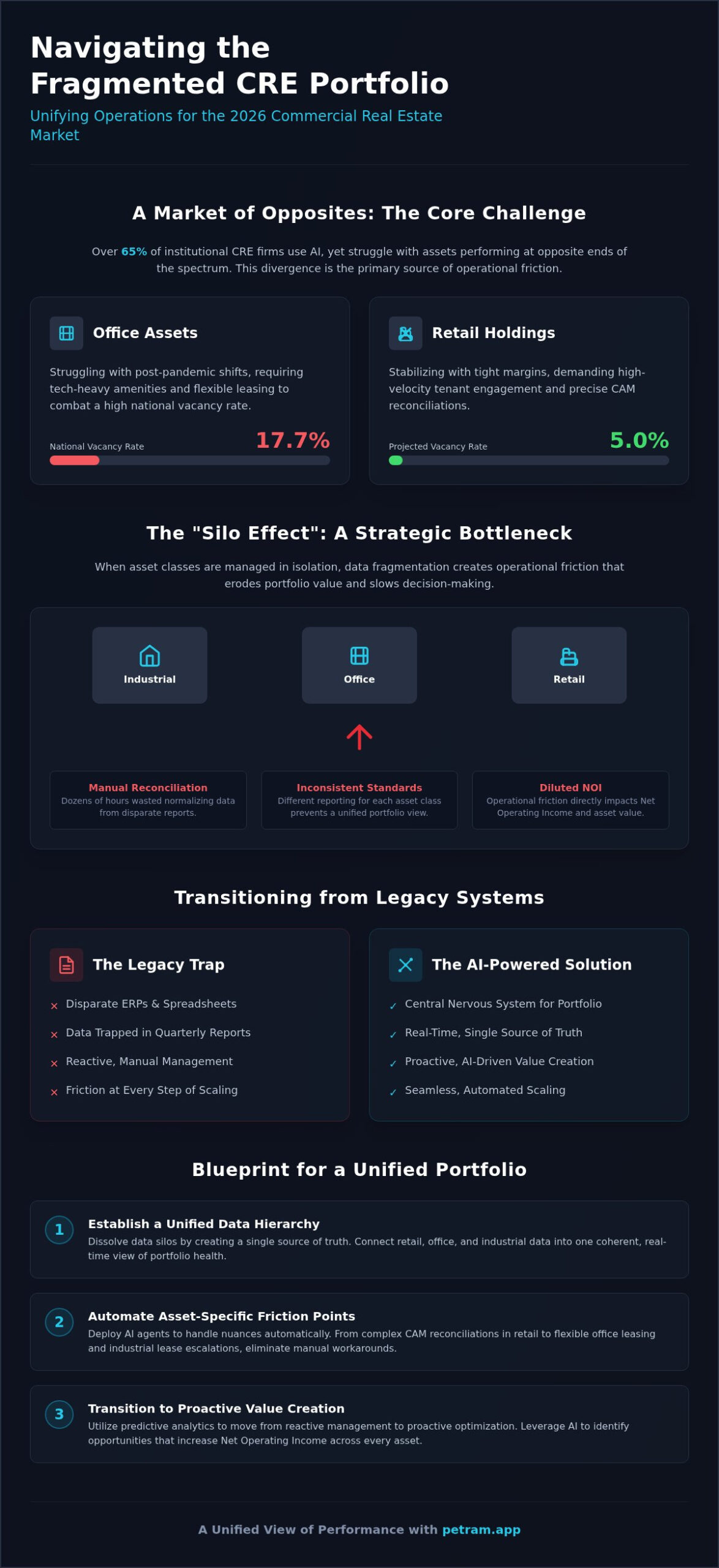
The 2026 market is defined by divergence. While the national retail vacancy rate is projected to stabilize at 5.0%, the office sector continues to struggle with a 17.7% vacancy rate. For an institutional corporate real estate portfolio, this means managing assets that are performing at opposite ends of the spectrum. The challenges of managing a diverse CRE portfolio emerge when these disparate asset classes are forced into a one-size-fits-all management model. Retail assets demand high-velocity tenant engagement and complex CAM reconciliations. Industrial assets require specialized tracking for rising 7.8% vacancy rates. Office assets need tech-heavy amenities to attract tenants in a flight-to-quality market. When these operational standards aren’t unified, decision-making stalls.
This “Silo Effect” creates a strategic bottleneck. If your retail reporting standards don’t talk to your industrial data, you lose the ability to see the portfolio’s total health. Operational friction doesn’t just slow down your staff; it dilutes your overall valuation. Investors in 2026 look for digital maturity and streamlined operations as much as they look at physical occupancy. A fragmented portfolio is a risky portfolio.
The Data Fragmentation Dilemma
Data silos are the silent killers of portfolio performance. Many firms still rely on disparate software systems, using one tool for retail and a legacy ERP for office holdings. This prevents a “single source of truth.” Manual data reconciliation is no longer just a nuisance; it’s a financial drain. When teams spend dozens of hours normalizing reports from different property types, they aren’t performing high-value analysis. In 2026, real-time visibility is the primary requirement for asset managers. You cannot respond to a 1.2% increase in retail asking rents if your data is trapped in a spreadsheet from last quarter. Digital optimization is the only way to maintain a competitive edge.
Operational Friction and Portfolio Scaling
Friction is the distance between a data point and a decision. In a diverse portfolio, this friction often hides in manual workarounds. You might see it in a spreadsheet used to track industrial lease escalations because your primary software was built for retail. These “hidden” costs add up. Friction at the property level directly dilutes capital growth at the portfolio level. Scaling requires a unified digital framework that handles asset-specific nuances automatically. Rezone serves as the central nervous system for these operations. It allows you to scale without increasing headcount, ensuring that every asset, whether office or industrial, contributes to a rising Net Operating Income.
Asset-Specific Friction: Bridging the Gap Between Retail, Office, and Industrial
Managing a multi-asset portfolio requires more than just high-level oversight. It demands an appreciation for the divergent operational rhythms of each property type. Retail, office, and industrial assets operate on entirely different timelines and reporting requirements. Attempting to force these into a singular, manual workflow is one of the primary challenges of managing a diverse CRE portfolio. When you treat a high-turnover retail center with the same procedural rigidity as a long-term industrial warehouse, you create friction that burns out staff and alienates tenants. Diversity is a hedge against market volatility, but only if your systems respect the unique needs of every asset class.
Retail and Office: The High-Touch Challenge
Retail management is a high-velocity endeavor. You aren’t just tracking rent; you’re managing high-volume tenant requests and navigating the labyrinth of complex CAM reconciliations. In a market where retail asking rents are forecasted to reach an average of $23.17 per square foot, accuracy in percentage rent calculations is non-negotiable. Similarly, the office sector’s “flight to quality” necessitates tech-heavy amenities and flexible leasing models to combat the national 17.7% vacancy rate. Managing these requires specialized commercial property management software capable of handling instant amenity bookings and seamless tenant communication. Without these automated touchpoints, your team is buried in administrative debt instead of driving asset value.
Industrial and Logistics: The Compliance Burden
Industrial assets present a different set of obstacles centered on longevity and regulatory adherence. With the U.S. industrial vacancy rate expected to rise to 7.8% by the end of 2026, maintaining high-quality, compliant facilities is the best way to retain credit-worthy tenants. This involves rigorous tracking of environmental standards and critical infrastructure maintenance. Implementing strong credit risk-management practices is essential for navigating the complexities of long-term lease obligations in logistics. AI agents within Rezone can monitor these obligations proactively, ensuring that preventive maintenance schedules are met before they become costly liabilities. By unifying these disparate workflows, you move from reactive troubleshooting to strategic growth. You can explore how Rezone streamlines these asset-specific nuances at Petram.app.
Why Legacy Systems Fail Diverse Commercial Portfolios
Many institutional firms still manage billion dollar portfolios using “good enough” technology. It’s a strategic mistake. Horizontal ERPs are designed for general business, not the granular complexities of multi-asset CRE. They function merely as a system of record; they’re passive digital filing cabinets that store data without interpreting it. In contrast, a modern system of action identifies risks and opportunities in real time. If your software doesn’t alert you to a pending lease expiration in your retail sector while simultaneously flagging a compliance gap in your industrial holdings, it’s failing you. These legacy limitations exacerbate the challenges of managing a diverse CRE portfolio by forcing teams into manual workarounds.
The post-pandemic commercial real estate market has accelerated the divergence between asset classes, leaving static systems in the dust. Spreadsheets have become the default tool for many managers, yet they are the primary enemy of portfolio optimization. They are prone to human error, lack version control, and create massive security risks. Relying on manual data entry in 2026 is a liability that erodes investor confidence and stalls growth.
Horizontal vs. Vertical SaaS for Real Estate
Vertical SaaS, like Rezone, is architected specifically for the nuances of commercial property. It handles complex data hierarchies that general business software ignores. The ROI of moving to a unified vertical platform is found in the immediate reduction of administrative debt. You stop paying your most expensive analysts to copy-paste data between tabs. Instead, you empower them to act on AI-driven insights that protect your Net Operating Income. A vertical platform understands that an industrial warehouse and a lifestyle retail center require different reporting standards, and it unifies them without losing granular detail.
The Hidden Cost of ‘Good Enough’ Tech
Using outdated tools imposes a hidden innovation tax on your operations. This tax is paid through lower tenant retention and missed lease renewal windows. Outdated systems also create compliance gaps, especially with new regulations like the FinCEN reporting mandates that became effective in March 2026. Automated workflows reduce human error, ensuring that every escalation and regulatory requirement is met with precision. High-tech optimization isn’t a luxury anymore. It’s the baseline for survival in an increasingly fragmented and scrutinized market. Transitioning to a unified digital framework is the only way to scale without proportionately increasing your overhead.
Strategic Frameworks for Unifying Fragmented CRE Workflows
Unifying fragmented workflows is the final hurdle in modernizing your asset management. Solving the challenges of managing a diverse CRE portfolio requires a transition from manual oversight to a structured, digital framework. This starts with a standardized data hierarchy. By mapping every asset class to a unified ledger, you ensure that an industrial warehouse and a luxury retail space contribute to a single source of truth. Centralizing tenant communication through a digital portal further removes friction, replacing the chaotic email chains of legacy management with a transparent, audit-ready history. This isn’t just about convenience; it’s about establishing professional control.
Standardizing Reporting Across the Portfolio
Consistency is the foundation of scale. You need KPIs that translate across asset classes without losing their specific relevance. While office assets might prioritize amenity utilization, industrial holdings focus on operational compliance and logistics throughput. AI agents within Rezone maintain data integrity across thousands of these data points, automatically normalizing disparate inputs for investor-ready reports. This level of precision eliminates the manual reconciliation that stalls growth. It allows you to leverage real estate portfolio optimization tools to generate predictive reporting that forecasts cash flow with surgical accuracy. A unified reporting structure offers several key advantages:
- Standardized KPIs: Aligning Net Operating Income (NOI) and Capital Expenditure (CapEx) across all property types for better capital allocation.
- Automated Escalations: Ensuring no rent increase or lease renewal is missed due to manual oversight or spreadsheet errors.
- Centralized Portals: Providing tenants with a modern, high-tech interface for requests, which increases retention rates.
Automating the Lease Lifecycle
The lease lifecycle is where diverse portfolios often leak value. AI agents proactively flag upcoming renewals and critical dates 180 days in advance, providing the lead time necessary to negotiate from a position of strength. This “Lead-to-Lease” efficiency is vital for maintaining high performance. Automated marketing and tenant matching further reduce vacancy periods, a critical capability when managing the 17.7% national office vacancy rate. By streamlining these escalations, you convert the challenges of managing a diverse CRE portfolio into a repeatable, high-margin operation. You’ll stop chasing data and start driving value. Modernize your portfolio with Rezone’s vertical SaaS today.
Future-Proofing Portfolios with Rezone’s AI-Driven Asset Management
The transition from manual oversight to autonomous management is the definitive shift of 2026. For firms facing the persistent challenges of managing a diverse CRE portfolio, the goal is no longer just keeping up with data entry. It’s about deploying a central nervous system that thinks as fast as the market moves. Rezone’s vertical SaaS replaces fragmented legacy tools with AI agents that don’t just observe; they execute. This evolution moves your operations from a state of constant reaction to one of strategic, automated efficiency. You’re no longer managing a collection of buildings. You’re leading a high-performance digital ecosystem.
Predictive analytics are the engine of this proactive value creation. Instead of waiting for a cooling system to fail in an industrial hub or a tenant to vacate a retail unit, AI agents analyze performance patterns to predict these events before they happen. This shift from reactive maintenance to proactive optimization preserves capital and keeps tenant satisfaction high. It turns your technology into a partner that anticipates needs rather than a tool that merely records history.
AI Agents: The New Operational Standard
AI agents represent a quantum leap beyond simple chatbots. These agents execute complex CRE workflows, such as identifying expense leaks in real-time or flagging revenue opportunities that human analysts might miss across thousands of line items. They are particularly vital for maintaining 2026 regulatory standards, including the rigorous FinCEN beneficial ownership reporting mandates. By automating these high-stakes compliance tasks, Rezone ensures your portfolio remains bulletproof without requiring a massive increase in back-office headcount. It’s about precision at scale. These agents act as tireless, expert assistants that allow your senior team to focus on high-level strategy rather than administrative minutiae.
Maximizing NOI Through Digital Transformation
Digital transformation is a direct driver of Net Operating Income (NOI). When you reduce the operational friction of managing multi-asset classes, you immediately increase the liquidity and value of those assets. Tech-forward portfolios that utilize vertical SaaS often see higher asset liquidity because their data is clean, audit-ready, and transparent for potential buyers or lenders. Rezone focuses on this bottom-line growth, linking software efficiency to tangible NOI expansion. This competitive advantage is what separates market leaders from those still struggling with the inherent challenges of managing a diverse CRE portfolio. Scaling your portfolio no longer means scaling your stress. It means leveraging intelligent automation to secure a future of professional clarity and absolute control.
Mastering the Multi-Asset Landscape Through Digital Unity
The divergence of the 2026 market demands a strategic shift from manual tracking to digital mastery. You’ve seen how asset-specific friction and data fragmentation stall growth across retail, office, and industrial holdings. By establishing a standardized data hierarchy and replacing legacy spreadsheets with vertical SaaS, you reclaim absolute control over your operations. The challenges of managing a diverse CRE portfolio shouldn’t be a barrier to scale; they’re an opportunity to optimize through intelligent, AI-driven infrastructure.
Rezone provides the precise workflow automation required to unify your holdings and drive measurable growth in Net Operating Income. It’s a platform architected specifically for CRE owners who prioritize asset performance and long-term liquidity. Optimize your diverse CRE portfolio with Rezone to replace operational stress with the calm of high-tech clarity. Your transition from complex management to automated efficiency begins here. The future of your portfolio is automated, and you’re now equipped to lead it with professional confidence.
Frequently Asked Questions
What are the biggest risks of managing a diverse CRE portfolio without specialized software?
Managing without specialized software exposes you to severe data fragmentation and reporting delays. Manual errors in lease tracking or CAM reconciliations often lead to significant financial leakage. These are core challenges of managing a diverse CRE portfolio that typically result in diluted asset valuations. Without a unified system, you lack the real-time visibility needed to respond to market shifts, leaving your portfolio vulnerable to operational inefficiencies and missed renewal windows.
How does vertical SaaS differ from traditional property management systems?
Vertical SaaS is architected specifically for the nuances of one industry, whereas traditional systems are often horizontal and generic. Rezone, as a vertical SaaS for CRE, handles complex data hierarchies that standard ERPs ignore. It understands the specific requirements of retail, office, and industrial assets natively. This specificity allows for deeper automation and more accurate performance tracking than any general-purpose business software could ever provide.
Can AI agents really handle complex commercial lease negotiations?
AI agents currently execute the complex workflows that support negotiations rather than replacing the human element entirely. They identify revenue opportunities, flag market rate discrepancies, and prepare data-driven insights in real time. By automating the administrative debt of lease analysis, these agents empower managers to negotiate from a position of absolute clarity. They ensure every escalation and clause is accounted for before a contract is finalized.
How do I unify reporting for retail and industrial assets in one platform?
You unify reporting by establishing a standardized data hierarchy that maps disparate KPIs into a single dashboard. Rezone uses AI agents to normalize data from different property types, ensuring that retail sales metrics and industrial compliance logs exist in one ecosystem. This digital optimization provides a central nervous system for your portfolio. It allows you to generate investor-ready reports that reflect the total health of your multi-asset holdings without manual reconciliation.
What are the first steps to digitizing a legacy commercial property portfolio?
The first step is auditing your current data silos to identify where manual workarounds are slowing your team down. Once these friction points are quantified, you must migrate your system of record into a system of action like Rezone. This involves digitizing legacy leases and establishing a unified digital framework. Moving away from spreadsheets is essential for achieving the real-time visibility required for professional asset management in 2026.
How does Rezone help in increasing the Net Operating Income (NOI) of an asset?
Rezone increases Net Operating Income (NOI) by automating high-value workflows and identifying hidden expense leaks. AI agents proactively monitor lease obligations and preventive maintenance schedules to prevent costly emergency repairs. By reducing the administrative headcount needed to manage complex portfolios, Rezone lowers operating expenses. Simultaneously, it flags under-market leases and renewal opportunities, directly driving revenue growth across your entire commercial property portfolio.
Is it difficult to migrate a diverse portfolio to an AI-driven platform?
Migration is significantly more efficient than it used to be thanks to AI-driven data ingestion tools. Modern platforms like Rezone are designed to ingest data from various legacy sources with minimal manual entry. While the transition requires a strategic commitment, the process is structured to maintain data integrity throughout the move. The long-term gain in operational speed and clarity far outweighs the initial effort of moving away from fragmented legacy systems.
What role does data security play in modern CRE portfolio management?
Data security is now a foundational requirement for regulatory compliance and institutional investor trust. With 2026 mandates like FinCEN reporting, your platform must ensure that beneficial ownership information and financial records are encrypted and audit-ready. A secure, tech-forward infrastructure protects your firm from cyber threats while ensuring that sensitive tenant data remains private. Security isn’t just a technical feature; it’s a critical component of your portfolio’s overall risk management strategy.