

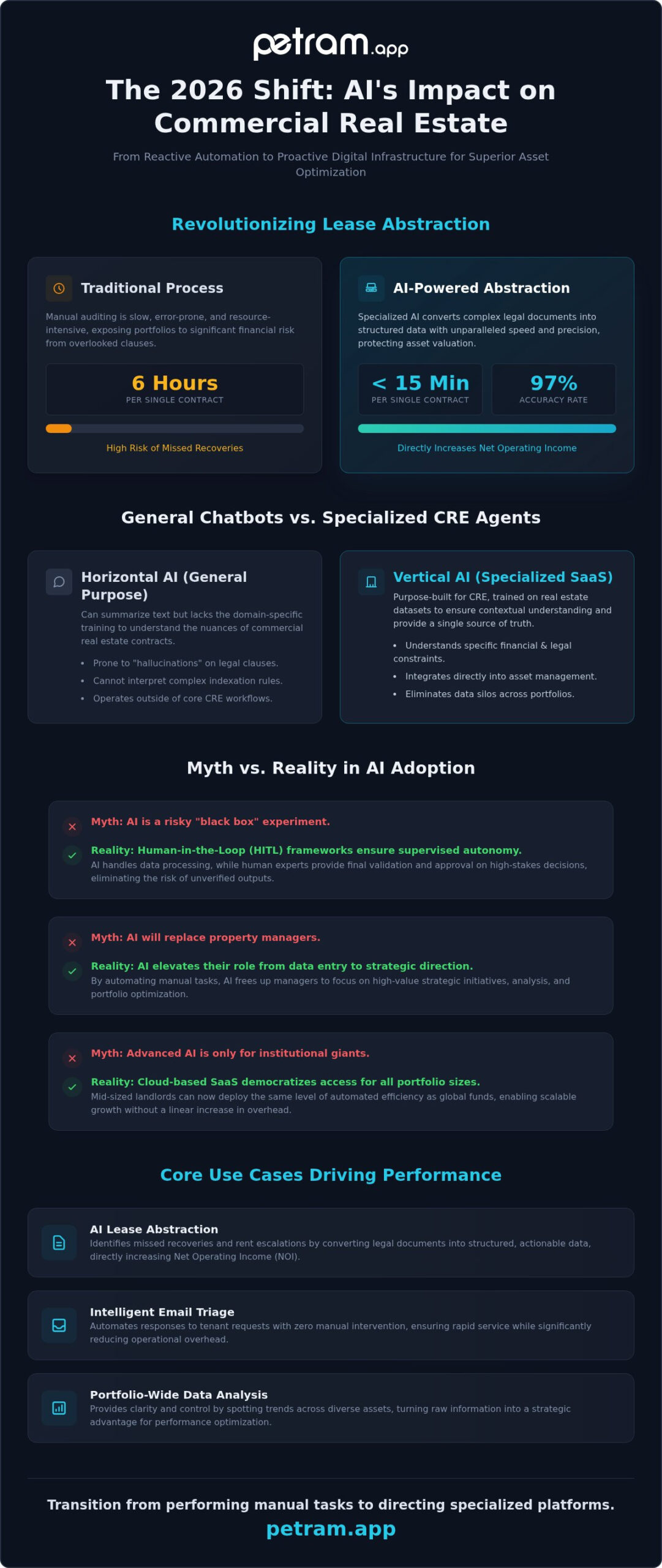
What if a single overlooked indexation clause in a premium office tower or a missed maintenance cap in a nationwide logistics hub could drain hundreds of thousands of złoty from your bottom line? While traditional teams often spend six hours manually auditing a single contract, the latest AI lease abstraction software achieves the same result in under 15 minutes with up to 97% accuracy. This isn’t just about speed. It’s about the precision required to protect your asset’s valuation in an increasingly complex national market.
You’ve likely experienced the frustration of data silos and the persistent fear that "hallucinating" AI models might misread a critical legal obligation. It’s a valid concern for any landlord managing multi-tenant portfolios where operational overhead is already a significant burden. This article promises to bridge that gap by showing you how vertical AI agents move beyond general automation to directly improve your Net Operating Income (NOI).
We’ll provide a clear framework for distinguishing between general-purpose chatbots and specialized SaaS platforms designed specifically for commercial real estate. You’ll discover how to transition from manual data entry to strategic asset direction, ensuring your digital infrastructure is as robust as your physical properties.
Key Takeaways
- Understand the 2026 shift from reactive automation to proactive digital infrastructure powered by specialized vertical AI agents.
- Learn how Human-in-the-Loop (HITL) frameworks eliminate the risk of AI hallucinations in high-stakes legal and financial reporting.
- Discover how AI lease abstraction software identifies missed recoveries and rent escalations to directly increase your asset’s Net Operating Income (NOI).
- Establish a data-first implementation strategy to dismantle legacy silos and ensure absolute transparency in automated decision-making.
- Transition from performing manual management tasks to directing specialized SaaS platforms like Rezone for superior asset optimization.
What is AI for Commercial Landlords? Defining the 2026 Landscape
In 2026, the commercial real estate sector has officially transitioned from the "exploration phase" into the "active majority." For Polish landlords, this means the era of treating artificial intelligence as a curiosity is over. Today, AI in CRE is defined as a sophisticated synergy between Large Language Models (LLMs) and specialized vertical SaaS logic. It is no longer a reactive tool used to fix errors after they occur. Instead, it has become the proactive digital infrastructure that underpins every decision from the boiler room to the boardroom.
This shift represents a fundamental change in how asset value is protected. Core components of this landscape include automated reporting, predictive maintenance, and AI lease abstraction software. By integrating these technologies, landlords are replacing manual, error-prone workflows with a system of automated efficiency that scales across national portfolios without increasing headcount. The focus has moved from "doing" tasks to "directing" agents that manage the granular details of property performance.
The Distinction Between Horizontal and Vertical AI
General-purpose AI often runs out of road when confronted with the intricate realities of multi-tenant lease structures. A horizontal chatbot might summarize a text, but it lacks the domain-specific training to interpret complex indexation clauses or specific Polish tax recovery nuances. Vertical SaaS platforms like Rezone are built differently. They utilize Natural language processing specifically trained on commercial real estate datasets. This ensures that the AI understands the context behind the data, integrating directly into the asset management workflow to provide a single, reliable source of truth for the entire organization.
Core Use Cases for Modern Landlords
The application of modern AI focuses on three high-impact areas that drive measurable performance. First, AI lease abstraction software converts hundred-page legal documents into structured, actionable data points in minutes. This eliminates the "data silo" problem where critical information stays trapped in legacy PDFs. Second, intelligent email triage allows systems to handle tenant requests with zero manual intervention, ensuring rapid response times while reducing operational overhead. Finally, portfolio-wide data analysis enables landlords to spot trends across diverse assets. This provides the clarity and control needed to optimize performance in a competitive market, turning raw information into a strategic advantage.
Myth vs. Reality: Can AI Agents Truly Replace CRE Workflows?
Skepticism is the natural response to any disruptive technology. Many landlords still view artificial intelligence as a risky experiment, fearing that high-stakes commercial decisions are too complex for an algorithm. The reality of 2026 is far more nuanced. We’ve moved past the era of "black box" automation into a period of supervised autonomy. This evolution relies on the Human-in-the-Loop (HITL) framework, where AI handles the heavy lifting of data processing while human experts retain final approval. It’s not about replacing the property manager; it’s about elevating them from a data entry clerk to a strategic asset director.
There’s a critical distinction between the Generative AI of 2023 and the Agentic AI of today. While early tools focused on content creation, modern agents focus on task execution. You can explore several practical use cases for generative AI that demonstrate this shift. These agents don’t just summarize a document; they understand the goal. In the Polish market, where operational costs can fluctuate, utilizing a specialized vertical SaaS platform ensures that these agents operate within the specific financial and legal constraints of local regulations.
A persistent myth suggests that sophisticated AI is reserved for institutional giants with massive IT budgets. This is no longer true. Cloud-based vertical SaaS has democratized access to high-level digital infrastructure. Mid-sized portfolios in Poland can now deploy the same level of automated efficiency as global funds, allowing them to scale without a linear increase in overhead costs.
Understanding Autonomous AI Agents
Autonomous agents are goal-oriented entities designed to execute multi-step processes. Unlike a basic search tool, an agent can manage a lease renewal from start to finish. It identifies the upcoming expiration, triages tenant communication, and prepares the necessary documentation based on historical data. This 24/7 capability ensures that tenant requests never sit in an inbox for days, providing the calm of automated efficiency that modern tenants expect.
The Reality of AI Reliability and Hallucinations
The fear of AI "hallucinations" is the primary barrier to adoption for AI lease abstraction software. Vertical SaaS platforms solve this by anchoring the model in ground truth data rather than letting it guess. By 2026, the industry has shifted toward deterministic business logic, where the AI must cite its source for every extracted data point. Grounding is the process of anchoring AI outputs in verified, internal property data to ensure every generated insight is factually accurate and legally sound. This ensures that your AI lease abstraction software provides a reliable foundation for financial reporting and asset valuation.
Beyond Efficiency: How AI Directly Increases Net Operating Income (NOI)
Net Operating Income is the ultimate arbiter of asset value. While productivity gains are beneficial, professional landlords require hard financial metrics to justify technology investments. The shift in 2026 is moving away from "soft" efficiency toward "hard" margin expansion. According to JLL’s 2025 Global Real Estate Technology Survey, while many firms are piloting AI, only a fraction have fully realized their strategic goals. Those who succeed do so by mapping automation directly to revenue growth and cost suppression.
Digital infrastructure is no longer a back-office expense; it’s a value-add during property disposition or refinancing. When a buyer sees a portfolio managed with high-level digital precision, the perceived risk drops. This transparency can compress cap rates and facilitate smoother due diligence. By replacing manual uncertainty with automated clarity, you’re not just managing a building. You’re optimizing a financial instrument.
Revenue Optimization Through Automated Lease Management
Revenue leakage is a silent killer of NOI. In the Polish market, where indexation is often tied to complex GUS or HICP figures, manual errors are common. AI lease abstraction software identifies missed indexation triggers and CAM (Common Area Maintenance) recoveries instantly. It scans thousands of pages to ensure every złoty owed is actually billed. Beyond simple recovery, landlords can now use these systems to automate commercial lease renewals well before a tenant considers moving. Proactive engagement based on predictive market rent alignment ensures your portfolio remains competitive without leaving money on the table.
Operational Cost Reduction
Reducing the cost-per-unit of management is essential for scaling. Automated triage systems handle the high volume of tenant communication, allowing your team to focus on high-value asset strategy rather than repetitive administration. This operational leaness directly expands your margins. Furthermore, modern AI integrates with smart building systems to optimize energy consumption. By analyzing occupancy patterns and utility rates in real-time, these platforms can lower utility spend significantly. This doesn’t just reduce costs; it improves your ESG standing, which is increasingly critical for institutional valuation. Streamlining reporting for stakeholders also saves hundreds of hours in manual data entry, providing a clear, real-time view of asset performance that was previously impossible to maintain.
Implementation Strategy: Navigating Data Silos and Compliance
Successful AI adoption begins with a "Data First" philosophy. Your software is only as capable as the records it processes. If your portfolio data remains trapped in fragmented Excel sheets or low-resolution scans, your automation efforts will stall. Clean, structured data is the fuel for high-performance asset management. Landlords must prioritize the digitization of their document stacks before expecting sophisticated outputs from any AI lease abstraction software.
We must also dismantle the "Black Box" problem. Landlords cannot afford to base multi-million złoty decisions on opaque algorithms. Transparency is non-negotiable. Every automated output must be traceable back to the source text. This ensures that your team remains the final authority, maintaining the professional literacy required for institutional-grade management. A phased rollout is the most reliable strategy for national portfolios. Start by deploying AI lease abstraction software to digitize and structure your existing contract data. This creates immediate value by uncovering hidden obligations. Once this foundation is secure, you can gradually introduce autonomous agents for complex tasks like proactive tenant triage or automated renewals.
Breaking Down CRE Data Silos
Legacy paper leases and disparate spreadsheets are the primary enemies of automated efficiency. Digitizing these assets requires more than just scanning; it requires structured extraction that allows data to flow between your accounting, leasing, and management modules. Interoperability ensures that a change in a lease term is instantly reflected in your financial forecasts. A Single Source of Truth is a unified digital repository where every stakeholder accesses the same verified, real-time data point for any given asset metric. This clarity eliminates the friction of conflicting reports and manual reconciliation. To achieve this, you may need to modernize your digital infrastructure with Rezone to ensure your data is ready for the next generation of AI agents.
Risk Management and Compliance
Managing tenant data privacy is a critical responsibility under evolving national and EU AI regulations. As the EU AI Act sets new standards for transparency and data usage, Polish landlords must ensure their digital tools are fully compliant. Audit trails are mandatory for automated financial reporting. Every extraction and every calculation performed by an AI agent must be logged and reviewable. This level of rigor protects your organization during audits and property dispositions. For deeper regulatory guidance, you can utilize commercial real estate compliance software to ensure your automation strategy aligns with the latest legal requirements.
Rezone: The Strategic Choice for AI-Driven Asset Optimization
Rezone represents the pinnacle of specialized digital infrastructure for the Polish commercial market. It isn’t a general-purpose automation tool but a vertical SaaS platform architected for the specific financial and legal rigors of professional asset management. By integrating AI lease abstraction software directly into your core operations, Rezone replaces the stress of fragmented data with the calm of automated efficiency. This is the definitive shift from being a reactive manager to becoming a proactive asset visionary. This evolution is essential for landlords who are serious about modernizing commercial property management.
The Rezone Advantage: Built for Asset Value
The platform’s proactive AI agents are designed with a singular focus: maximizing Net Operating Income. These agents don’t just process data; they optimize workflows across entire national portfolios. Whether you are managing a logistics hub or a premium office tower, the need for structured digital infrastructure is universal. Rezone provides the clarity required to eliminate manual chaos, ensuring that every lease obligation is captured and every recovery is billed. The platform’s AI lease abstraction software capabilities ensure that even the most complex multi-tenant structures are simplified into actionable insights. This specialized immersion in the financial sector allows the system to handle regulatory standards with unparalleled precision. This systematic approach allows your team to stop performing repetitive tasks and start directing a high-output digital workforce that works 24/7.
Future-Proofing Your Portfolio
Professional confidence in 2026 stems from the ability to anticipate market shifts before they impact the balance sheet. Rezone stays ahead of emerging trends, from the complexities of asset tokenization to the granular requirements of advanced data analytics. It serves as a reliable business partner that understands both traditional real estate foundations and the cutting-edge technology needed to evolve them. This commitment to professional literacy ensures that your organization remains a serious, high-level player in a competitive landscape. You gain the self-assurance of an expert who understands the future of the industry. Rezone acts as a proactive guide that stays one step ahead of the market, offering solutions to problems you may not have even fully quantified yet. This air of exclusivity and high-level competence suggests that Rezone is the ideal partner for those serious about scaling and professionalizing their operations through modern means. The time for experimentation has passed. It is now time for strategic execution. Modernize your portfolio with Rezone’s AI Agents to secure your asset’s future.
Securing Asset Value Through Digital Modernization
The transition from manual oversight to automated direction is no longer a strategic option; it’s a requirement for maintaining a competitive edge in Poland’s evolving commercial landscape. By 2026, the industry focus has shifted from the initial hype of general automation to the precise application of vertical SaaS solutions. Implementing AI lease abstraction software is the foundational step in dismantling data silos and ensuring every indexation and recovery is captured with institutional accuracy. This isn’t just about saving time. It’s about building an authoritative digital infrastructure that protects your asset’s valuation during disposition or refinancing.
As you scale, the calm of automated efficiency will replace the stress of legacy management. Rezone provides the specialized AI agents and proactive workflow optimization necessary to turn complex data into measurable Net Operating Income growth. Scale your commercial portfolio with Rezone’s AI-driven platform and lead the market with professional confidence. The future of commercial real estate belongs to those who direct technology rather than just deploying it. Take the first step toward a modernized, future-proof portfolio today.
Frequently Asked Questions
What is the difference between a chatbot and an AI agent for real estate?
A chatbot is a passive interface designed to respond to specific queries using conversational logic. In contrast, an AI agent is a proactive, goal-oriented entity capable of executing multi-step workflows such as lease renewals or maintenance triage. While a chatbot merely answers a question about a tenant’s balance, an agent can identify an overdue payment, draft a reminder, and update the financial record. This distinction is critical for landlords seeking to professionalize their digital infrastructure.
How does AI for commercial landlords help in increasing property value?
AI increases property value by directly expanding your Net Operating Income (NOI). By utilizing AI lease abstraction software, landlords can identify missed indexation triggers or unrecovered Common Area Maintenance (CAM) charges that often go unnoticed in manual audits. These recovered funds directly improve the bottom line. Additionally, automated efficiency reduces operational overhead, allowing you to manage a larger portfolio without a linear increase in staff costs, which effectively compresses cap rates during disposition.
Is my data safe when using AI-driven property management software?
Data security is a pillar of professional AI-driven property management software. Modern platforms utilize enterprise-grade encryption and strictly adhere to EU GDPR standards and the latest AI regulatory frameworks. Every automated decision or data extraction creates a robust audit trail, ensuring transparency for financial reporting. You maintain full control over your proprietary data, as specialized vertical SaaS providers prioritize secure, isolated environments to protect sensitive tenant and financial information from unauthorized access.
Can AI really read and understand complex commercial lease agreements?
Modern AI lease abstraction software is specifically trained to interpret the dense legal language found in 100-page commercial agreements. These systems achieve accuracy rates between 90% and 97% on standard terms, including complex rent escalations and termination rights. By leveraging Natural Language Processing, the software converts unstructured text into actionable data points. This eliminates the risk of human fatigue during manual reviews, ensuring that critical clauses are never overlooked in a multi-tenant portfolio.
Do I need to hire a technical expert to implement AI in my property management business?
You don’t need a dedicated technical team to implement specialized vertical SaaS like Rezone. These platforms are designed for commercial real estate professionals rather than software engineers. The integration process focuses on connecting your existing document repositories and accounting modules. Most landlords find that their current management staff can master the interface quickly. The goal is to replace complex management stress with a user-friendly system that automates the heavy lifting for you.
What happens if the AI makes a mistake in a tenant communication or financial report?
Mistakes are mitigated through a Human-in-the-Loop (HITL) framework where AI serves as a high-speed assistant rather than a final decider. Before any financial report is finalized or a tenant communication is sent, a human manager reviews the output. Vertical SaaS anchors its logic in ground truth data to prevent hallucinations. If a discrepancy occurs, the system provides a direct link to the source document, allowing your team to verify the information instantly and maintain professional literacy.
How much does it cost to implement AI for a commercial property portfolio?
Implementation costs typically follow a subscription or volume-based model, making it accessible for both mid-sized and institutional portfolios. While manual lease abstraction can cost between 800 zł and 2,000 zł per document in staff time, AI solutions significantly reduce this expense. Most professional landlords find that the software pays for itself within the first few months by uncovering lost revenue from missed indexations or expense recoveries. The investment scales according to your specific portfolio size and management needs.
Will AI replace property managers in the commercial sector?
AI isn’t a replacement for the expertise of a seasoned property manager. It’s a tool that shifts their role from manual execution to strategic direction. By automating repetitive tasks like data entry and basic triage, managers can focus on high-value activities such as tenant retention and capital improvement planning. The most successful landlords in the 2026 market are those who use technology to augment their human talent, ensuring they spend time on decisions that truly move the needle.