

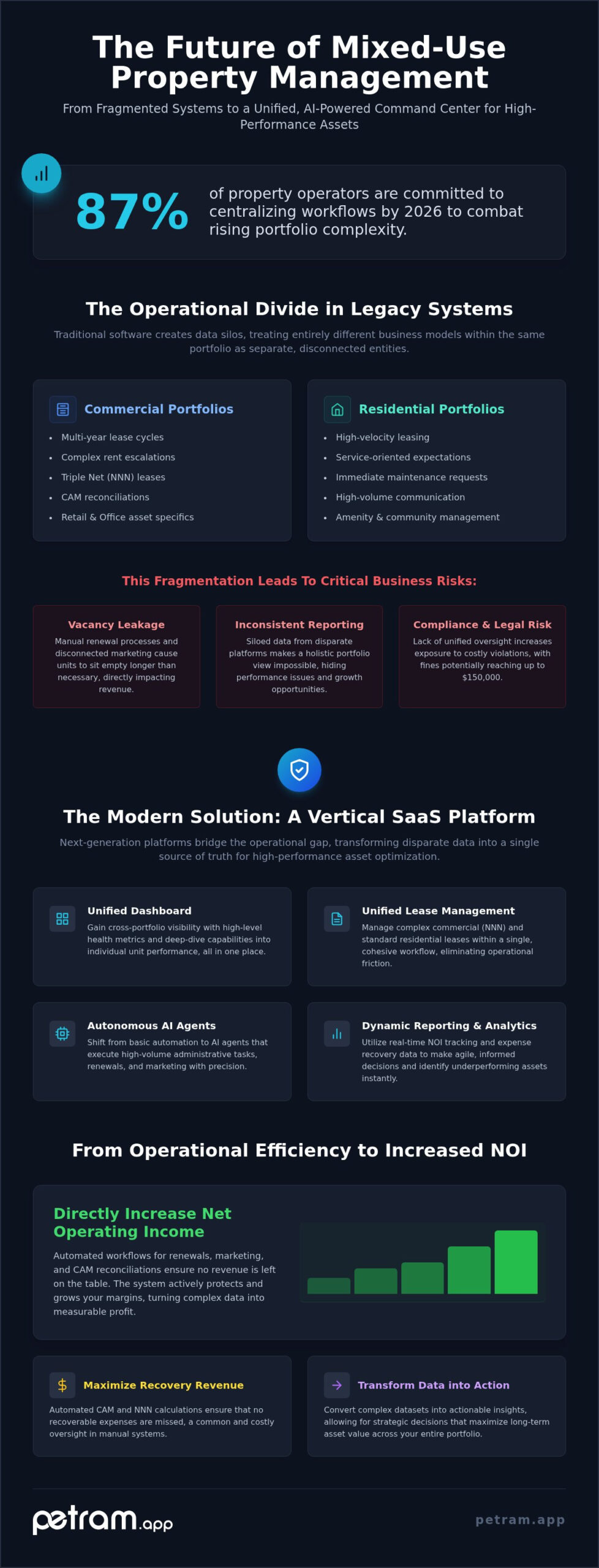
By 2026, 87% of property operators have committed to centralizing their workflows to combat the rising complexity of multi-asset portfolios. You’ve likely felt the operational strain of managing retail, office, and residential units through a patchwork of disconnected platforms. Selecting the right mixed-use property management software is no longer optional when fragmented data leads to inconsistent reporting and vacancy leakage. It’s a systemic challenge that traditional, siloed tools simply weren’t built to solve.
Modernizing your stack is a strategic necessity for professionalizing your operations and scaling with confidence. This guide explores how next-generation platforms replace manual friction with automated precision. You’ll learn to unify disparate asset classes and deploy AI agents that protect your margins. We’ll provide a clear roadmap for utilizing vertical SaaS to transform complex data into actionable insights, ensuring your portfolio remains competitive in an increasingly high-tech landscape. Discover how to treat every square meter as a high-performance asset while driving a direct increase in your Net Operating Income.
Key Takeaways
- Understand how vertical SaaS architecture effectively bridges the operational gap between complex commercial lease cycles and residential service expectations.
- Identify the core requirements of next-generation mixed-use property management software, including unified dashboards for cross-portfolio visibility.
- Explore the shift from basic automation to autonomous AI agents capable of executing high-volume administrative tasks with precision.
- Learn to quantify the direct increase in Net Operating Income (NOI) achieved by deploying automated renewal and marketing workflows.
- Gain a strategic roadmap for migrating from legacy infrastructure to an AI-driven platform like Rezone to maximize long-term asset value.
Navigating the Complexity of Mixed-Use Portfolios in 2026
The operational landscape for mixed-use development has reached a critical threshold in 2026. You aren’t just juggling different tenants; you’re managing entirely different business models within a single building footprint. Commercial lease cycles, characterized by multi-year terms and complex escalations, sit in direct friction with the high-velocity, service-oriented expectations of residential residents. Modern asset owners have recognized that passive administration is a relic of the past. Success now demands active asset optimization. This shift requires specialized mixed-use property management software that functions as a vertical SaaS solution, specifically engineered for the unique interplay of these asset classes.
Data silos act as a silent tax on your portfolio. When residential data doesn’t communicate with the commercial ledger, you lose the holistic view required for genuine growth. Fragmented reporting hides performance leaks and prevents the kind of agile decision-making required in a volatile market. Moving away from traditional software to an AI-enabled framework allows you to bridge these gaps, turning operational friction into a competitive advantage.
The Evolving Definition of Mixed-Use Assets
The lines between asset types are blurring. Retail spaces now frequently incorporate flexible workspaces, while residential lobbies double as high-end office hubs. A "one-size-fits-all" software approach fails because it treats these nuances as outliers rather than the core business. Specialized CRE portfolios require digital infrastructure that understands the tax implications of retail CAM charges just as well as it handles residential maintenance requests. Without this level of specialization, your operational efficiency suffers. You need a platform that treats your entire property as a single, high-performance operational unit.
Identifying the Management Gap in Legacy Systems
Legacy systems often rely on manual data entry across disparate platforms. This creates substantial risk. In 2026, the regulatory environment is more demanding than ever. For example, civil action by the Department of Justice for housing violations can now result in fines up to $150,000. Relying on fragmented reporting makes it nearly impossible to ensure total compliance across diverse lease structures. Beyond legal risks, manual workflows cause vacancy leakage. When lease renewals aren’t automated, units sit empty longer than necessary. Implementing modern mixed-use property management software eliminates these gaps, ensuring every decision is backed by unified, real-time data and automated precision.
Essential Features for Modern Mixed-Use Property Management Software
Scaling a diverse portfolio requires more than just a digital filing cabinet. It demands a command center. A unified dashboard allows you to see the forest and the trees simultaneously; providing high-level portfolio health metrics while enabling a deep dive into individual unit performance. By 2026, the standard for mixed-use property management software **** has shifted toward centralization. With 87% of operators moving toward shared service models, your technology must bridge the gap between commercial and residential operations without sacrificing the granular detail required for either.
Unified Lease and Tenant Management
Managing a Triple Net (NNN) lease alongside a residential agreement in a single environment used to be an operational nightmare. Modern platforms solve this by offering specialized workflows for diverse contract types. Automated rent escalations and CAM reconciliations ensure that no recovery revenue is left on the table. This is critical for maintaining margins. Instead of manual spreadsheets, your software should handle complex commercial calculations while providing a streamlined portal for residential residents. These portals must cater to both business owners requiring detailed ledger access and residents seeking immediate service. Adopting a sophisticated vertical SaaS solution ensures that these distinct tenant needs are met within a single, cohesive workflow.
Dynamic Reporting and Data Analytics
Real-time expense tracking and recovery are the foundations of a healthy Net Operating Income (NOI). In 2026, waiting for quarterly reports is a competitive disadvantage that limits your agility. Advanced reporting modules now provide real-time NOI tracking across your entire portfolio, allowing you to identify underperforming assets or unexpected spikes in utility costs before they impact your bottom line. Predictive analytics have also become a core feature for the modern manager. With AI adoption among property managers rising to 34% in 2025, the ability to forecast vacancy and renewal trends is now a baseline expectation for high-performance firms. These tools analyze historical data and market signals to predict which tenants are at risk of non-renewal, giving your team the lead time needed to mitigate vacancy leakage. Customizable stakeholder reports further professionalize your operations, delivering the precise data investors and owners need to validate your management strategy with total transparency.
Leveraging AI Agents for Seamless Workflow Automation
The technological leap in 2026 is defined by the shift from passive automation to autonomous intelligence. Basic automation followed rigid, "if-this-then-that" rules. Autonomous AI agents possess the capability to reason through complex scenarios. This makes them indispensable for modern mixed-use property management software. These agents don’t just notify you of a task. They execute it. By handling high-volume administrative burdens without human error, they allow your team to pivot from manual data entry to high-level portfolio strategy. Reducing operational overhead becomes a byproduct of intelligent task prioritization rather than a constant struggle for efficiency.
AI-Driven Asset Optimization with Rezone
Deploying AI agents through Rezone transforms how you protect asset value. These agents monitor lease expirations across your entire portfolio, automatically triggering renewal sequences based on real-time market data. They process complex commercial contracts with a precision that manual review simply can’t match. This ensures total data integrity across thousands of specific data points. From CAM caps to percentage rent clauses, these agents identify discrepancies before they impact your ledger. It’s about moving from reactive management to proactive asset protection.
Enhancing Tenant Experience via Intelligent Workflows
Intelligent workflows allow for a nuanced communication strategy that respects the distinct needs of your tenant classes. A retail business owner requires professional, data-centric updates regarding common area maintenance. A residential resident wants immediate, empathetic responses to facility issues. AI-assisted helpdesks resolve these disparate issues rapidly. They provide a personalized experience for every segment without increasing your headcount. To understand the broader impact of these technologies on your bottom line, consider the role of AI agents for real estate: Enhancing CRE Operations. Integrating AI agents into your mixed-use property management software ensures that every interaction reinforces the value of your asset.
Evaluating ROI: How Specialized Software Increases NOI
Net Operating Income (NOI) remains the definitive metric for asset performance. In the 2026 real estate climate, maximizing this figure requires a move beyond simple cost-cutting. You must focus on value creation. Implementing specialized mixed-use property management software allows you to quantify the return on your digital transformation efforts with surgical precision. By automating renewal and marketing workflows, you directly reduce vacancy rates. Every day a unit remains unoccupied is a permanent loss of revenue. Intelligent systems identify these gaps before they occur, ensuring your marketing efforts are proactive rather than reactive.
The Financial Impact of Vertical SaaS
Legacy software often functions as a glorified ledger. It records history but does not shape the future. In contrast, vertical SaaS like Rezone acts as a revenue engine. It targets the specific friction points inherent in mixed-use portfolios, such as the complex reconciliation of commercial CAM charges and residential utilities. Manual management is riddled with hidden costs. These include missed rent escalations, billing errors, and the high price of administrative time spent on data entry. Centralizing these diverse operations into a single platform eliminates these inefficiencies. You replace the stress of manual oversight with the calm of automated accuracy. This transition doesn’t just save money; it generates it by ensuring every contractual escalation is captured and every expense is properly recovered.
Future-Proofing Asset Value
Asset valuation is increasingly tied to data quality. Institutional investors in 2026 prioritize portfolios that offer transparent, real-time, data-backed reporting. High-fidelity data reduces perceived risk and can lead to more favorable capitalization rates. Professionalizing your operations through modern mixed-use property management software allows you to scale your portfolio without a proportional increase in headcount. You gain the ability to manage more units with a leaner, more strategic team. This operational leverage is essential for maintaining agility in a fluctuating market. Scaling with technology rather than personnel ensures that your margins remain protected even as you grow. To optimize your asset performance and secure your competitive edge, evaluate the financial impact of Rezone for your portfolio.
Implementing Rezone: A Strategic Asset Management Move
Transitioning to a modern tech stack is a strategic pivot rather than a simple software swap. It represents a fundamental recalibration of your business model toward operational flow. Migrating from legacy systems requires a methodical approach to ensure that your historical data doesn’t compromise your future performance. By 2026, the industry has shifted away from the bloated, consultant-led implementation cycles common with traditional providers. You need a platform that integrates into your existing asset management framework with minimal friction and maximum impact. Success in this phase depends on your ability to foster a digital-first management culture where your team transitions from manual executors to strategic orchestrators.
Setting the right KPIs is essential for measuring the success of your new mixed-use property management software. You shouldn’t just track basic occupancy; you must measure software-driven performance indicators. Monitor the reduction in manual administrative hours and the increase in CAM recovery accuracy. These metrics provide the data-backed evidence needed to validate your digital transformation to stakeholders and investors.
Seamless Onboarding and Data Migration
The integrity of your AI agents depends entirely on the quality of the data they consume. Cleansing legacy data is a non-negotiable first step in the migration process. You must eliminate duplicates and standardize lease terms to ensure your new environment operates at peak efficiency. Rezone’s architecture is specifically engineered to handle this complexity, allowing for rapid configuration of workflows that respect the unique nuances of mixed-use assets. This focus on rapid time-to-value ensures that your portfolio starts capturing NOI improvements within weeks rather than months, avoiding the high-friction rollouts typical of legacy competitors.
Scaling with AI-Enabled Management
Scaling a portfolio in a fluctuating market requires a lean, agile infrastructure. Leveraging Rezone allows you to manage larger, more complex portfolios without a proportional increase in your administrative headcount. The system evolves alongside your business. Through continuous software updates and AI learning, the platform adapts to your specific operational patterns and tenant behaviors. This creates a compounding effect of efficiency. As the AI learns, your workflows become more predictive and less reactive, securing your position as a market leader. Don’t let legacy friction limit your growth potential. Modernize your portfolio with Rezone Property Management SaaS and transform your operational complexity into a scalable competitive advantage.
Securing Your Competitive Edge in a High-Tech Market
The transition from fragmented legacy systems to a unified, AI-driven environment is the definitive shift for asset managers in 2026. Managing retail, office, and residential units within a single footprint demands more than just administrative oversight; it requires a strategic focus on asset optimization. By deploying autonomous AI agents and vertical SaaS architecture, you replace manual friction with the calm of automated precision. It’s the only way to maintain agility in an increasingly complex real estate market.
This modernization directly impacts your bottom line by securing every lease escalation and ensuring accurate CAM recoveries. Selecting the right mixed-use property management software isn’t just a technical upgrade. It’s a commitment to professionalizing your operations and scaling with confidence. Rezone provides the specialized CRE tools and AI-driven workflow optimization designed to increase your Net Operating Income. Don’t let legacy inefficiencies limit your portfolio’s potential. Take the lead by transforming your digital infrastructure into a high-performance growth engine today.
Optimize your asset value with Rezone Property Management Software
Frequently Asked Questions
What is the difference between mixed-use and traditional property management software?
Traditional software often siloes data by asset class. Specialized mixed-use property management software unifies commercial and residential workflows into one vertical SaaS architecture. It handles the friction between multi-year retail leases and high-turnover residential units. Rezone provides a central dashboard that allows managers to oversee distinct lease structures without switching platforms. You gain total visibility into your portfolio performance without the need for manual reconciliation between disparate, disconnected ledgers.
How do AI agents actually help in managing commercial properties?
AI agents in Rezone act as autonomous operators that execute high-volume administrative tasks. They monitor lease expirations, trigger automated renewal sequences, and process complex documentation with higher precision than human review. By handling these repetitive workflows, they reduce operational overhead and allow asset managers to focus on strategic growth. These agents ensure data integrity across thousands of points, from CAM reconciliations to rent escalations, protecting your bottom line.
Can mixed-use software handle different tax and compliance rules for residential and retail?
Yes, the platform is specifically engineered to navigate the diverse regulatory landscapes of different asset classes. It manages the specific tax implications of retail CAM charges alongside residential compliance requirements. This is critical as regulations become more complex in 2026. For example, Fair Housing Act penalties for repeat offenders can now reach $115,054. Rezone ensures your portfolio remains compliant across every unit type through automated tracking and intelligent documentation.
Is Rezone suitable for small mixed-use portfolios or just enterprise level?
Rezone is designed to be scalable, making it suitable for both boutique portfolios and large-scale enterprise operations. It provides the same sophisticated AI-driven tools regardless of your unit count. Small managers benefit from the ability to scale without increasing headcount, while enterprise firms use the vertical SaaS architecture to centralize complex workflows. The goal is to provide institutional-grade asset optimization to any professional manager committed to modernization and growth.
How does vertical SaaS for real estate improve Net Operating Income (NOI)?
Vertical SaaS improves NOI by eliminating the hidden costs of manual management and fragmented reporting. It ensures that every contractual rent escalation is captured and every recoverable expense is billed correctly. By automating renewal workflows, the software reduces vacancy leakage, which directly preserves revenue. These efficiencies allow you to manage a larger portfolio with a leaner team, protecting your margins while increasing the overall market valuation of your assets.
What are the security standards for cloud-based CRE management platforms in 2026?
In 2026, cloud-based CRE platforms must adhere to high-level encryption and data sovereignty standards. Rezone utilizes cloud-based infrastructure that ensures data integrity and protection against evolving cyber threats. Security protocols include multi-factor authentication and real-time monitoring to safeguard sensitive financial and tenant information. This robust digital infrastructure provides asset owners with the confidence that their portfolio data is both accessible and secure against unauthorized access at all times.
Can I integrate my existing accounting tools with Rezone?
Rezone is built to integrate seamlessly into your existing asset management framework. It typically supports connections with major accounting tools to ensure a smooth transition of financial data and historical records. This integration prevents the creation of data silos and allows for a holistic view of portfolio performance. By centralizing your financial workflows, you achieve a more accurate and real-time understanding of your expenses and revenue across all asset types.
Does the software support multi-tenant office buildings alongside retail?
The software is specifically designed to handle the complexities of multi-tenant office buildings, retail spaces, and residential units within a single environment. It manages diverse lease structures, including percentage rent in retail and complex escalations in office leases. This flexibility is what defines high-quality mixed-use property management software. Rezone ensures that every tenant type receives a tailored experience while you maintain a unified, real-time view of your entire asset portfolio.