

By 2026, a static PDF report is no longer a record of performance; it’s a liability that actively erodes your net operating income. You’ve likely felt the friction of fragmented data and the sting of delayed reporting cycles that cause you to miss critical market opportunities. It’s a common frustration for professionals who demand more than manual data entry and its inevitable human errors. This article promises to reveal how the latest commercial real estate analytics software can transform your operations from reactive to proactive.
Real-time visibility. Automated workflows. Increased asset value. We’ll explore the AI-driven frameworks and advanced reporting tools necessary to optimize asset performance and scale your portfolio with absolute precision. With 90% of real estate companies now testing AI solutions, the transition toward automated lease and expense reporting is no longer optional for those who intend to lead the market. You’ll discover how modern vertical SaaS solutions like Rezone are redefining the Polish market by providing the digital infrastructure needed for sophisticated asset management. We’ll break down the specific technologies that allow you to replace management stress with the calm of automated efficiency and high-level growth.
Key Takeaways
- Understand the transition from retrospective accounting to prospective intelligence for superior asset control.
- Learn to leverage commercial real estate analytics software to automate data ingestion and track critical KPIs like NOI and WALT with precision.
- Master a comparison framework that prioritizes total cost of ownership and ease of use to ensure high adoption rates across your management team.
- Transform raw portfolio data into strategic visual stories and heatmaps that drive board-level decisions and maximize asset value.
- Explore how Rezone integrates AI agents into a unified vertical SaaS to reduce operational friction within the Polish commercial market.
The Evolution of Commercial Property Reporting Tools
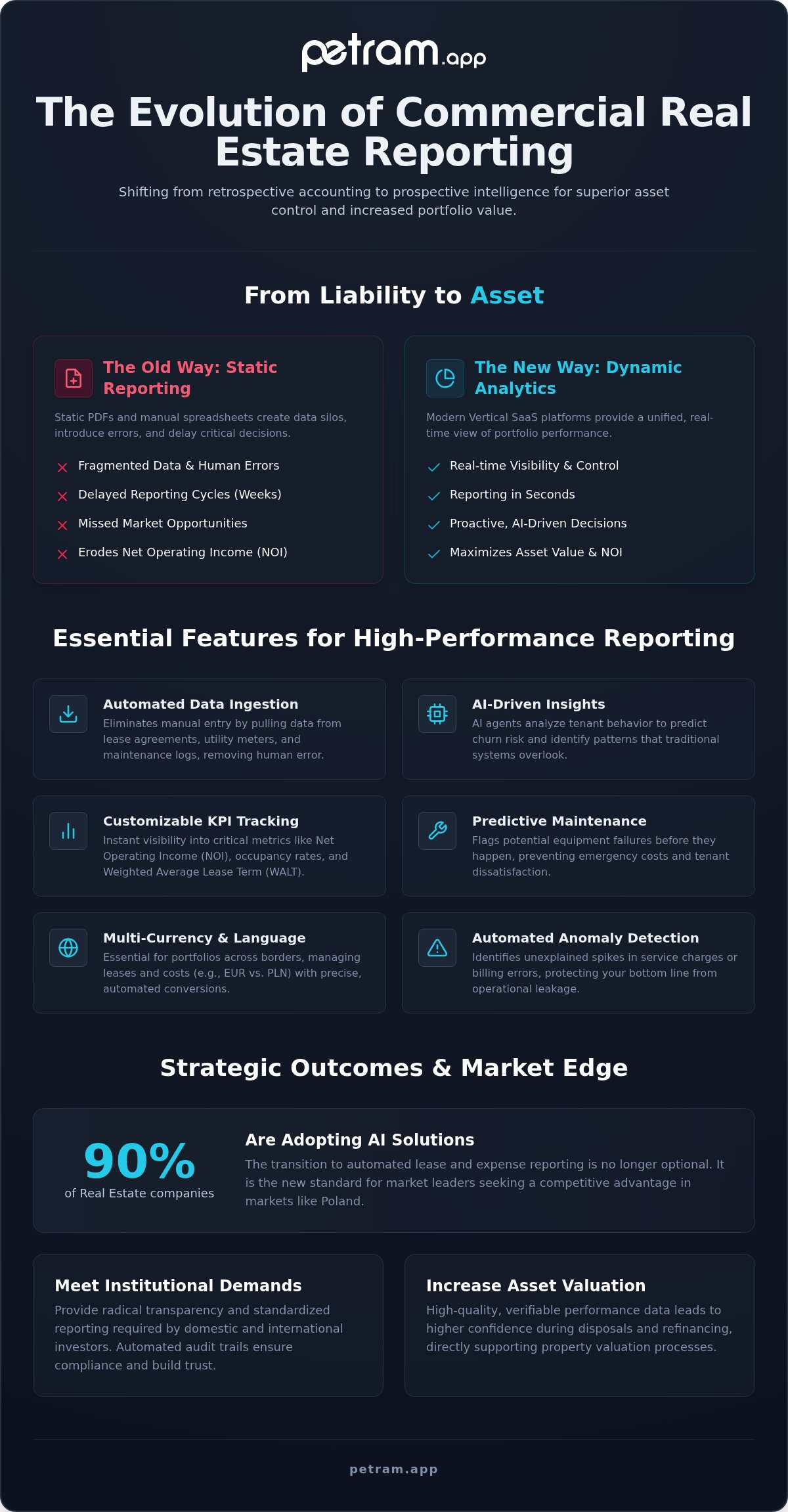
Commercial property reporting tools have transitioned from digital filing cabinets into sophisticated digital platforms. They consolidate disparate data points into actionable intelligence. In 2026, the industry has abandoned retrospective accounting. We now focus on prospective asset management. This shift allows owners to anticipate vacancies and optimize expenses before they impact the bottom line. Modern commercial real estate analytics software provides the real-time infrastructure necessary for national competitiveness in Poland’s evolving market. It’s no longer about looking back at what happened; it’s about predicting what comes next.
Vertical SaaS architecture plays a decisive role here. By eliminating data silos, these platforms ensure that property owners, asset managers, and accountants work from the same dataset. This alignment reduces operational friction and speeds up the decision-making process. When your digital infrastructure is unified, you gain a strategic advantage that legacy systems simply cannot match.
From Manual Spreadsheets to Dynamic Dashboards
Excel is a liability. It hides human errors and creates fragmented data silos that stall growth. Relying on manual entries often leads to reporting cycles that take weeks to finalize. By the time the report is ready, the market has moved. Dynamic dashboards reduce these cycles from weeks to seconds. They provide immediate visibility into portfolio health. Unlike generic business intelligence tools, CRE-specific platforms understand the nuances of lease structures, indexation, and service charge reconciliations. They provide the granularity required to manage complex Polish portfolios without the friction of traditional methods.
Meeting the Demands of Modern Institutional Investors
Institutional stakeholders demand radical transparency. Whether you’re dealing with domestic investors or international funds entering the Polish market, standardized reporting is the baseline. You must provide consistent data across diverse asset classes like office buildings in Warsaw and logistics hubs in Poznań. Automated audit trails ensure every financial adjustment is traceable and compliant with local regulations. This level of detail directly supports the property valuation process by providing accurate, verifiable performance history. High-quality data leads to higher confidence during disposals or refinancing. By adopting a unified commercial real estate analytics software, you professionalize your operations and meet the rigorous expectations of the modern capital market.
Essential Features for High-Performance Asset Reporting
High-performance asset reporting in 2026 demands more than just historical snapshots. It requires a system that functions as a central nervous system for your portfolio. The most effective commercial real estate analytics software now features automated data ingestion. It pulls information directly from digitized lease agreements, smart utility meters, and maintenance logs. This eliminates the latency inherent in manual entry. It also removes the risk of human error that often plagues complex financial reconciliations in high-value transactions.
Customizable KPI tracking remains the foundation of professional management. You need instant visibility into Net Operating Income (NOI), occupancy rates, and Weighted Average Lease Term (WALT). For portfolios operating across borders, multi-currency and multi-language support are essential. In Poland, managing assets with leases denominated in Euro but operating costs in Polish Zloty (zł) requires precise, automated conversion to maintain margin clarity. Granular expense tracking further optimizes performance by identifying operational leakages. This might include unexplained spikes in service charges or inefficiencies in facility management contracts that erode your bottom line.
AI-Driven Insights and Predictive Analytics
The real differentiator in 2026 is the shift from reactive to proactive reporting. AI agents now analyze tenant behavior to identify churn risks months before a notice period begins. They look for patterns in communication and payment history that traditional systems overlook. Predictive maintenance reporting also prevents capital expenditure shocks. By analyzing equipment performance data, the software flags potential failures. This allows you to repair a HVAC system before it breaks during a Warsaw heatwave, avoiding emergency costs and tenant dissatisfaction. Automated anomaly detection in service billing ensures you never overpay for utilities due to meter errors or vendor mistakes.
Integrated Tenant and Lease Performance Metrics
Strategic portfolio management relies on a clear view of lease expiry profiles. You must visualize your national exposure at a glance to manage re-leasing risks effectively. For retail-heavy assets, monitoring tenant sales performance is critical for calculating turnover rent and assessing unit viability. Generating a ‘rent roll’ for lenders or potential buyers used to take days of manual spreadsheet manipulation. Modern systems automate this entire process, providing a “single source of truth” for all stakeholders. If you want to see how these capabilities can streamline your operations, you might explore vertical SaaS solutions designed specifically for the Polish commercial market. This level of integration ensures your reporting is a tool for asset value optimization, not just a compliance requirement.
Evaluating Commercial Reporting Solutions: A Comparison Framework
Selecting a reporting engine is a high-stakes decision that dictates your portfolio’s agility. You must look beyond the sticker price. Assessing the total cost of ownership involves weighing license fees against implementation expenses. In the Polish market, implementation often involves complex data migration from legacy systems or localized accounting adjustments. If the hidden costs of setup and training aren’t quantified early, your projected ROI will evaporate. You need a clear understanding of the full financial commitment before signing a contract.
Ease of use is equally critical. If your property managers find the interface unintuitive, they’ll revert to manual workarounds. This compromises data integrity. Your commercial real estate analytics software should empower your team, not burden them with technical complexity. Integration capabilities also define your success. The tool must communicate seamlessly with your existing ERP and accounting systems to ensure a “single source of truth.” Finally, consider scalability. Whether you’re managing three office buildings in Warsaw or a national network of logistics hubs, the software must handle increased data volumes without performance degradation.
Cloud-Based Platforms vs. Legacy On-Premise Systems
Modern cloud-based infrastructure offers security advantages that legacy on-premise systems can’t match. Encrypted data storage and automated backups protect your sensitive financial records from local hardware failures. Field managers and remote stakeholders gain real-time access to performance metrics, allowing for immediate intervention when KPIs dip. By opting for a managed SaaS solution, you eliminate the need for extensive internal IT overhead. You focus on asset performance while the provider handles security patches and platform updates.
Vertical SaaS vs. Horizontal Management Tools
Generic management tools often fail because they lack the specialized logic required for commercial assets. A “one-size-fits-all” approach doesn’t account for the intricacies of turnover rent in retail or the complex service charge reconciliations in Grade A office spaces. Vertical SaaS solutions like Rezone are built with CRE-specific workflows at their core. They optimize reporting for specific asset types including office, retail, and logistics. This specialization reduces operational friction. It ensures that your commercial real estate analytics software understands the unique regulatory and financial landscape of the Polish market, providing a level of precision that horizontal tools simply lack.
Optimizing NOI Through Strategic Data Visualization
Strategic data visualization is the bridge between raw numbers and executive action. In 2026, board-level reviews don’t rely on thick binders of spreadsheets. They demand visual stories that highlight performance instantly. By using advanced commercial real estate analytics software, you can deploy heatmaps to identify high-performing versus underperforming assets across your national footprint. This allows you to see exactly where your capital is generating the best returns and where operational friction is eroding value.
Trend analysis for operational expenses across Poland provides the context needed for precision management. You can track rising utility costs or maintenance spikes in specific regions, allowing for proactive adjustments before they impact your year-end NOI. Hard data also serves as your strongest leverage during rent negotiations and capital improvement justifications. When you can visually demonstrate a building’s efficiency gains or market positioning, stakeholder buy-in becomes a streamlined process.
Visualizing Operational Efficiency and Expense Trends
Benchmarking utility costs across similar assets reveals hidden inefficiencies. If an office building in Kraków shows a 15% higher energy spend than a comparable asset in Warsaw, you have an immediate target for investigation. Visual charts help identify outliers in maintenance spending, ensuring that small operational leaks don’t turn into major capital expenditure spikes. Strategic visualization compresses months of analytical work into seconds of actionable clarity.
Building Automated Reporting Workflows for Stakeholders
Efficiency isn’t just about the data you see; it’s about how that data moves. You can establish ‘set-and-forget’ monthly report distributions that ensure every stakeholder receives the exact information they need without manual intervention. You might tailor specific views for owners who want high-level yields, managers who need granular opex, or lenders focusing on debt-service coverage ratios. By integrating automated property management workflows, you can trigger instant alerts when performance deviates from your baseline. This ensures you’re always ahead of the curve, rather than reacting to outdated figures. Modern commercial real estate analytics software shouldn’t just store data; it should actively communicate it.
Professionalize your reporting and scale your commercial portfolio with the precision of Rezone.
Elevating Portfolio Value with Rezone Reporting
Rezone redefines the standard for commercial real estate analytics software by embedding AI agents directly into its core reporting layer. This isn’t just about data storage. It’s about data activation. In the Polish market, where fragmented information often stalls growth, a unified vertical SaaS provides the necessary clarity to scale. By centralizing reporting, Rezone transforms your portfolio from a collection of assets into a high-performance investment vehicle. Transparent, digital data rooms further increase asset liquidity. They provide prospective buyers or lenders with immediate, verifiable proof of performance history. This reduces the friction during due diligence and positions your assets as premium opportunities in a competitive landscape.
AI Agents: The Future of Proactive Reporting
Administrative burdens often bury property management teams in low-value tasks. Rezone agents automate the collection of data from fragmented sources, including digitized invoices and legacy utility records. They don’t just present the numbers. These agents suggest specific NOI-improving actions based on real-time reports. For example, an agent might flag a recurring maintenance cost in a Kraków facility that exceeds the portfolio average or automatically prepare lease renewal scenarios. This shifts your team’s focus from data entry to strategic optimization. It turns your reporting engine into a proactive consultant that identifies opportunities you haven’t even quantified yet.
Scaling Your National Portfolio with Precision
Growth shouldn’t require a linear increase in headcount. Managing hundreds of units with a lean management team is now a reality through high-tech automation. Rezone allows you to centralize control while maintaining rigorous local asset oversight across Poland. You can monitor a logistics hub in Gdańsk and a retail park in Katowice from a single, authoritative interface. This precision ensures that no operational leakage goes unnoticed, regardless of portfolio size or geographic spread. Modernizing your national CRE strategy starts with choosing a partner that understands the future of the industry. You can get started with a Rezone property management SaaS demo today to see these AI agents in action. By adopting these tools, you replace the stress of complex management with the calm of automated efficiency and professional confidence.
Securing Your Competitive Edge in the 2026 Market
The era of retrospective reporting has ended. Success in the current landscape requires a transition from reactive accounting to prospective asset intelligence. We’ve examined how the right digital infrastructure eliminates data silos and transforms raw metrics into visual stories for executive action. Implementing a sophisticated commercial real estate analytics software is no longer a luxury; it’s a fundamental requirement for maintaining national competitiveness. By prioritizing vertical SaaS solutions over generic tools, you ensure your workflows are optimized for the specific demands of the Polish commercial sector.
Rezone stands at the forefront of this evolution. It provides AI-agent driven automation and national scale reliability that legacy systems simply cannot match. This platform is specialized for commercial assets, ensuring every feature directly contributes to increasing your net operating income. It’s time to replace the friction of manual entry with the calm of automated efficiency. Scale your portfolio with Rezone’s AI-driven reporting tools to professionalize your operations and unlock new levels of asset value. Your journey toward a modernized, high-performance portfolio begins with a single strategic decision.
Frequently Asked Questions
What are the most important KPIs for commercial property reporting?
Net Operating Income (NOI), occupancy rates, and Weighted Average Lease Term (WALT) are the primary indicators of portfolio health. You should also monitor service charge recovery ratios and indexation schedules to protect margins against inflation. Tracking these metrics through commercial real estate analytics software ensures you have a real-time view of asset performance. This allows for rapid intervention if an asset’s yield deviates from your strategic baseline.
How can reporting tools help increase Net Operating Income (NOI)?
Reporting tools identify operational leakages by benchmarking expenses across your entire portfolio. You can spot unexplained spikes in utility costs or maintenance spending that erode your bottom line. By visualizing these trends, you make data-driven decisions on capital improvements or service contract renegotiations. This proactive approach prevents small inefficiencies from scaling into significant financial losses, directly protecting your asset’s net cash flow and overall market valuation.
Is it difficult to migrate from Excel to a commercial reporting platform?
Migrating from spreadsheets is a structured process that modern platforms have simplified through automated data ingestion. You don’t have to manually re-enter every lease. The software maps your existing data into a unified database, ensuring a clean transition without losing historical records. While the initial setup requires a focused implementation phase, the long-term reduction in human error and reporting latency provides an immediate return on the investment.
Can AI agents really automate my monthly property reports?
AI agents handle the heavy lifting of data collection, anomaly detection, and summary drafting for your monthly cycles. They pull information from fragmented sources like utility bills and maintenance logs to compile a comprehensive overview. These agents can even suggest NOI-improving actions based on the data they analyze. This automation reduces the administrative burden on your management team, allowing them to focus on tenant relationships and strategic growth rather than manual document preparation.
What is the difference between residential and commercial reporting software?
Commercial software is built to handle complex lease structures including turnover rent, indexation, and multi-year service charge reconciliations. Residential tools typically focus on high-volume, simple tenancies that don’t require the same level of financial granularity. In a commercial context, you need a system that supports institutional reporting standards and diverse asset classes like office, retail, and logistics. Using a specialized commercial real estate analytics software ensures these professional requirements are met.
How does cloud-based reporting improve stakeholder transparency?
Cloud-based platforms provide a “single source of truth” that all stakeholders can access in real-time. Owners, lenders, and asset managers no longer rely on static PDFs that become outdated the moment they’re sent. You can set up automated report distributions and granular access levels to ensure everyone has the visibility they need. This transparency builds trust with institutional investors and speeds up the decision-making process for disposals or refinancing.
Are these reporting tools compliant with Polish financial regulations?
Modern platforms like Rezone are specifically localized to meet Polish financial and regulatory requirements. They handle local VAT regulations, indexation based on GUS or HICP data, and specific service charge reconciliation rules common in the Polish market. This localization ensures that your financial reporting is accurate for local tax authorities and compliant with national accounting standards, giving you the professional confidence to scale your operations safely within Poland.
Can I integrate my existing accounting software with Rezone?
Yes, Rezone utilizes an open architecture designed to integrate seamlessly with your existing accounting and ERP systems. This connectivity ensures that financial data flows between platforms without manual intervention or double entry. By bridging the gap between property management and accounting, you eliminate data silos and reduce the risk of reconciliation errors. This integration is vital for maintaining a lean management team while overseeing a growing national portfolio of commercial assets.