

In 2026, the competitive edge in commercial real estate isn’t found in a static dashboard; it’s owned by those who deploy AI agents to execute strategy in real time. You’ve likely felt the operational strain of fragmented spreadsheets and the frustration of reporting delays that can cost thousands of zł in missed market timing. Managing a high-value portfolio in Poland’s evolving market requires more than just historical views. It demands a proactive digital infrastructure.
This guide demonstrates how to master the transition to advanced real estate data analytics software. You’ll learn to move beyond passive data collection to embrace AI-driven insights that directly optimize your NOI and overall portfolio value. We will explore the mechanics of real-time performance tracking, automated tenant risk assessments, and predictive maintenance forecasting. By the end of this article, you’ll have a clear roadmap for replacing manual overhead with automated efficiency, ensuring your assets remain resilient and profitable in a sophisticated technological era.
Key Takeaways
- Transition from looking at what happened to predicting what should happen next by utilizing AI-driven prescriptive modeling.
- Optimize your real estate data analytics software by integrating high-impact data streams like real-time utility efficiency and maintenance cycles.
- Learn the strategic advantages of choosing vertical SaaS over horizontal BI to ensure your software understands the specific logic of commercial asset management.
- Follow a structured 5-step implementation plan to eliminate fragmented spreadsheets and identify hidden expense leakage across your portfolio.
- Leverage proactive AI agents to automate complex management tasks and drive consistent growth in your portfolio’s Net Operating Income.
The Evolution of Real Estate Data Analytics Software in 2026
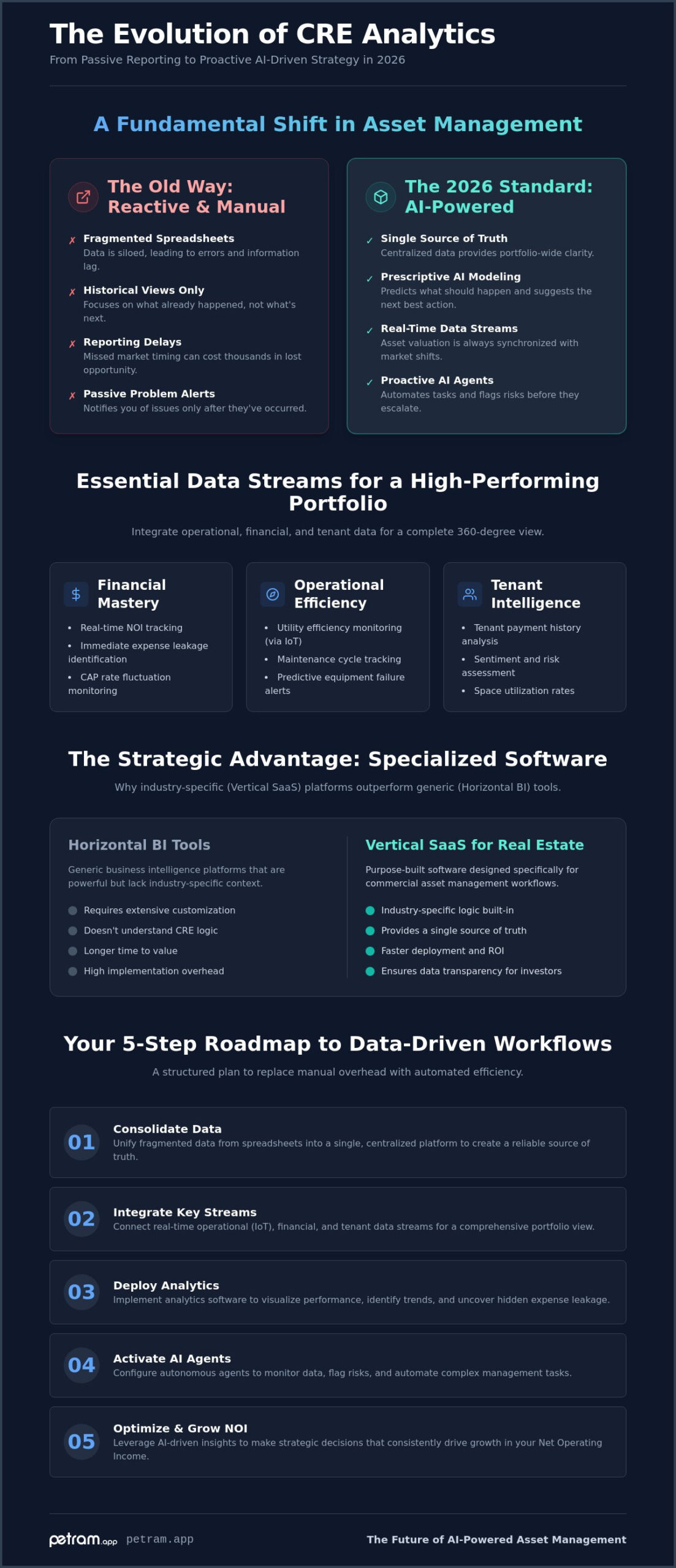
The era of passive observation in commercial real estate has ended. In 2026, the market moves at a velocity that renders traditional, manual tracking methods obsolete. Modern real estate data analytics software has transitioned from a tool for simple reporting into a robust engine of prescriptive intelligence. While legacy systems focused on descriptive analytics, telling you what happened last month, today’s high-performing portfolios rely on models that dictate exactly what you should do next to protect margins.
Relying on Excel-based tracking in the current Polish market is no longer a viable strategy; it’s a structural liability. Manual data entry creates an information lag that can lead to missed lease renewals or unoptimized utility costs, potentially draining thousands of zł from your bottom line. Asset managers now require vertical SaaS solutions that provide a single source of truth across diverse portfolios. This evolution is a fundamental pillar of modern Property technology (proptech), where industry-specific logic replaces the limitations of generic business intelligence.
From Passive Dashboards to Active AI Agents
Traditional BI alerts were designed to notify you of a problem after it occurred. The current standard involves AI agents that interpret incoming data to trigger immediate management actions. Instead of just seeing a notification about a tenant’s declining credit score, an AI agent can proactively flag the risk and suggest a restructured lease agreement or a proactive renewal outreach. This moves the manager from a reactive stance to a position of total control. Autonomous CRE Analytics is the standard for 2026.
The Impact of Real-Time Data on Asset Valuation
Dynamic property valuation is now driven by instantaneous data streams rather than static quarterly appraisals. This shift allows for a more granular understanding of how operational efficiency directly influences asset value. High levels of data transparency foster greater investor confidence, as stakeholders can verify performance metrics in real time. By eliminating the traditional reporting lag, you ensure that your portfolio’s valuation is always synchronized with the latest market shifts in Poland, providing a precise foundation for capital allocation and exit strategies.
Transitioning to these advanced systems isn’t just about upgrading your tech stack. It’s about fundamentally changing how your organization perceives and acts upon information. When data is live, every decision becomes more accurate, and every asset becomes more resilient.
This pursuit of asset resilience is a universal goal for property owners globally, whether managing commercial office space or specialized hospitality; for an example of a property that focuses on a high-quality, specialized guest experience, you can discover Pointes North Inn.
Essential Data Streams for High-Performing Commercial Portfolios
Maximizing the value of a commercial asset requires more than a cursory glance at occupancy rates. High-performing managers recognize that a building is a living ecosystem of data. While some platforms focus narrowly on foot traffic, sophisticated real estate data analytics software integrates internal operational metrics with external market context to provide a 360-degree view. You need to move beyond visible trends to capture the quiet signals within your infrastructure. Data is lifeblood. It’s the pulse of every square meter.
Financial mastery depends on real-time NOI tracking and the immediate identification of expense leakage. If a cooling system in a commercial office tower runs inefficiently for a week, the financial impact can be substantial. Monitoring CAP rate fluctuations and expense ratios through a centralized lens ensures that your financial strategy remains agile. Realizing the promise of data in commercial real estate requires this level of granular oversight, where every financial resource is accounted for and every revenue stream is optimized.
Optimizing NOI through Operational Efficiency
Operational data shouldn’t sit in a silo. By tracking utility efficiency and maintenance cycles, you can identify hidden costs that traditional accounting misses. Smart Building IoT sensors provide a constant stream of facility health indicators, allowing your real estate data analytics software to predict equipment failure before it happens. This predictive maintenance prevents sudden capital expenditure spikes. It transforms your maintenance team from a cost center into a value-preservation unit, keeping your operational overhead predictable and lean.
Tenant Retention and Sentiment Analytics
Tenant intelligence is the new frontier of risk management. By analyzing payment history alongside sentiment data and space utilization rates, you can predict lease defaults months before they occur. Behavioral patterns often signal a tenant’s intent long before a formal notice is served. Understanding how space is actually used allows you to optimize rent per square foot during renewals. When you build data-driven tenant profiles, your leasing strategies become surgical rather than speculative. You don’t just fill space; you curate a resilient tenant mix.
Market context completes the picture. Integrating competitive benchmarking and macroeconomic trends ensures your portfolio isn’t operating in a vacuum. If you’re looking to unify these disparate data streams into a single, actionable command center, exploring how Petram.app (Rezone) synchronizes operational and financial intelligence is a logical next step. True control comes from seeing the connections between a sensor alert, a tenant’s sentiment, and your bottom-line NOI.
How to Build a Modern Real Estate Analytics Stack
Constructing a high-performance tech stack requires a strategic choice between generic visibility and specialized intelligence. Many asset managers initially gravitate toward horizontal Business Intelligence (BI) tools because of their broad visualization capabilities. However, these platforms lack the inherent logic required to process complex commercial leases, CAM reconciliations, or tenant-specific recovery structures. Choosing a specialized real estate data analytics software ensures that your foundation is built on industry-specific protocols rather than generic data points. You don’t need a tool that just draws charts; you need a system that understands the financial architecture of a building.
An API-first architecture is the non-negotiable standard for 2026. This allows for seamless data ingestion from accounting modules, IoT sensors, and external market feeds without the need for manual CSV uploads. As you scale from a single office building in Kraków to a multi-national portfolio, your stack must maintain its integrity. This requires a cloud environment that prioritizes rigorous data security and regulatory compliance, particularly regarding GDPR standards in the Polish market. Protecting your data isn’t just a technical requirement; it’s a fiduciary duty that directly impacts your fund’s risk profile.
Vertical SaaS: The CRE Advantage
Generic tools require you to build data models from scratch, a process that can take months and cost thousands of zł in consulting fees. Vertical SaaS solutions like Rezone offer out-of-the-box CRE metrics that provide immediate value. These pre-built real estate data models understand the nuances of asset performance, allowing you to bypass the implementation hurdles of horizontal software. Rezone specifically integrates management workflows and analytics into one ecosystem, ensuring that every operational action is recorded and analyzed instantly. This integration eliminates the friction between “doing the work” and “reporting the work.”
Ensuring Data Integrity and Interoperability
The biggest obstacle to digital transformation is “dirty data” trapped in legacy paper-based systems or fragmented spreadsheets. You must implement a rigorous cleaning process to ensure that historical data is accurate before it enters your modern stack. Real-time syncing between your accounting and management modules is essential to prevent discrepancies that lead to expense leakage. In the context of 2026 CRE tech, Data Interoperability is defined as the ability of disparate software systems to exchange and interpret data autonomously without losing contextual meaning or requiring manual re-entry. This seamless flow is what allows real estate data analytics software to function as a true command center.
How to Implement Data-Driven Workflows: A 5-Step Guide
Implementation is where strategy meets execution. Transitioning to a data-driven model requires a tactical shift from observing results to engineering them. Most managers treat analytics as a post-mortem tool, looking at what went wrong after the quarter ends. To gain a competitive edge, you must integrate your real estate data analytics software directly into your daily operations. This isn’t just about installing software; it’s about a fundamental change in management philosophy that prioritizes speed and precision.
- Step 1: Audit your data silos. Identify where information is trapped. Whether it’s in isolated spreadsheets or legacy accounting software, these blind spots represent lost revenue and structural risk.
- Step 2: Define North Star metrics. Focus on what actually moves the needle for your fund. In the Polish market, this usually means maximizing NOI or optimizing energy-related operational costs in zł.
- Step 3: Select an integrated platform. Choose a solution that doesn’t just show data but uses AI agents to trigger workflows. This ensures that every insight leads to a documented management action.
- Step 4: Automate routine reporting. Free your team from the manual labor of compiling monthly PDFs. Automation ensures accuracy and allows your best talent to focus on high-level portfolio strategy.
- Step 5: Iterate based on predictive insights. Use the software’s forecasting capabilities to stay ahead of market cycles. Adjust your leasing and maintenance strategies before the market forces your hand.
Automating Commercial Lease Renewals
Lease management is traditionally reactive, leading to unnecessary vacancy periods and lost income. By setting triggers based on expiration data and local market rent benchmarks, you can initiate renewals six to twelve months in advance. Advanced real estate data analytics software can even draft renewal proposals by analyzing specific tenant performance and payment history. This proactive approach ensures you’re capturing maximum market value without the risk of extended downtime. You can discover how Rezone automates these workflows to protect your portfolio’s occupancy levels and long-term stability.
Transitioning from Reporting to Action
Rezone: The Future of AI-Powered Asset Management
Rezone represents the definitive evolution of real estate data analytics software. It moves beyond the limitations of generic visualization tools to provide a vertical SaaS architecture engineered specifically for the nuances of commercial ownership. By consolidating fragmented data streams into a unified digital infrastructure, Rezone provides asset managers with unparalleled portfolio-wide visibility. This level of integration is the key to modernizing workflows that directly increase long-term asset value and liquidity in the Polish market. It’s about total control over every square meter.
The software acts as a proactive partner rather than a passive repository. Traditional systems require you to hunt for insights; Rezone surfaces them through a sophisticated understanding of CRE logic. This shift from “data gathering” to “strategic execution” allows firms to remain agile in a market where timing is everything. When your digital infrastructure is synchronized, your assets become more resilient and your investment thesis becomes easier to defend to stakeholders.
Scaling with AI-Driven Efficiency
Efficiency in 2026 is defined by the ability to scale without bloating operational costs. Rezone allows small management teams to oversee expansive commercial portfolios by deploying AI agents that handle the heavy lifting of data interpretation. These agents ensure rigorous compliance with evolving Polish and EU regulations while executing routine management tasks with surgical precision. Automated workflows don’t just save time; they protect the bottom line by eliminating the information lag that leads to expense leakage and missed market opportunities. You can manage more with less, without sacrificing the granular oversight your assets require.
Getting Started with Rezone
The transition from legacy systems to a modern AI-powered stack is a streamlined journey. Rezone’s onboarding process focuses on modernizing legacy property data, ensuring that historical records are cleaned and integrated into your new digital ecosystem. You have the flexibility to customize AI agents to align with your specific investment strategy, whether your priority is maximizing NOI in Warsaw’s office sector or optimizing retail assets in regional cities. This bespoke approach ensures your technology is a direct reflection of your business goals. Optimize your commercial portfolio with Rezone today to secure your place at the forefront of the industry.
Mastering the Future of Commercial Asset Value
The transition from manual tracking to autonomous intelligence isn’t just a technical upgrade; it’s a strategic necessity for the modern asset manager. By integrating high-impact data streams and eliminating information silos, you protect your portfolio against market volatility and operational expense leakage. You’ve seen how the right real estate data analytics software transforms passive reporting into active, prescriptive management that directly boosts your Net Operating Income.
Success in Poland’s sophisticated real estate landscape requires a partner that understands the specific financial architecture of commercial assets. Rezone provides that foundation as an authorized vertical SaaS provider designed for commercial asset value optimization. With our integrated AI agent technology, you can move beyond observation to execute complex management tasks with surgical precision. It’s time to replace the stress of fragmented data with the clarity of automated efficiency. Request a demo of Rezone and see AI agents in action to begin your journey toward total portfolio optimization. The tools for your next phase of growth are ready when you are.
Frequently Asked Questions
What is the best real estate data analytics software for commercial portfolios?
Rezone is the premier choice for commercial managers because it’s a vertical SaaS engineered specifically for the complexities of CRE assets. Unlike generic business intelligence tools, it understands the financial architecture of complex leases and CAM reconciliations. This specialization allows managers to move beyond simple charts and into actionable, asset-specific intelligence that drives real value.
How does AI improve data analytics in commercial real estate?
AI moves the needle by transitioning your analytics from descriptive to prescriptive. It processes massive datasets to identify subtle patterns in utility consumption or lease compliance that traditional tools overlook. This allows for proactive interventions, such as adjusting cooling systems in a Warsaw office tower before a heatwave causes a cost spike in zł, protecting your margins in real time.
Can I integrate my existing accounting software with a new analytics platform?
Integration is a standard feature for modern platforms utilizing an API-first architecture. You can sync your existing accounting modules directly with your real estate data analytics software to eliminate manual CSV uploads and data silos. This real-time synchronization ensures that your financial reporting is always accurate and reflects the current state of your portfolio’s liquidity and performance.
What are the most important KPIs to track in commercial real estate analytics?
Focus on Net Operating Income (NOI), expense leakage, and tenant retention metrics. In the current Polish market, energy efficiency and ESG compliance indicators have also become critical performance markers for institutional investors. Tracking these KPIs through a centralized dashboard provides the clarity needed to make high-stakes capital allocation decisions without the fog of fragmented data.
How do AI agents differ from traditional real estate reporting tools?
Traditional reporting tools are passive; they tell you what happened after the fact. AI agents are active participants in your management strategy that trigger specific workflows based on incoming data. Instead of just flagging a late payment, an AI agent can initiate a standardized recovery process or draft a tenant communication automatically, reducing the operational burden on your team.
Is real estate data analytics software secure for sensitive financial information?
Security is a primary pillar of modern cloud-based property technology. Enterprise platforms utilize advanced encryption and strict access controls to protect sensitive financial and tenant data. For managers operating in Poland, ensuring your software is fully compliant with GDPR is non-negotiable for maintaining investor trust and adhering to strict European regulatory standards.
What is the difference between horizontal BI and vertical SaaS for real estate?
Horizontal BI tools are generic platforms that require extensive, costly customization to work for real estate. Vertical SaaS, such as Rezone, comes with pre-built data models and industry-specific logic already integrated. You don’t have to build your own metrics from scratch. You get immediate value from a system that already speaks the language of commercial asset management.
How much does real estate data analytics software cost for large portfolios?
Costs for enterprise-level platforms usually scale with the complexity and size of your portfolio. Most providers use a tiered subscription model based on the number of assets or the total square meters under management. While specific figures depend on your unique configuration, the investment is typically justified by the resulting growth in asset value and the significant reduction in manual operational overhead.