

What if a disputed CAM charge isn’t really about the amount, but about how the lease defines the expense or allocates it? CAM reconciliation disputes and how to avoid them start with identifying the exact clause and calculation behind the disagreement. A vague expense category, unclear cap, or record kept separately from the accounting entry can turn a year-end statement into a prolonged back-and-forth.
When the lease sets a short review or objection window, a fast response matters. But challenging a total without showing the reason is unlikely to resolve the issue. Compare the reconciliation with the executed lease, trace each questioned figure to its supporting records, and explain the discrepancy clearly within the applicable deadline.
This guide explains how to assess CAM charges against lease terms, organize evidence, and prepare a timely, fact-based objection or response. It also covers practical controls for keeping reconciliation records consistent from one period to the next. Rezone, Petram.app’s property-management platform for commercial real estate, supports digital workflows across property operations.
Key Takeaways
- CAM reconciliation disputes and how to avoid them become easier to manage when you identify the lease provision and calculation behind each questioned charge.
- Review eligibility, allocation, caps, credits, arithmetic, and supporting records as prompts for investigation, not automatic proof of an error.
- Protect your ability to respond by calendaring lease deadlines, separating disputed items, and keeping a clear written record of the review.
- Build recurring controls around each lease’s notice, statement, review, and response provisions to reduce last-minute reconciliation work.
- Consistent ownership and documented follow-up make reconciliation workflows more repeatable. Digital tools can support that work without replacing lease or accounting review.
What CAM Reconciliation Disputes Are, and Why Lease Language Comes First
A CAM reconciliation compares a tenant’s estimated payments for common area maintenance with the expenses the lease allows the landlord to recover for the relevant period. The statement may show an additional balance, a credit, or no adjustment. None of these outcomes proves on its own that the calculation is right or wrong. The lease determines which costs qualify and how the tenant’s share is calculated.
CAM is not automatically interchangeable with every operating expense associated with a property. One lease may include certain shared-area services, while another defines recoverable expenses differently or excludes particular costs. Property taxes, insurance, utilities, management fees, and capital expenditures may receive different treatment depending on the wording. Apply the relevant lease rather than relying on customary practice or another tenant’s arrangement.
A reconciliation discrepancy is a difference between a billed amount and a tenant’s calculation or expectation. A substantiated lease-based dispute identifies the specific charge, evidence, and lease provision that support the challenge. This distinction keeps the review focused. A tenant may question an amount without yet establishing that it conflicts with the contract.
Which lease terms govern a CAM reconciliation?
Start with the executed lease and any amendments or incorporated schedules. Locate the expense definition and exclusions, then review the allocation method, any caps, and the provisions covering statements and reconciliation. Read related documents together because a schedule or amendment may change how a clause applies.
Notice, payment, review, and audit periods vary by lease. Find the timing provisions that apply to the specific agreement instead of assuming a standard window. For a property or lease in Poland, or one involving another jurisdiction, qualified legal professionals can assess applicable local rules. Requirements may depend on both the governing documents and relevant law.
When does a difference become a dispute?
An arithmetic question may be resolved by checking the figures. A substantive disagreement arises when the parties differ on whether an expense is eligible, how it should be allocated, whether a cap applies, what documentation supports it, or how a lease clause should be interpreted. Treat each concern separately instead of challenging the statement as a whole without explanation.
Make each issue traceable by identifying the charge description, reconciliation period, amount in question, and lease clause you believe governs it. For example, if a shared-area expense appears to use an allocation basis that differs from the lease, state the calculation shown, the contractual basis you read, and the supporting record that would clarify the difference. This helps distinguish a missing explanation from a genuine contractual disagreement.
Clear property-management processes help teams maintain continuity between lease records, expense information, and review work. The commercial property management software strategic guide explores how digital operations platforms support structured property workflows. Better-organized records can help teams manage CAM reconciliation disputes and how to avoid them, while lease interpretation remains grounded in the applicable documents and professional legal review.
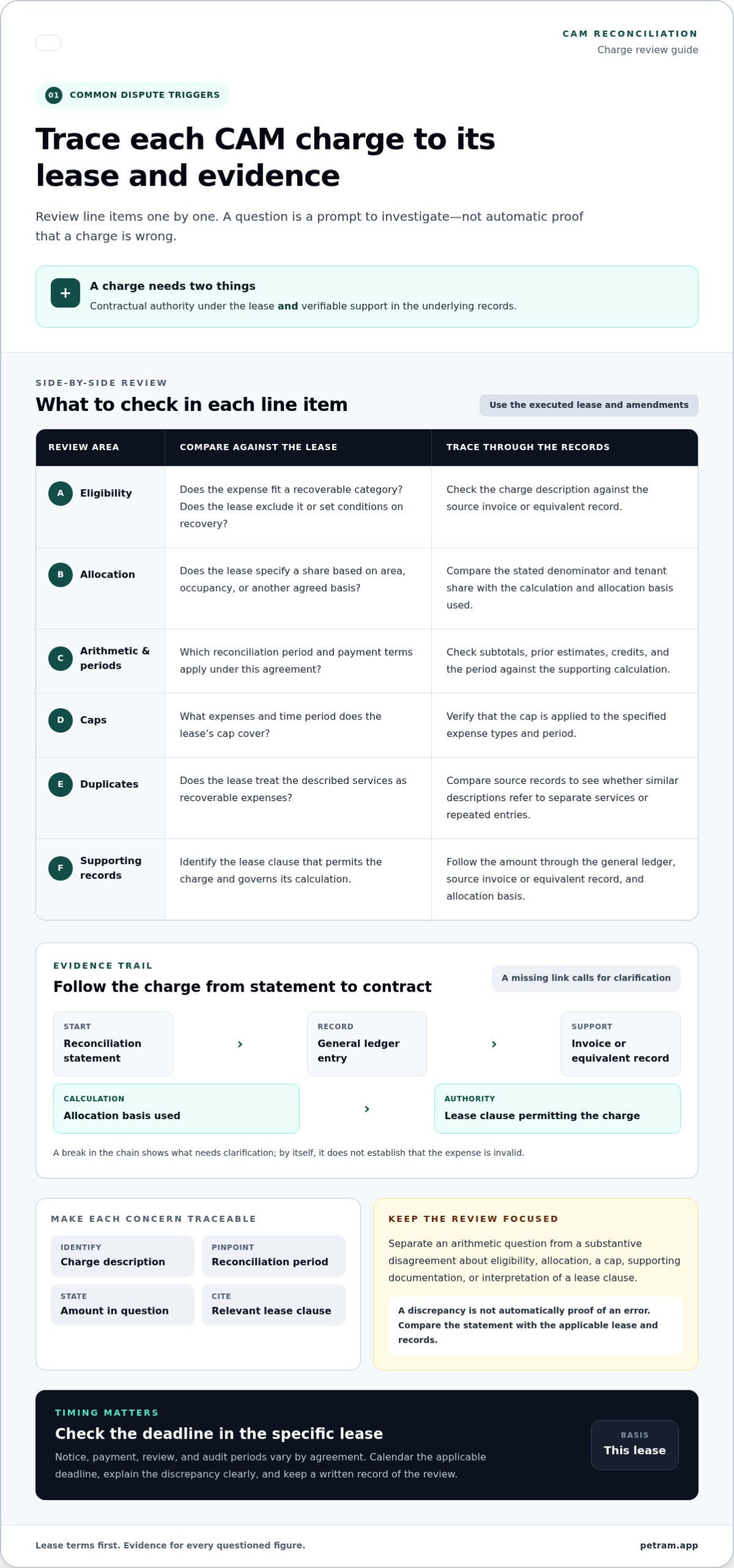
Common CAM Dispute Triggers: Trace Each Charge to Its Evidence
Review each line item rather than treating the reconciliation as one unexplained total. Check eligibility, allocation, arithmetic, caps, credits, and supporting records. These are prompts for investigation, not automatic signs of improper billing. Apply the lease’s definitions and calculation rules consistently across the statement.
A CAM charge needs both contractual authority under the lease and verifiable support in the underlying records. Trace the amount from the reconciliation statement to its general ledger entry, source invoice or equivalent record, allocation basis, and the lease clause that permits the charge. A break in that chain shows what needs clarification, but does not by itself establish that the expense is invalid.
Which expense and allocation issues deserve scrutiny?
Compare each expense category with the lease’s included and excluded language. Then test the calculation against the specified allocation method, such as the tenant’s share of area, occupancy, or another agreed basis. Review caps and credits separately. A cap may apply only to defined costs, while a credit may relate to a different period. Verify the method rather than assuming an error.
- Eligibility: Does the expense description fit a recoverable category? Does the lease exclude it or set conditions on recovery?
- Allocation: Do the stated denominator and tenant share match the basis identified in the lease?
- Arithmetic and periods: Do subtotals, prior estimates, credits, and the reconciliation period match the supporting calculation?
- Caps: Is the cap applied to the expense types and time period specified in the lease?
- Duplicates: Do similar descriptions refer to separate services, or could they be repeated entries? Compare source records before drawing a conclusion.
What records help substantiate or challenge a charge?
Gather the reconciliation statement, executed lease and amendments, prior statements, and relevant operating records. For each questioned line, connect the accounting entry to an invoice or equivalent source record, the period it covers, its expense category, and the allocation calculation. Organize the trail by charge so a reviewer can follow the reasoning without piecing it together from scattered files.
If a source document or calculation is missing, specify what would answer the question. For example, request the invoice supporting a named expense or the calculation showing how a stated allocation basis was applied. Record the request and response beside the item. Missing evidence calls for clarification, but is not proof that the underlying cost is ineligible. This approach makes CAM reconciliation disputes and how to avoid them easier to assess by separating an unanswered question from a substantiated lease-based challenge.
Consistent records depend on reliable property-management workflows. Rezone property-management software provides a digital operations platform with AI agents designed to support commercial property workflows. It can help teams create continuity across property-management records, alongside lease analysis and professional advice.
How to Handle a CAM Reconciliation Dispute Without Losing the Audit Trail
A disciplined process keeps a disagreement specific, timely, and reviewable. Preserve the original reconciliation statement and record each action as it happens. That creates a clear history of what was questioned, what evidence was considered, and how each party responded.
- Calendar the applicable deadline. Check the executed lease, amendments, and relevant schedules for the actual notice, review, payment, audit, and response provisions. Record where each date comes from and allow time to gather records before a required response. Don’t assume a standard review window applies.
- Reconcile the statement. Compare billed amounts with prior estimates, credits, available supporting records, and the lease’s calculation method. As questions arise, note the specific charge and period involved.
- Isolate each disputed item. Separate questions about expense eligibility, allocation, arithmetic, caps, and missing documentation. Distinguish what you can verify from what remains unresolved so the issue is clear to both parties.
- Respond in writing and track follow-up. State the basis for each question, identify the lease language and evidence reviewed, and request a specific correction, record, or explanation. Retain the sent communication and delivery record, then track replies against the lease requirements.
Keep disputed and undisputed amounts distinct in your records. Don’t assume that raising an objection changes a payment obligation or suspends a deadline. Follow the lease and seek applicable professional advice before deciding how to handle payment while an issue remains open.
A neutral issue log makes the process easier to hand off and less dependent on individual memory. Include the charge, period, relevant lease clause, evidence reviewed or requested, requested correction, responsible owner, and current status. Date each update, preserve earlier entries, and record both the landlord’s explanation and the tenant’s response. Capture the facts without presenting either party’s position as established before the review is complete.
How should a written objection be structured?
Identify the reconciliation statement and billing period, then list each questioned charge separately. For each item, cite the relevant lease provision, explain the calculation or documentation concern, and specify the record or clarification requested. Ask for a written response, retain delivery evidence, and track the response date against the lease’s actual terms.
What if the parties cannot resolve the disagreement informally?
Before escalating, review the lease’s audit, dispute-resolution, notice, and escalation provisions. Preserve the original statement, correspondence, source documents, calculations, and each revised version in a dated record. If the disagreement remains material or turns on rights or interpretation, seek qualified legal or accounting advice appropriate to the governing jurisdiction.
A timely, specific objection tied to a lease clause and supporting evidence is more useful than a general rejection of the reconciliation. To manage CAM reconciliation disputes and how to avoid them, define the issue, preserve the record, and follow the agreed process without blurring what is known with what still needs to be established.
Prevent Repeat CAM Reconciliation Disputes With Consistent Controls
A dispute often exposes a process gap: inconsistent expense coding, unclear ownership, missing source records, or a review that starts too close to a deadline. Fixing one statement may settle one issue. Preventing recurrence takes controls that operate throughout the year and make the next reconciliation easier to prepare and verify.
| Control area | Reactive fix | Preventive control |
|---|---|---|
| Timing | Search for records after a question arrives. | Maintain a recurring calendar based on each lease’s actual statement, notice, review, and response provisions. |
| Ownership | Route questions informally between teams. | Assign responsibility for coding, statement preparation, quality review, and tenant communication. |
| Evidence | Rebuild support from scattered files. | Apply consistent coding and retain source documents with clear period coverage and links to accounting entries. |
| Review status | Rely on email threads to track progress. | Record review, approval, open questions, and version changes in a consistent process. |
Keep the calendar specific to each lease. Don’t automatically copy one property’s review dates or notice requirements to another, even if the agreements appear similar. Use the executed documents and amendments to set reminders for relevant milestones, then assign an owner to confirm completion and flag approaching actions.
How can property teams make records easier to review?
Standardize expense categories, file naming, accounting periods, and approval history across properties. Make each entry traceable to its supporting record, and retain the version used in the review. Comparing with prior periods can flag an unusual change in an expense or allocation for investigation. A variance is a reason to examine the facts, not proof that a charge is wrong.
Clear accountability matters. The person coding an expense may not be the person reviewing a statement or communicating with a tenant. Define those handoffs, including who resolves coding questions and who confirms that supporting records are ready for review. Shared conventions make the process easier to follow when responsibilities change or teams manage multiple properties.
Where can software and AI support the workflow?
Digital operations platforms and AI agents can support workflow coordination by helping teams organize operational tasks and improve process visibility. They don’t replace lease interpretation, accounting review, or professional judgment. Their value depends on disciplined inputs, assigned ownership, and clear review steps. Rezone is vertical SaaS for commercial real estate property management, with AI agents designed to support operational workflows.
For teams strengthening the digital foundation behind repeatable property operations, explore Rezone’s commercial property management platform. Consistent controls won’t determine how every clause should be interpreted, but they can make records and responsibilities easier to manage and help teams approach CAM reconciliation disputes and how to avoid them more reliably.
Turn CAM Dispute Resolution Into a Repeatable Property-Management Workflow
A reconciliation issue is harder to resolve when information sits in separate inboxes, spreadsheets, and accounting records, with no clear owner for the next step. A repeatable workflow connects each stage, from receiving a statement to recording the outcome. It doesn’t determine whether a charge is valid. It helps teams apply the right review process and preserve a coherent record.
What should a repeatable reconciliation workflow contain?
Map the process from statement receipt through lease-term review, evidence gathering, objection handling, and resolution recording. Give each stage an accountable owner and identify who takes over if an issue remains unresolved. A workflow should guide coordination, not impose the same contractual timetable on every property.
- Intake: Record the statement, property, relevant period, receipt date, and applicable lease documents.
- Review: Assign responsibility for comparing the statement with lease terms and gathering relevant evidence.
- Response: Identify who prepares and approves communications, and who tracks open questions and replies.
- Resolution: Record the agreed outcome, remaining disagreement, and any follow-up needed for the property record.
Responsibilities may span landlords, property managers, finance teams, and tenant representatives. Define who owns each handoff, including escalation when a question needs accounting or legal review. The workflow must follow the applicable lease and amendments, along with relevant jurisdiction-specific requirements. In Poland or elsewhere, qualified professionals should assess those requirements instead of relying on a generic process.
How does Rezone fit into a broader CRE operations strategy?
Manual coordination offers flexibility, especially when teams need to adapt to different lease provisions or unusual cases. Its limitations appear when task ownership, records, and follow-up depend on individual habits. Digital workflows provide a more consistent structure for organizing operational work and tracking responsibilities, while interpretation and decisions remain with the appropriate people.
Rezone is vertical SaaS for commercial real estate property management, with AI agents designed to support operational workflow optimization. A platform can support consistent coordination, but it should not be treated as deciding lease eligibility, validating a charge, or resolving a dispute. For wider context on digital operations in commercial real estate, explore this commercial property management software guide.
Make the process repeatable: clarify ownership, connect review stages, and record outcomes in a way the team can carry forward. These foundations help property teams manage CAM reconciliation disputes and how to avoid them without treating every lease or disagreement as identical. Explore Rezone as a platform for modernizing commercial property operations.
Make the Next Reconciliation Cycle More Predictable
Use the next cycle to improve how your property team works together. Choose a property and map how information moves between operations, finance, and lease administration. Clarify who owns each handoff and where decisions are recorded. A focused workflow review can reveal friction before it becomes routine, while keeping each lease’s terms at the center of the process.
That operational discipline gives teams a stronger foundation for managing CAM reconciliation disputes and how to avoid them. The goal isn’t to eliminate every disagreement. It’s to make the work behind each review more visible, consistent, and easier to carry forward as responsibilities or portfolios change.
Rezone is vertical SaaS designed for commercial real estate property management, with AI agents that help streamline operational workflows. Explore Rezone’s commercial property management platform to see how a digital operations platform can support your broader property-management strategy. Start building a more connected operating model, one deliberate improvement at a time.
Frequently Asked Questions
What is a CAM reconciliation dispute?
A CAM reconciliation dispute arises when a landlord and tenant disagree about the lease-based treatment or calculation of shared property expenses. For example, a tenant may question whether a year-end adjustment reflects the same expense period covered by its estimates. To assess CAM reconciliation disputes and how to avoid them, identify the issue at line-item level and distinguish a normal true-up from a claim that the lease or calculation was applied incorrectly.
How long does a tenant have to dispute CAM charges?
There’s no universal deadline. The applicable period depends on the lease and, where relevant, local law. Check whether the timing runs from the statement date, receipt, or another event, and confirm any specified notice method. Don’t assume a period quoted in a general guide applies to your contract. Record the trigger date and seek qualified advice promptly if the language is ambiguous or the deadline may be close.
Can a tenant dispute CAM charges without invoices?
A tenant can raise a focused question or request supporting records, subject to the review and audit rights in the lease. If a single vendor invoice covers several services or areas, for example, ask for the basis used to assign the relevant portion to CAM. Specify what record would help clarify the amount. The absence of an invoice in the initial statement doesn’t by itself establish that the underlying cost is invalid.
What CAM expenses are commonly disputed?
Disagreements can involve costs that appear in more than one category, credits that don’t seem to flow through to the final statement, or a charge whose description doesn’t explain its purpose. If similar service entries appear twice, compare their dates, vendors, and source records before concluding they’re duplicates. Treat these as signals for review, not automatic overcharges. The lease determines which categories and calculations apply.
What should a CAM dispute letter include?
A useful letter makes each request easy to answer. Identify the statement and period, then describe the charge and the specific information needed to evaluate it. For example, ask the recipient to explain how a particular credit was applied rather than making a broad claim that the reconciliation is incorrect. Attach or reference relevant calculations, follow the lease’s notice method, and keep a copy of the communication and delivery confirmation.
What happens if a landlord and tenant cannot resolve a CAM dispute?
If direct discussion doesn’t settle the matter, the next step depends on the contract and applicable law. Check whether the lease calls for an audit, a defined review procedure, or another escalation route before taking action. Don’t assume a dispute automatically changes payment or other contractual obligations. Preserve each party’s position and the records behind it, then seek qualified legal or accounting guidance if interpretation or material amounts remain contested.
Can property management software prevent CAM reconciliation disputes?
Software can’t decide whether a lease permits a charge, but structured digital operations can help teams coordinate responsibilities and move work through established review stages. Retain human oversight of lease interpretation and accounting judgment. Rezone is commercial real estate property-management SaaS with AI agents designed to support operational workflow optimization, not guarantee dispute resolution.
Are CAM reconciliation rules the same in every country?
No. Lease wording and applicable local requirements can affect how reviews and disputes are handled, so a procedure used in one jurisdiction may not fit another. For a portfolio operating across borders, maintain a consistent internal framework while documenting each lease’s governing terms and jurisdiction-specific requirements separately. In Poland or elsewhere, consult qualified local legal or accounting professionals before applying a policy that could affect contractual rights or deadlines.