

A building can be well run and still underperform as an investment. That’s why asset management vs property management in real estate isn’t just a question of job titles. It’s about connecting daily building decisions to the owner’s wider objectives. When responsibilities overlap or updates don’t reach the right people, it becomes harder to understand how leasing, expenses, and operations affect portfolio performance.
The distinction can feel unclear because both roles influence a property’s results, but they work at different levels and make different types of decisions. This article explains where strategic asset oversight ends and property-level execution begins, where the roles intersect, and how clear decision rights and information handoffs strengthen coordination. You’ll also see how digital workflows can improve visibility without replacing professional judgment. For commercial real estate teams, Rezone provides software tools and AI-driven management workflows to help connect operational activity with broader management priorities.
Key Takeaways
- In asset management vs property management in real estate, distinguish portfolio-level direction from building-level execution before assigning decisions.
- Map who recommends, approves, coordinates, and reports so overlapping responsibilities don’t create gaps or delays.
- Compare roles by scope, time horizon, decisions, and outputs, then adapt the framework to your organization’s structure.
- Connect portfolio objectives to property plans through clear stages, defined decision points, and consistent records.
- Use commercial real estate software as a shared workflow layer to improve visibility while keeping accountable professionals in control.
Asset Management vs. Property Management in Real Estate: Why the Distinction Matters
Asset management sets investment direction; property management coordinates execution at the property level. One focuses on how real estate supports the owner’s objectives across a portfolio. The other organizes the work and information needed to operate individual buildings. Understanding the difference helps owners assign decisions clearly and connect day-to-day activity with broader performance priorities.
The roles are related, but they aren’t interchangeable. Asset managers assess performance information and determine where attention may be needed. Property managers coordinate building operations and report what is happening on the ground. Investment management, often referred to as financial asset management, includes real estate as an asset class. In practice, real estate asset oversight turns that broader perspective into priorities for a property or portfolio.
What is real estate asset management?
Real estate asset management is the portfolio-level planning and performance oversight that aligns property decisions with an owner’s objectives. An asset manager evaluates information such as operating results, leasing conditions, and property plans to set priorities, monitor progress, and identify issues that may need review. The role focuses on direction and oversight, not personally handling every building task.
For example, if a building’s leasing activity or costs differ from expectations, an asset manager may assess what the variance means for the property plan and decide whether priorities or approvals need to be revisited. This is oversight, not a guaranteed outcome or investment recommendation.
What is real estate property management?
Real estate property management is the coordination of a specific building’s operations, tenant interactions, service requests, and routine administration. Property managers organize recurring work, communicate with relevant parties, and keep activity moving within their assigned authority. Their execution and reporting also give asset managers and owners information to use in broader performance reviews.
For instance, a property manager may track a tenant request through the agreed process and report its status, while an asset manager considers how recurring operational issues relate to property-level priorities. The precise tasks and authority depend on the management agreement and organizational structure.
Both perspectives are necessary. Strategic oversight without reliable operating information can leave decisions disconnected from building conditions. Strong operations without clear direction can keep tasks moving without showing how they support the owner’s objectives. Coordination closes that gap: priorities inform property plans, and operational records help decision-makers evaluate progress and respond to emerging issues.
The distinction in asset management vs property management in real estate is a practical question of decision ownership, not simply terminology. Responsibilities vary by organization, portfolio structure, and management agreement. In one structure, an owner may approve major priorities while a manager recommends and coordinates implementation; in another, decision rights may be distributed differently. Clear role definitions show who recommends, who approves, who executes, and who reports, without assuming there is one universal org chart.
How Asset and Property Managers Divide Responsibilities and Decisions
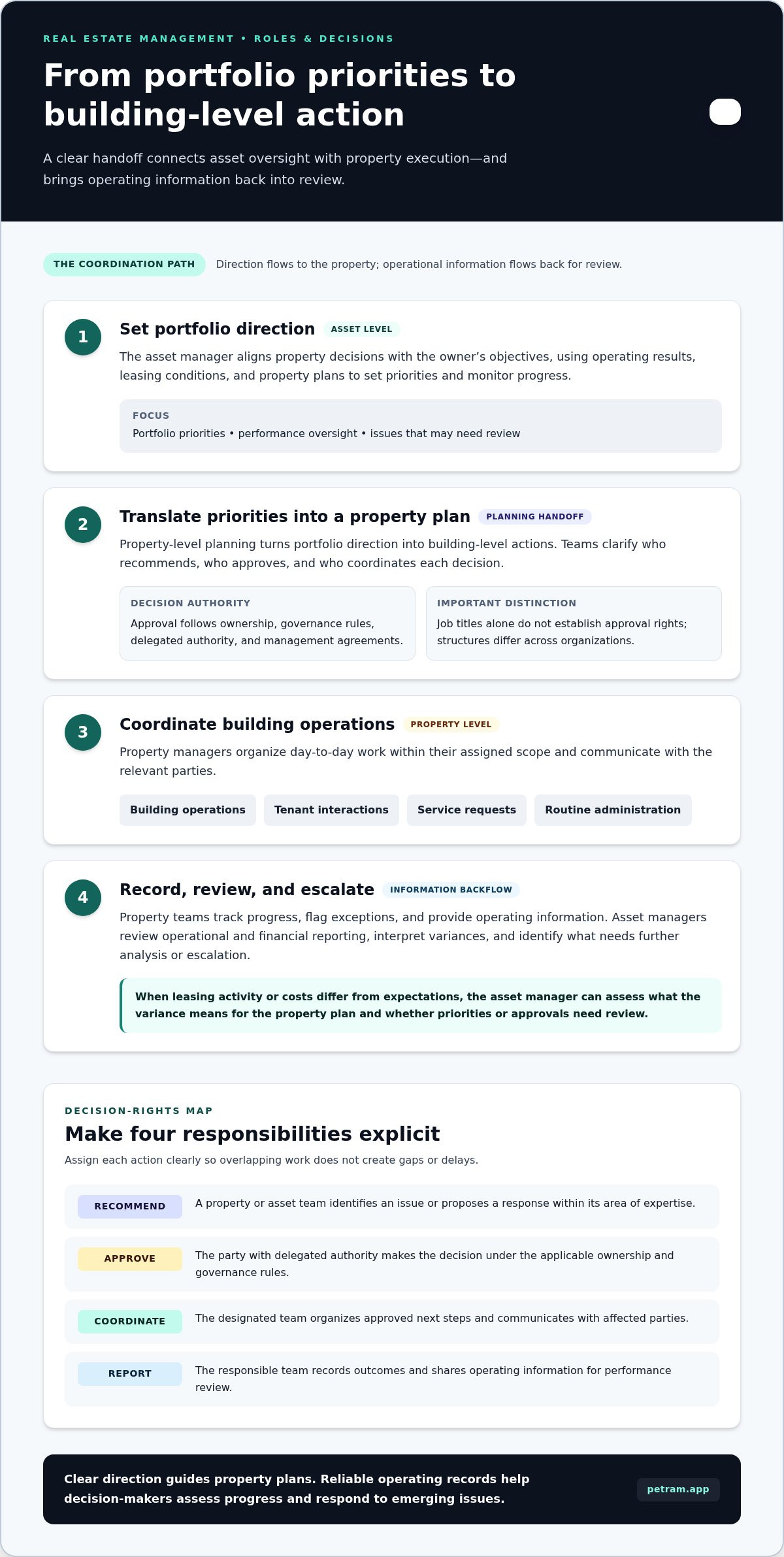
Responsibilities are easiest to distinguish by decision horizon. Portfolio direction sets priorities; property planning translates them into building-level actions; recurring execution generates the activity and reporting used to assess progress. There is no universal org chart. Ownership structure, delegated authority, and management agreements determine who recommends, approves, coordinates, and reports at each stage.
Which decisions sit at the asset level?
At the asset level, managers may assess portfolio priorities, define or monitor performance targets, and review whether individual property plans remain aligned with owner objectives. They use operational and financial reporting to interpret results, identify variances, and decide what needs further analysis or escalation. An asset manager may recommend a revised priority, while approval authority rests with the owner, investment committee, or another designated decision-maker under the relevant governance arrangements.
Which responsibilities sit at the property level?
Property-level teams coordinate building operations, tenant-facing communication, service requests, and routine activity tracking within their assigned scope. They record progress, flag exceptions, and provide timely operating information for review. If a recurring issue affects a property plan or requires a decision beyond delegated authority, the team can escalate it with the relevant context. Specific duties differ by contract and organizational structure, so job titles alone don’t establish approval rights.
A practical responsibility map separates the work into four actions:
- Recommend: A property or asset team identifies an issue or proposes a response within its area of expertise.
- Approve: The party with delegated authority makes the decision, based on ownership and governance rules.
- Coordinate: The designated team organizes the approved next steps and communicates with affected parties.
- Report: The responsible team records outcomes, open items, and relevant changes for oversight.
Consider a pattern of tenant requests related to the same building system. The property team can log the requests, coordinate a response within its authority, and report whether the issue recurs. The asset manager can review that operating information alongside other property and financial reporting. If the pattern affects a property priority, the asset manager may recommend a change or further review; the appropriate owner or delegate decides whether to approve it. This creates a traceable handoff without asking either role to duplicate the other’s work.
Clear thresholds make the handoff useful. Define which matters can be handled through routine coordination, which require a recommendation, and which need formal approval. Then specify what information accompanies an escalation, such as the issue, its status, relevant context, and the decision required. That way, reporting informs planning instead of becoming a disconnected record of activity.
For teams refining these handoffs, commercial real estate workflow software can support organized coordination and visibility. In the broader asset management vs property management in real estate framework, technology helps teams share information, while accountable people remain responsible for decisions.
Asset Management vs. Property Management: A Practical Comparison
The most useful comparison isn’t a rigid job description. It shows how each function contributes to decisions and what it produces. In asset management vs property management in real estate, the distinction becomes clearer when you compare objectives, scope, time horizon, decision focus, and outputs side by side. The examples below are illustrative; actual mandates and approval rights differ across organizations.
Compare objectives, time horizons, and outputs
Use the comparison as a working reference, then adapt it to the ownership structure and management agreements in place. An output should give the next person enough context to review, approve, coordinate, or report the work.
| Comparison area | Asset management | Property management |
|---|---|---|
| Primary objective | Align property performance and plans with owner objectives; output: priorities or an asset plan. | Coordinate reliable building-level delivery; output: completed operational workflows and activity records. |
| Scope | One asset or a portfolio, depending on the mandate; output: portfolio or property-level review. | A specific building or assigned group of properties; output: property operating updates. |
| Time horizon | Strategic and periodic, with priorities reviewed as performance information changes; output: updated direction or review notes. | Recurring and near-term, focused on ongoing activity; output: current task status and operating records. |
| Decision focus | Assess performance, set priorities, and make recommendations or seek approval; output: a documented decision or recommendation. | Coordinate activity within delegated authority and escalate exceptions; output: action status and a decision request when needed. |
| Typical information | Needs operational updates and relevant financial reporting to assess progress; output: analysis for oversight. | Needs clear priorities, authority limits, and reporting expectations; output: operating information for review. |
Where do asset and property management overlap?
Improvement planning is a common intersection. An asset manager may assess whether an upgrade supports a property priority and identify the decision or approval required. A property manager may coordinate the approved work within the assigned scope, track progress, and report relevant operating impacts. Neither role automatically controls every decision; delegated authority and governance determine who recommends and who approves.
Take a building upgrade as an example. The property team can provide information about the issue, operational constraints, and work status. The asset team can evaluate that information against the property plan and prepare a recommendation if a strategic decision is needed. The designated owner or approver then decides whether to proceed. After approval, the responsible property team coordinates execution and reports the outcome. A clear escalation path prevents a proposal from being mistaken for approval, while an assigned coordinator reduces duplicate follow-ups.
Practical takeaway: Asset oversight needs timely operating records, exceptions, and status updates from the property level. Property teams need current priorities, decision boundaries, and clear escalation routes from asset oversight. That information exchange makes the comparison useful in practice, not just on an organization chart.
How to Coordinate Asset and Property Management in a Real Estate Portfolio
Coordination works best as a repeatable cycle: set objectives, translate them into property plans, track execution, and review outcomes. Each handoff should identify an owner, the information needed, the decision to be made, and the record that closes the loop. The process below uses a hypothetical commercial building; teams can adapt it to their portfolio and management structure.
- Set objectives. The owner or delegated asset lead establishes the property’s priorities. They need relevant portfolio direction and current property information, such as operating updates and outstanding issues. The decision is which objectives should guide the next planning period. Record them in an approved objective or planning document so the property team has a clear reference.
- Translate objectives into a property plan. The asset lead and property team shape the objectives into proposed actions, responsibilities, and review points. They need building-level context, operational constraints, and clarity on who can authorize each action. The designated approver decides which proposals proceed. Record the agreed plan, decision owner, and any conditions attached to approval.
- Track execution. The property team coordinates approved activity and provides updates against the plan. Relevant information includes status, changes, unresolved dependencies, and issues that may affect delivery. The decision point is whether work remains within the agreed scope or needs escalation. Keep a consistent status record, including open items and the next action owner.
- Review outcomes. The asset lead reviews property updates alongside the objectives and other relevant reporting. They determine whether the plan remains appropriate, needs adjustment, or requires a further decision from the owner or delegate. Record the review outcome, rationale, and any revised priorities, then communicate them to the property team.
Create clear decision rights and escalation paths
For each action, define who proposes it, who approves it, and who coordinates completion. Set escalation triggers around deviations from the agreed plan using thresholds established by the organization, rather than assuming one standard applies to every property. Document each handoff and decision in a shared record. This makes responsibilities easier to follow across teams and properties, especially when a recommendation is still awaiting approval.
Connect property reporting to portfolio review
Choose a reporting cadence that fits the portfolio, the nature of the work, and the management structure. A routine update can summarize progress and open items; an exception report can bring a material deviation to the appropriate decision-maker sooner, according to the agreed process. Keep reporting definitions consistent so asset-level reviewers can interpret updates across properties without losing important local context. Human review remains essential: records inform decisions, while accountable people assess their meaning and authorize changes.
Clear objectives, traceable handoffs, and consistent reporting give both functions a reliable operating rhythm. Rezone property management software supports connected workflows for commercial real estate teams.
How Commercial Real Estate Software Supports Connected Management
Software can provide a shared workflow and information layer between portfolio oversight and building-level activity. Its role is to help teams organize work and maintain consistent records, not to decide which priorities matter or replace accountable managers. Clear records give reviewers a more coherent view of activity; professional judgment still determines what the information means and what action is appropriate.
For example, a property team might document an update against an agreed plan. Asset-level reviewers can use that information during a portfolio review, while the property team remains responsible for reporting accurate operating status. If information is fragmented across separate records or handoffs, teams may spend time reconciling the picture instead of assessing it. A connected workflow can make those handoffs easier to follow.
What to assess in a shared management platform
Evaluate a platform against the way your teams make and carry out decisions. The right criteria depend on portfolio structure, reporting needs, and assigned responsibilities. Consider whether the system can support strategic oversight and property-level execution without blurring who owns each decision.
- Workflow fit: Can teams represent the handoffs between planning, operating activity, review, and follow-up?
- Data consistency: Can relevant teams work from records that use clear, agreed definitions?
- Role clarity: Is it apparent who owns a task, who reviews it, and who has authority to decide?
- Reporting visibility: Can reviewers understand status, context, and unresolved items without losing property-level detail?
- Team adoption: Can the people responsible for maintaining and using records follow the process consistently?
These are evaluation questions, not assumptions about what every platform provides. A system is useful only when its workflows reflect actual decision rights and teams keep its information current. Define the process first: decide what needs recording, who updates it, and how the information supports review. Then assess whether a platform makes that process practical.
Where Rezone fits in the operating model
For commercial real estate owners and managers, Rezone is a vertical SaaS platform focused on commercial real estate management workflows. Its AI-driven management tools support workflow optimization and are designed to help users increase asset value. In an operating model, software can support coordination and visibility, while owners, asset managers, and property teams remain responsible for decisions and execution.
That distinction matters in asset management vs property management in real estate: digital tools can help connect information across roles, but they don’t replace clear mandates, thoughtful review, or accountable people. A practical next step is to identify where handoffs and records become difficult to follow, then consider how a purpose-built workflow layer could support the process.
Explore Rezone for commercial real estate management.
Make the Next Handoff Clearer
Your next improvement doesn’t need to begin with a portfolio-wide overhaul. Choose one recurring handoff that creates uncertainty, such as how a property update becomes a review item. Define what information should accompany it, who reviews it, and how the outcome is recorded. A small, well-defined workflow gives teams a practical starting point for strengthening coordination.
That’s the operational value of understanding asset management vs property management in real estate: clear expectations help people act with confidence while keeping decision-making accountable. As your processes mature, shared digital workflows can support consistent information and give teams a stronger foundation for ongoing improvement.
To improve coordination across commercial real estate workflows, explore Rezone.
Frequently Asked Questions
Is asset management the same as property management?
No. They’re distinct functions, though one organization or professional may cover parts of both. Asset management considers how a real estate holding fits the owner’s objectives; property management addresses the administration and operation of the property. To distinguish them in practice, look at the decision being made: is it about the owner’s broader plan, or about carrying out an assigned activity at a building?
Can one person perform both asset management and property management?
Yes. An owner or small team may handle both types of work, especially where the portfolio has a simple structure. The key is to separate the responsibilities even if one person holds both roles. For example, record when you’re proposing a portfolio decision and when you’re coordinating a property task. That distinction helps preserve a clear rationale and approval trail.
Does property management report to asset management?
Not always. A property manager might report to an asset manager, directly to an owner, or through another management structure. The reporting relationship depends on the organization’s governance and the management agreement. For clarity, define who receives routine updates, who reviews exceptions, and who can authorize a change. A reporting line alone doesn’t establish decision authority, so document approval responsibilities separately.
What is the difference between an asset manager and a property manager in commercial real estate?
In commercial real estate, the distinction is mainly the level of responsibility and the decisions involved. For a lease renewal, an asset manager might assess the proposal against ownership priorities, while a property manager coordinates relevant communication and tracks the process within their assigned authority. The example is illustrative, not a fixed division of duties. The agreement and internal governance determine who makes the final decision.
How does asset management use property-level reporting?
Asset management uses property-level reporting to understand changes that could warrant attention, not simply to collect activity logs. For example, if a report shows a recurring operational issue, the reviewer can compare it with earlier updates, consider whether the pattern affects an agreed priority, and decide whether further analysis is needed. Useful reporting includes enough context to interpret a change, such as status, timing, and unresolved questions.
Can property management software support asset management workflows?
Yes. Property management software can support asset-related workflows when it helps teams maintain organized, usable information for review. It doesn’t make investment decisions or replace accountable managers. Rezone is vertical SaaS for commercial real estate, with AI-driven management tools designed to support workflow optimization and asset-value goals. The software supports the management process, while professionals remain responsible for interpreting information and deciding what to do.
Does the distinction between asset and property management change for residential real estate?
The underlying distinction can still apply in residential real estate, but the way responsibilities are organized may differ. An individual landlord, for example, might coordinate tenant matters while also considering broader ownership priorities. In a larger residential portfolio, those responsibilities may be assigned to separate people or teams. The property type doesn’t determine the reporting structure; ownership arrangements and delegated responsibilities do.